Body
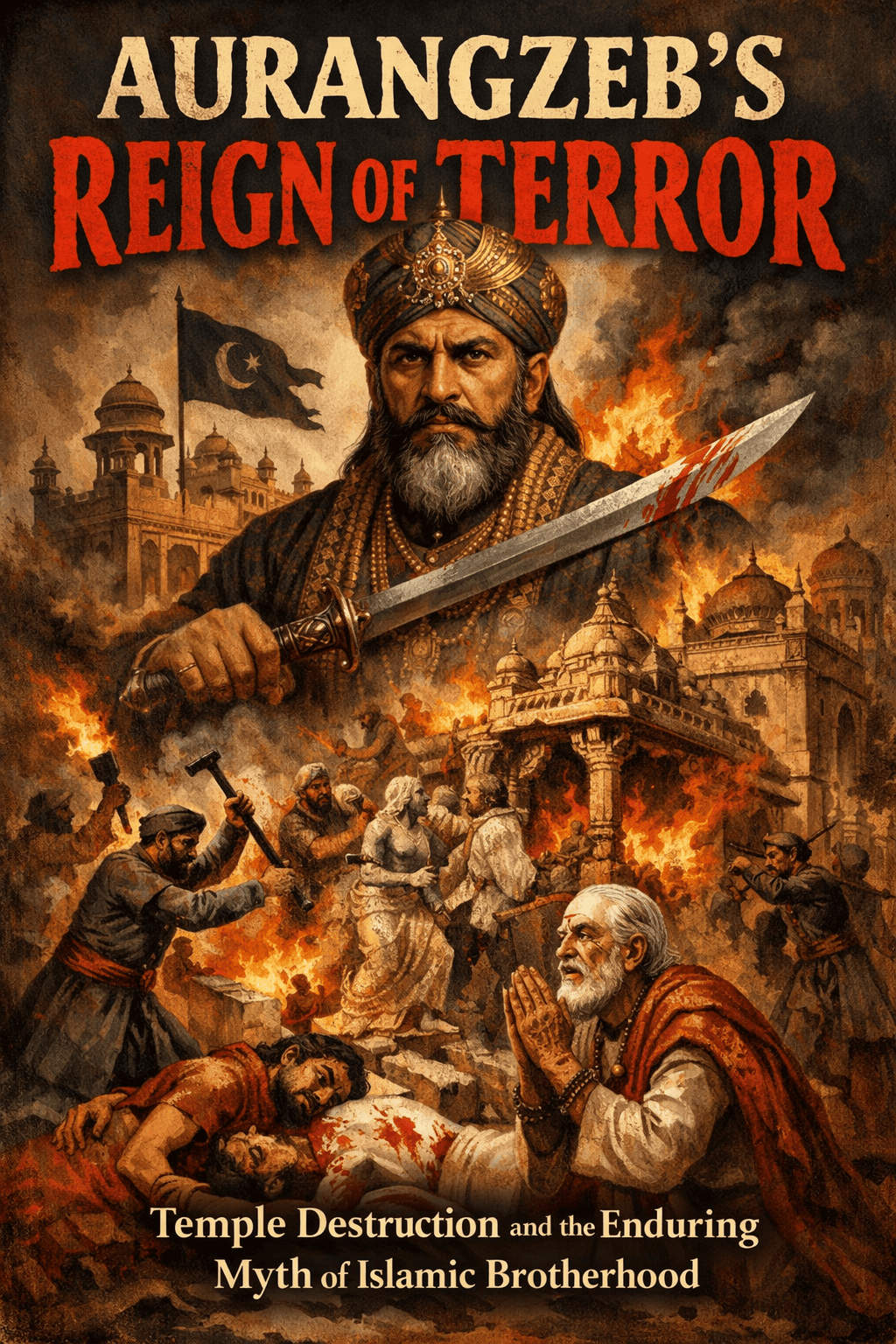
Undoubtedly, the reign of Aurangzeb is perhaps the worst of bad news as far as the Hindu civilisational memory is concerned. Indeed, the attitude towards Aurangzeb shown by some powerful sections of the Muslim community in our own time offers one of the most telling evidences for this fact. Most of the Muslim clergy today, especially on TV debates, are quite candid in their assertion that the Gyanvapi “mosque” is a settled fact—i.e., the Hindus have no claim over the original Kashi Visvanatha Temple. Neither is this bigoted claim restricted only to the Kashi Visvanatha Temple but that is a story for another day. But this only makes it imperative to fish out at least a partial list of the Hindu temples that Aurangzeb destroyed on an epic scale throughout India. As we remarked elsewhere, every Hindu temple destroyed and replaced with a mosque is conquered territory, and Hindus have ceded enough over the centuries. It was the prolonged chain of all such cessations that led to the “creation“ of Pakistan. The following is a brief list of some of the major Hindu temples that Aurangzeb destroyed—both while he was still a prince and after he became the sultan—throughout India. The circumstances leading to the destruction of each temple are also briefly given, verbatim from primary sources. These sources include but are not limited to Jadunath Sarkar’s extraordinary volumes on Aurangzeb, William Crooke’s Handbooks, De Graaf’s chronicles, Aurangzeb’s Farmans, Charles Stewart’s accounts, Akhbarat, and the Maasir-i-Alamgiri.
This list is by no means exhaustive and is meant to be a ready reckoner of sorts given the manner in which Aurangzeb has been elevated almost to sainthood by the secular mafia masquerading as historians. Historians like Audrey Truschke have attempted to contextualize Aurangzeb's actions as political rather than purely religious, arguing that he destroyed temples selectively to punish rebellions rather than out of blanket bigotry. However, primary sources paint a starkly different picture: a ruler driven by Islamic orthodoxy, who viewed Hindu idolatry as an affront to his faith and systematically targeted temples across vast swathes of India.
Aurangzeb as Prince: Early Acts of Iconoclasm
Even before ascending the throne in 1658, Aurangzeb displayed a zeal for temple destruction that foreshadowed his later policies. As a prince governing provinces like Gujarat and the Deccan, he ordered the demolition of several key Hindu sites, often accompanied by acts of desecration to assert Islamic dominance.
1. The temple of Chintaman, situated close to Saraspur, and built by the jeweller Sitadas, was converted into a mosque named Quwat-ul-Islam by order of the Prince Aurangzib, in 1645. He slaughtered a cow in the temple. This act not only destroyed a sacred space but humiliated the Hindu community by performing a ritual slaughter in a vegetarian sanctum.
2. “In Ahmadabad and other parganas of Gujarat in the days before my accession [many] temples were destroyed by my order.” Aurangzeb's own admission in his farmans reveals a premeditated campaign against Hindu worship sites in Gujarat, a region rich in Jain and Hindu heritage.
3. “The village of Satara near Aurangabad was my hunting-ground. Here, on the top of a hill, stood a temple with an image of Khande Rai. By God’s grace I demolished it, and forbade the temple dancers (murlis) to ply their shameful trade.” This destruction targeted not just the structure but the cultural practices associated with it, banning devadasis and erasing a site of Maratha reverence.
4. Aurangzeb’s order to the Subahdar of Gujarat: “In the city and parganas of Ahmadabad (i.e., Gujrat), the Hindus following their superstitious customs light lamps in the night of Diwali. … It is ordered that in bazaars there should be no illumination at Diwali.“ This edict extended beyond physical destruction to suppress Hindu festivals, enforcing Islamic norms on public life.
These early actions, documented in Mughal court records like the Maasir-i-Alamgiri, demonstrate Aurangzeb's interpretation of Islamic rule as incompatible with Hindu polytheism. Critics from within Muslim scholarship, such as those highlighting his rigid policies, argue that such intolerance alienated subjects and weakened the empire.
Aurangzeb as Sultan: A Systematic Campaign of Destruction
Upon becoming emperor, Aurangzeb escalated his efforts, issuing general orders for temple demolitions across the empire. His reign saw the destruction of hundreds, if not thousands, of temples, often justified in religious terms as upholding Sharia. Defenders like some Marxist historians claim these were political moves against rebellious Rajas, but the language in primary sources—praising the acts as victories for Islam—belies this.
1. “It has been decided according to our Islamic Canon Law that no new temple should be allowed to be built.” This blanket policy set the tone for his rule.
2. “The temple of Somnath was demolished early in my reign and idol worship (there) put down. It is not known what the state of things there is at present. If the idolators have again taken to the worship of images at the place, then destroy the temple in such a way that no trace of the building may be left, and also expel the worshippers from the place.” Somnath, already sacked by Mahmud of Ghazni, faced renewed assault under Aurangzeb.
3. “On Dec 19, 1661, Mir Jumla entered the city of Cooch-Bihar, which had been evacuated by its king and people, and appointed Sayyid Mohammed Sadiq to be chief judge, with directions to destroy all the Hindu temples and to erect mosques in their stead. Mir Jumla himself with a battle-axe broke the image of Narayan.” This incident in Bengal highlights the personal involvement of Mughal officials in iconoclasm.
4. “The Emperor learning that in the temple of Keshav Rai at Mathura, there was a stone railing presented by Dara Shukoh, remarked, ‘In the Muslim faith it is a sin. even to look at a temple, and this Dara had restored a railing in a temple! This fact is not creditable to the Muhammadans. Remove the railing. By his order Abdul Nabi Khan (the Faujdar of Mathura) removed it.” Aurangzeb's disdain extended to his own brother's tolerant acts.
5. Nov 20, 1665: “As it has come to His Majesty’s knowledge that some inhabitants of the mahals appertaining to the province of Gujarat have again built the temples which had been demolished by imperial order before his accession … therefore, His Majesty orders that the formerly demolished and recently restored temples should be pulled down.’’
6. April 9, 1669: “The Emperor ordered the governors of all the provinces to demolish the schools and temples of the infidels and strongly put down their teaching and religious practices.’’ This empire-wide farman marked a turning point, affecting education and worship.
7. May 1669: “Salih Bahadur, mace-bearer, was sent to pull down the temple of Malarna [Sawai Madhopur, Rajasthan].”
8. Sept. 2, 1669: “News came to Court that according to the Emperor’s command, his officers had demolished the temple of Vishwanath at Benares.” The Kashi Vishwanath destruction remains a flashpoint today.
9. January, 1670: “In this month of Ramzan, the religious-minded Emperor ordered the demolition of the temple at Mathura known as the Dehra of Keshav Rai. His officers accomplished it in a short time. A grand mosque was built on its site at a vast expenditure. The temple had been built by Bir Singh Dev Bundela at a cost of 33 Lakhs of Rupees. Praised be the God of the Great Faith of Islam that in the auspicious reign of this destroyer of infidelity and turbulence, such a marvellous and seemingly impossible feat was accomplished. On seeing this strength of the Emperor’s faith and the grandeur of his devotion to God, the Rajahs felt suffocated and they stood in amazement like statues facing the walls. The idols, large and small, set with costly jewels, which had been set up in the temple, were brought to Agra and buried under the steps of the mosque of Jahanara, to be trodden upon continually.” The Keshav Rai temple's fate exemplifies symbolic humiliation.
10. “Emperor Aurangzeb partially destroyed the Sitaramji temple at Soron; one of his officers slew the priests, broke the image, and defiled the sanctuary at Devi Patan in Gonda.”
11. April 7, 1670: “News came from Malwa that Wazir Khan had sent Gada Beg, a slave, with 400 troopers, to destroy all temples around Ujjain. A Rawat of the place resisted and slew Gada Beg with 121 of his men.” Resistance here shows Hindu pushback.
12. “Order issued on all faujdars of thanas, civil officers (mufasaddis), agents of jagirdars, kroris, and amlas, from Cuttack to Medinipur on the frontier of Orissa: The imperial paymaster Asad Khan has sent a letter written by order of the Emperor, to say, that the Emperor learning from the newsletters of the province of Orissa that at the village of Tilkuti in Medinipur a temple has been [newly] built, has issued his august mandate for its destruction, and the destruction of all temples built anywhere in this province by the worthless infidels. Therefore, you are commanded with extreme urgency that immediately on the receipt of this letter you should destroy the above-mentioned temples. Every idol-house built during the last 10 or 12 years, whether with brick or clay, should be demolished without delay. Also, do not allow the crushed Hindus and despicable infidels to repair their old temples. Reports of the destruction of temples should be sent to the Court under the seal of the qazis and attested by pious Shaikhs.”
13. “In every pargana, officers have come from the thanas with orders from the Presence [i.e., Aurangzeb] for the destruction of idols.” This letter was preserved in the Yasho-Madhav temple of Dhamrai in the Dacca district, dated 27 June, 1672.
14. “Darab Khan was sent with a strong force to punish the Rajputs of Khandela and demolish the great temple of that place. He attacked the place on 8th March, 1679, and pulled down the temples of Khandela and Sanula and all other temples in the neighbourhood.”
15. May 25, 1679: “Khan-i-Jahan Bahadur returned from Jodhpur after demolishing its temples, and bringing with himself several cart-loads of idols. The Emperor ordered that the idols, which were mostly of gold, silver, brass, copper or stone and adorned with jewels, should be cast in the quadrangle of the Court and under the steps of the Jama Mosque for being trodden upon.”
16. January 1680: “The grand temple in front of the Maharana’s mansion at Udaipur—one of the wonderful buildings of the age, which had cost the infidels much money, was destroyed and its images broken.”
17.” On 24 January 1680, the Emperor went to view the lake Udaisagar and ordered all the three temples on its banks to be pulled down.”
18. “On 29 January, Hasan Ali Khan reported that 172 other temples in the environs of Udaipur had been demolished.”
19. “On 22 February, the Emperor went to look at Chitor, and by his order the 63 temples of the place were destroyed.”
20. August 1680: “Abu Turab returned to Court and reported that he had pulled down 66 temples in Amber.”
21. “On August 2, 1680, the temple of Someshwar in western Mewar was ordered to be destroyed.”
22. September 1687: “On the capture of Golkonda, the Emperor appointed Abdur Rahim Khan as Censor of the city of Haidarabad with orders to put down infidel practices and heretical innovations and destroy the temples and build mosques on their sites.”
23. 1690: “Instances of Aurangzib’s temple destructions at Ellora, Trimbakeshwar, Narsinghpur, Pandharpur, Jejuri, and Yavat (Bhuleshwar).”
24. 1693: “The Emperor ordered the destruction of the Hateshwar temple at Vadnagar, the special guardian of the Nagar.”
25. April 3, 1694: “The Emperor learnt from a secret news-writer of Delhi that in Jaisinghpura, Bairagis used to worship idols, and that the Censor on hearing of it had gone there, arrested Sri Krishna Bairagi and taken him with 15 idols away to his house; then the Rajputs had assembled, flocked to the Censor’s house, wounded three footmen of the Censor and tried to seize the Censor himself so that the latter set the Bairagi free and sent the copper idols to the local subahdar.”
26. Mid of 1698: “’Hamid-ud-din Khan Bahadur who had been deputed to destroy the temple of Bijapur and build a mosque (there), returned to Court after carrying out the order and was praised by the Emperor.”
27. Aurangzeb’s letters of 1698 to Ruhullah Khan, Zulfiqar Khan, and Mughal Khan ordering temple destructions in Maharashtra: “The demolition of a temple is possible at any time as it cannot walk away from its place. The houses of this country [Maharashtra] are exceedingly strong and built solely of stone and iron. The hatchet-men of the Government in the course of my marching do not get sufficient strength and power to destroy and raze the temples of the infidels that meet the eye on the way. You should appoint an orthodox inspector (darogha) who may afterwards destroy them at leisure and dig up their foundations.”
28. January 1, 1705: “The Emperor, summoning Muhammad Khalil and Khidmat Rai, the darogha of hatchet-men, ordered them to demolish the temple of Pandharpur, and to take the butchers of the camp there and slaughter cows in the temple. It was done.”
These destructions spanned from Gujarat to Orissa, Rajasthan to Maharashtra, covering nearly 70% of undivided India's landmass. Academic studies map over 200 confirmed demolitions, with estimates suggesting thousands more. Even Muslim scholars critiqued his approach for its extremism, noting it fueled discord rather than unity.
Postscript: Themes of Bigotry and Geographical Extent
Clearly, this list is just the tip of the iceberg. Two important themes emerge. The first is the obvious and undisguised Islamic bigotry coursing through Aurangzeb’s veins unambiguously expressed in such violent language of intolerance. The mere sight of a temple aroused cataclysmic hatred within him. The second is the sheer geographical extent of Aurangzeb’s temple destructions: Delhi, Uttar Pradesh, Rajasthan, Madhya Pradesh, Gujarat, Maharashtra and Karnataka. That’s almost seventy percent of undivided India’s landmass. Pious Islamic deeds piously, proudly documented by Aurangzeb himself. A gift and an inspiration for posterity. Small wonder that a whole gamut of future fanatics like Shah Waliullah, Syed Ahmed Khan, Allama Iqbal and Zia-ul-Haq held Aurangzeb as a role model and lamented the loss of his guidance for properly putting the infidel Hindus in their place. While some historians defend Aurangzeb by pointing to grants he made to a few temples or arguing his actions were politically motivated, the overwhelming evidence from farmans and chronicles shows a pattern of religious supremacy. Estimates of four million deaths under his rule, dismissed by apologists as "questionable," underscore the human cost.
Echoes in Modern Times: Anti-Hindu Incidents in Bangladesh
Aurangzeb's legacy persists in contemporary South Asia, where similar patterns of religious intolerance against Hindus continue. In Bangladesh, a nation born from the partition Aurangzeb's ideological descendants helped foster, recent years have seen a surge in anti-Hindu violence, often justified under Islamist pretexts. Following the ouster of Prime Minister Sheikh Hasina in August 2024, attacks on Hindus escalated, with mobs targeting them as perceived allies of the secular Awami League. By 2025, Wikipedia documented widespread violence, including temple vandalisms, murders, and forced conversions. In December 2024, a Hindu businessman in Shariatpur was attacked with sharp weapons and doused in petrol by a mob. Earlier, in Pahalgam-related backlash, Islamist groups exploited anti-India sentiment to justify assaults.
Human Rights Watch's 2025 report highlighted attacks on ethnic and religious minorities, including Hindus, amid political instability. India's MEA spokesperson noted nearly 2,900 attacks on minorities under the Yunus government by late 2025. A lynching in December 2025 sparked protests in India, with Hindutva activists storming the Bangladesh High Commission. BBC reported the killing of a Hindu man during violent protests, straining Indo-Bangla ties. Al Jazeera detailed how Hindus face mounting threats, with disinformation campaigns exacerbating fears. In 2025 alone, at least six Hindus were killed in 18 days, including a shop owner. The UK government's 2025 note on Bangladesh acknowledged Hinduism as a minority faith under pressure, despite constitutional protections. These incidents, often involving temple destructions reminiscent of Aurangzeb, occur in a country where Islam is the state religion, fueling anti-minority sentiments.
Conclusion: Islam's Troubled Legacy of Brotherhood
The historical record of Aurangzeb's temple destructions, combined with ongoing anti-Hindu violence in Bangladesh, substantiates a harsh truth: Islam, as practiced in these contexts, is not a religion of brotherhood. While apologists cite verses on tolerance, the actions of rulers like Aurangzeb—proudly documented as Islamic triumphs—and modern extremists reveal a pattern of supremacy over coexistence. Even Muslim scholars have critiqued such rigidity for sowing discord. From Mughal India to contemporary Bangladesh, the evidence points to a faith often wielded as a tool of domination, not unity. Hindus, having ceded territory and heritage for centuries, must confront this reality to reclaim their civilizational memory.









Comments
Add new comment