Body
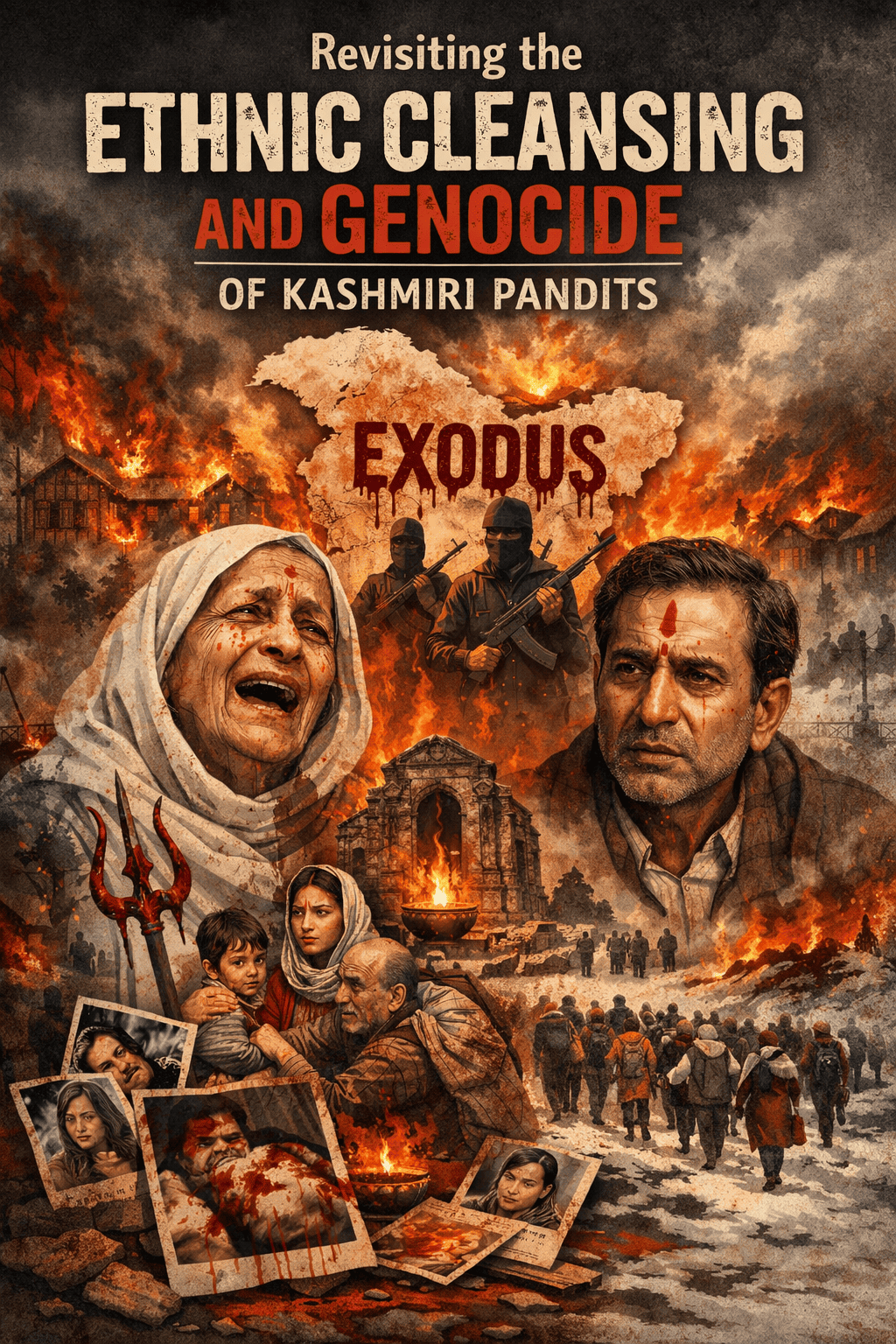
Time possesses an eerie capacity to soften the edges of even the most brutal atrocities, allowing societies to relegate them to distant echoes rather than urgent reckonings. In the case of the Kashmiri Pandits, this temporal erosion has turned a profound national tragedy into a largely forgotten chapter of India's post-independence history. Beginning in the late 1980s and peaking in 1990, over 250,000 indigenous Kashmiri Hindus—known as Pandits—were systematically driven from their ancestral homeland in the Kashmir Valley. This forced exodus, marked by more than 1,000 murders, the burning of 16,000 homes, and the desecration of over 500 temples, stands as one of the most complete ethnic cleansings in modern times. It represents not just a failure of governance but a deep moral lapse in a nation that champions secularism and pluralism.
The purpose of revisiting this horror, now over three decades later, is not to stoke division but to revive a collective conscience that has grown numb. India has moved forward, celebrating economic growth and cultural diversity, while a quarter-million of its citizens remain displaced, their pain sidelined in political discourse. The events in Kashmir lacked precise terminology until the 1990s, when the term "ethnic cleansing" emerged from the Bosnian conflict to describe similar forced homogenizations. As defined by the United Nations, ethnic cleansing involves using force or intimidation to render an area ethnically uniform by expelling targeted groups. Genocide, meanwhile, entails acts aimed at destroying, in whole or in part, a national, ethnic, racial, or religious group. The Kashmiri Pandit exodus aligns with both definitions. In 1995, India's National Human Rights Commission (NHRC), led by former Chief Justice M.N. Venkatachaliah, explicitly labeled it "akin to genocide." These are not inflammatory accusations but judicially affirmed realities that demand recognition and redress.
Historical Context: A Fragile Harmony Shattered
The Kashmiri Pandits, a community of Brahmin scholars and professionals, have inhabited the Valley for thousands of years, contributing to its rich tapestry of Shaivite philosophy, Sanskrit literature, and syncretic culture. By the 1980s, they formed a small minority—about 5% of the population—amid a Muslim-majority region. The seeds of discord were sown during the Partition of 1947, when Kashmir's accession to India sparked ongoing tensions with Pakistan. However, the immediate catalyst was the rise of militancy in the late 1980s, fueled by Pakistan's Inter-Services Intelligence (ISI) through initiatives like "Operation Topac," which armed and trained insurgent groups such as the Jammu Kashmir Liberation Front (JKLF) and Hizbul Mujahideen. Political missteps in New Delhi exacerbated the crisis. The 1987 Jammu and Kashmir Assembly elections, widely regarded as rigged in favor of the National Conference-Congress alliance, alienated Kashmiri youth and provided fertile ground for radicalization. Yet, these factors—often cited as excuses—fail to explain why the violence zeroed in on the Pandits with such ferocity. The militants' agenda was clear: to establish an Islamic state free of non-Muslim influences. Slogans like "Ralive, Tsalive ya Galive" (Convert, leave, or perish) blared from mosque loudspeakers, echoing through the streets and instilling terror. This was not a broad anti-India uprising but a targeted purge driven by the Pandits' Hindu identity, severing centuries of coexistence where Hindus and Muslims had shared festivals, neighborhoods, and livelihoods.
The Onslaught: A Campaign of Terror and Targeted Violence
The violence unfolded with chilling precision, beginning in late 1989 with assassinations designed to maximize fear. Prominent figures were the first victims, symbolizing the militants' intent to dismantle the community's leadership. On September 14, 1989, Tika Lal Taploo, a respected BJP leader and advocate, was shot dead outside his home in Srinagar in broad daylight. The killers vanished into the crowd, underscoring the collapse of law and order under Chief Minister Farooq Abdullah's administration. The murders escalated rapidly. In November 1989, Justice Neelkanth Ganjoo, who had previously sentenced JKLF founder Maqbool Bhat to death, was gunned down in a crowded market on Hari Singh Street. Other high-profile killings followed, including Doordarshan director Lassa Kaul in December 1989 and poet Sarwanand Koul Premi in January 1990. To amplify the horror, militants employed sadistic tactics against women, aiming to shatter community morale. Girija Tickoo, a 28-year-old laboratory assistant, was abducted from a colleague's home in May 1990, subjected to gang rape, and gruesomely sawn in half while alive—a act confirmed through survivor testimonies and human rights investigations.
Sarla Bhat, a nurse at the Sher-i-Kashmir Institute of Medical Sciences, was kidnapped from her workplace on April 14, 1990. Her body, riddled with bullets, was discovered days later in old Srinagar. Allegations pointed to her supervisor, Dr. Abdul Ahad Guru, highlighting betrayals within professional and social circles. Mass executions added to the nightmare: In Wandhama (1998), 23 Pandits were slaughtered; Nadimarg (2003) saw 24 burned alive; and Chattisinghpora (2000) claimed 36 lives, including Sikhs mistaken for Pandits. Recent incidents, like the 2024 Pahalgam attack, serve as grim reminders of lingering threats. By January 19, 1990—now commemorated as Exodus Day—the Valley descended into hysteria. Militants seized mosques to broadcast ultimatums, while masked gunmen roamed streets, torching Hindu properties and chanting anti-India slogans. Newspapers like Aftab and Al-Safa published threats, urging Hindus to flee by dusk. That fateful night, amid gunfire and mobs, tens of thousands abandoned their homes, cramming into buses and trucks bound for Jammu. The government appeared paralyzed, abdicating responsibility as chaos reigned.
The Devastation: Cultural Erasure and Human Toll
The scale of the displacement was staggering. Official figures report 219 killings by mid-1990, but community estimates exceed 1,500, with thousands unaccounted for. Over 16,000 homes were looted and razed, erasing family legacies. More than 500 temples, including ancient sites like the Kheer Bhawani shrine, were vandalized—idols smashed, structures defiled—in a bid to obliterate Hindu heritage. The Valley, once a beacon of cultural pluralism, was rendered ethnically uniform, with Pandits reduced to fewer than 3,000 residents today. Survivors endured abject misery in refugee camps in Jammu, battling heat, disease, and poverty. Suicide rates spiked, and intergenerational trauma—marked by lost education and shattered identities—persists. Economically, the community lost livelihoods as professionals, teachers, and landowners. This exodus, the largest since Partition, transformed a vibrant minority into perpetual exiles.
Cultural representations have begun to pierce the silence. The 2020 film Shikara, directed by Vidhu Vinod Chopra, depicts the tragedy through a love story of a young couple amid the 1990 chaos. Inspired by Rahul Pandita's book Our Moon Has Blood Clots, it portrays burning homes, forced migrations, and resilience over 30 years of exile. Released months after Article 370's abrogation in 2019—which revoked Jammu and Kashmir's special status and bifurcated the state—the film reignited discussions, emphasizing hope amid horror.
Denial, Apathy, and the Quest for Accountability
Explanations for the atrocity often invoke external factors: Pakistani interference, election rigging, or New Delhi's blunders. While valid contributors to the insurgency, they mask the core driver—religious intolerance. Militant groups explicitly targeted Hindus to "purify" Kashmir, with local complicity evident in neighbors aiding looters or remaining silent. India's response has been marked by denial. Media often euphemized it as "migration," while secular intellectuals portrayed Pandits as privileged elites, ignoring their vulnerability. Successive governments promised rehabilitation but delivered sporadically: VP Singh's administration offered minimal aid; Manmohan Singh's 2010 package faltered on security issues. Narendra Modi's post-370 initiatives, including jobs and housing, have enabled a trickle of returns—around 6,000—but safety concerns linger. Internationally, the issue has faded, overshadowed by geopolitics. Organizations like the Global Kashmiri Pandit Diaspora (GKPD) commemorate January 19 annually with global events in India, the US, UK, and Canada, labeling it genocide and demanding justice. In 2020, gatherings in Jammu's Jagati camp, Mumbai, Delhi, and overseas highlighted ongoing refugee status for half a million people.
Toward Justice: Remembrance as Redemption
Reviving this narrative is essential for healing. Proper labeling as genocide instills urgency: prosecute perpetrators, rebuild temples (mirroring Kashi Vishwanath's restoration), and facilitate secure returns via protected townships. India's conscience cannot afford complacency. As militancy evolves, honoring the Pandits means constitutional safeguards, memorials, and compensation. Their story is not mere history but a call to reclaim Kashmir's pluralistic essence. In remembering, we prevent repetition, ensuring that time heals rather than erases.
Comments
Add new comment