Body
Written by Damodaran ji
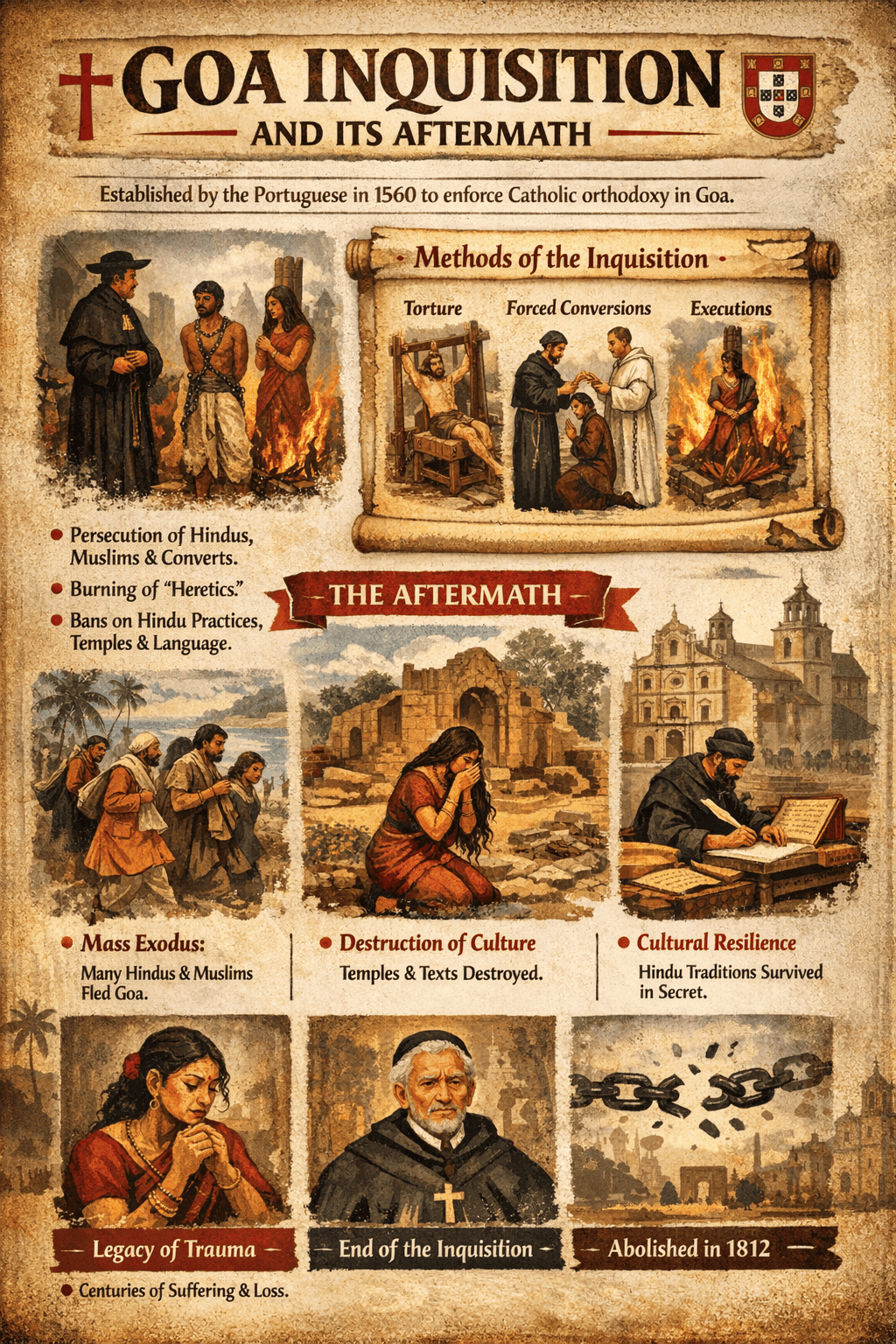
Francis Xavier was a frustrated man. He landed on the shores of Goa on 6th May 1542 with high hopes and a great mission: to harvest a million souls from this accursed land and enjoin them in the army of his only true God. Ever since Francs Xavier was deputed by King Joao III of Portugal to the Far East, he was driven by one mission – to evangelise and establish the Christian faith wherever he sets his feet. But what he had to face here, in spite of every effort, by hook or crook, made by his Jesuit priests of the Society of Jesus was defeat by the gullible natives. Xavier started by reforming the Portuguese Christians in Goa who had deviated away from the path of Jesus. There were also Jews to be converted, who had fled from Spain and Portugal earlier on account of religious persecution and Inquisition there and taken asylum in Bharat. He also ministered the sick in the hospitals and went around on the streets ringing a bell to entice the children and people to his religious preaching. Goa was a Portuguese colony since three decades by then. However the early converts, who found asylum with the Portuguese from the atrocities committed by the Muslim rulers, were Christians for namesake but continued to follow their old religion. Intolerant to such blasphemous activities, Xavier wrote a letter to King Joao III of Portugal in 1545 to set up Inquisition in Goa. However Aleixo Diaz Falcao and Francisco Marques were sent to Goa as the Inquisitors only in 1557 and earned a sinister renown as the most cruel in the entire Christendom. In 1863, the Goan historian J C Barretto Miranda wrote as under about the inquisition in Goa: “The cruelties which in the name of the ‘religion of peace and love’ that this tribunal practiced in Europe was carried to even greater excesses in India. ….Every word of theirs was a sentence of death and at their slightest nod were moved to terror the vast populations spread over the Asiatic regions… (Ref. 1)”
Inquisition and before
Even before the establishment of Inquisition, Hindus were systematically hounded and their temples and religious practices were subject to severe restrictions. King Joao III, called ‘John the Pious’ for his zeal in spreading Christianity, directed the Viceroy of Goa, Joao de Castro as under: “……. we command you to discover by diligent officers all the idols and do demolish and break them up in pieces where they are found, proclaiming severe punishments against anyone who shall dare to work, cast, make in sculpture, engrave, paint or bring them from other places; and against who publicly or privately celebrate any of their sports, keep by them any heathenish frankincense or assist and hide the Brahmins, the sworn enemies of the Christian profession … It is our pleasure that you punish them with that severity of the law without admitting any appeal or dispensation in the least (Ref. 2)”. Historian T. R. de Souza writes: “At least from 1540 onwards, and in the island of Goa before that year, all the Hindu idols had been annihilated or had disappeared, all the temples had been destroyed and their sites and building materials were in most cases utilised to erect new Christian Churches and Chapels”. Destruction apart, the temple properties were confiscated: “… The government transferred to the Church and religious orders the properties and other sources of revenue that had belonged to the Hindu temples that had been demolished or the temple servants who had been converted or banished. Entire villages were taken over at times or for being considered rebellious and handed over with all the revenues to the Jesuits”. (Ref. 3). Harassment and depredation apart, the object of those abhorrent ‘laws’ was to force all ‘infidels’ to convert, as T R de Souza notes (Ref. 4): ‘A particularly grave abuse was practised in Goa in the form of ‘mass baptism’ and what went before it. The Jesuits staged an annual mass baptism on the Feast of the Conversion of St. Paul (January 25th), and in order to secure as many neophytes as possible, a few days before the ceremony, the Jesuits would go through the streets of the Hindu quarter in pairs, accompanied by their Negro slaves, whom they would urge to seize the Hindus. When the blacks caught up a fugitive, they would smear his lips with a piece of beef, making him an ‘untouchable’ among the people. Conversion to Christianity was then his only option’.
The office of the Inquisition, the ‘Holy Office’, called ‘Orlem Goro’ by native Goans, was set up in the Palace of the Sabaio Adil Khan with 200 cells and other facilities for confinement, and torture within. The Goan Inquisition lasted from 1560 to 1812 and was regarded as the most violent inquisition ever executed by the Catholic Church in the world. The screams of tortured victims who were subject to brute force in the presence of their relatives could be heard far away, piercing the stillness of the nights. Eyelids were torn off and limbs were amputated to leave behind only the trunk and the head. Dellon, a French Doctor, who suffered as a prisoner of Inquisition, wrote a book Relation de l’inquisition de Goa in which he describes in detail the process of Inquisition, the tortures, the inhuman treatment and the act of ‘Auto da fe’ (burning on stake) in Goa, dubbing it as nothing but hell. He records the number of people burnt on stake including entire families whose properties were then confiscated. The Portuguese destroyed most of the Inquisition records when it was abolished in 1820 and we have lost the count of the thousands who burnt at stake for their only crime: not abandoning their faith.
Various writers recorded their anguish at the severity of the Goan Inquisition, the worst of all the five Inquisitions in the world: ‘The Inquisition, this tribunal of fire, …. the scourge of humanity. On seeing the monster, everyone fled and disappeared. The Indians … were astounded to see the God of Christianity more cruel than that of Mohammed, deserted the territory of the Portuguese and went to the lands of the Muslims ….’ (Ref. 5) Another author Joao Felix Pereira voiced contempt in his book ‘Historia de Portugal’ (p. 235): ‘…. Thousands of victims died at the stake in flames; when these bloody executions brought fears of a seditious movement, the Viceroys and Governors …. employed the dagger of the assassins and poison’.
J C Barreto Miranda in his ‘Quadros historicos deGoa’ (p. 147) states: ‘…the cruelties, which in the name of the religion of peace and love, increased in the greatest excesses in India’.
Conversions – out of conviction or coercion?
(Ref. The Goa Inquisition by A. K. Priolkar, p. 50-59)
Burton, writing 80 years ago, refers to ‘fire and steel, the dungeon and the rack, the rice pot and the rupee’ which played ‘the persuasive part in the good work… assigned to them’. … it sums up in nutshell the methods used and the satisfaction at the result, for the Jesuits were fanatics, and like all fanatics they did irreparable harm” (Ref. 6). Dr. Antonio Noronha, a former Judge of the High Court of Goa, in his essay ‘The Hindus and the Portuguese Republic’ comments as follows: “Until 1560, there existed but one church and mission house in the fort of Rachol. In the course of less than 30 years, a major part of the inhabitants of that province had embraced Christianity and 28 parishes had been established. Some by fear of physical force; others from moral cowardice; many because they could not overcome the love for the country of their birth from which they would otherwise be expelled; not a few to avoid the loss of their properties and interests; some with their eyes on lucrative jobs – and almost none from conviction’ (Ref. 7). Fr James Brodrick, a Jesuit biographer of St Xavier, wrote that the policy followed by Minguel Vaz, a co-worker of St. Xavier, involved ‘a great deal of pressure, social and financial and resulted in breeding a hatred of Christianity’. …..‘He was yet narrow minded and very oppressively hostile to the native religion. It was not as he imagined, by destroying Hindu Sanctuaries in Portuguese territory and applying their revenues to the building of churches that the Indians would be won to Christianity. No Hindu in Goa, Cochin, Malacca and other centres was ever forced by that policy to accept the faith, but a great deal of pressure, social and financial, was exercised to persuade them to do so. Of course, it had exactly the opposite effect and bred a hatred of Christianity’ (Ref. 8).
Evolution of the Policy of Religious Persecution in India
(Ref. The Goa Inquisition by A. K. Priolkar, p. 60-86)
Friar Antonio wrote a letter dated 4th November 1518 to the King of Portugal which states the plan of the Franciscans to get rid of all the vestiges of Hinduism in Goa: “Your Majesty should order that the poor mendicants who are known as Joguis should not enter this island …. they restore the heathenism of the local people”. The letter further states: “Sir, there is a great temple in this island of Divar which has much freestone and a large part of it is already destroyed. We pray your Majesty to make a gift of it to this monastery” (Ref. 9). A new Vicar General Minguel Vaz arrived in Goa in 1532 and he fathered the policy of systematic religious persecution in Goa, leading to the policy of ‘Rigour of Mercy’ in 1541 in Goa. In that year, Hindu temples were destroyed and the leaders of the Hindu community were made to agree of ‘their own volition’ that the income of the lands belonging to the temples which had been destroyed might be applied to the upkeep of Christian churches and missionaries (Ref. 10). Attempts were also made to convert the native Goans to Christianity. On 6th November 1541, Martin Afonso de melo wrote to the king of Portugal from Goa: “…… many more would have been converted had it not been for some persons who support these Hindus …. These principal leaders should be converted to Christianity and if they do not agree, order that they should be taken to Portugal …. If they do not become Christians before they return, it should be ordered that they should convert within the following Six months and if they do not wish to do so that, they should leave these lands” (Ref. 11). The Vicar General Fr. Minguel Vaz and Diogo Borba struggled hard to bring about early Christianisation of the natives of Goa. St. Paul’s College was started for imparting religious instruction to the new converts and it was maintained out of the income of the Hindu temples which had been destroyed (Ref. 12). However the pace of proselytization continued to be disappointingly slow and it was clear that unless recourse could be had to more drastic measures, it would not be possible to accelerate it.
Minguel Vaz sought approval for a 41-point plan that can be found in the Archivo National of Torre de Tombo. Some of the suggestions are: “Since idolatry is so great offence against God, it should not be permitted within the Portugal territories and an order should be promulgated in Goa to the effect that in the whole island, there should not be any temple, public or private, contravention whereof should entail grave penalties; no official should make idols in any form; no Hindu festival should be publicly celebrated in the whole island; Brahmin preachers from the mainland should not gather in the houses of the Hindus; and that persons in-charge of St. Paul should have the powers to search the houses of the Brahmins and other Hindus, in case there exists a presumption or suspicion of the existence of idols there” (Ref. 13). On these lines, King Joao III decreed measures on 8th March 1547 against idolatry and the Hindus.
On 29th August 1566, Viceroy D Antao de Noronha promulgated the folowing order which applied to the entire territory under Portuguese rule: “I order that no Hindu temple be erected in any of the territories of my King, the Lord of these parts, and that Hindu temples which already have been erected be not repaired without my special permission, contravention of which will entail the penalty of such temples being destroyed and their value applied towards the expenses of pious works” (Ref. 14). The Portuguese rulers hoped that the Hindu temples would ruin if left unrepaired. However, the Hindus of Salcete, whose temples were threatened, moved to the other side where there were no Portuguese to persecute them (Ref. 15). The idol of Shri Mangesh was probably moved from Cortalim at this time in 1566. The Jesuit historian Francisco de Souza records about Shri Mangesh as under: “Formerly the Cortalos (the villagers of Cortalim) were greatly devoted to their idols …. All of them bear the title Xenens (Shenvis), that is to say, teachers; …. The Church of Cortalim is erected in the same site where formerly the idol of Mangesh was worshipped” (Ref. 16). With missionary zeal, the Viceroy ordered in 1567 to burn down as many temples of Salcete as possible. The Viceroy’s men and the missionaries of Salcete strove day and night to burn down temples and break the idols found therein. Francisco de Souza writes that the number of temples destroyed at this time was 280 (Ref. 17). In a report submitted by Irmao Gomes Vaz to the King on 12th December 1567, it is stated that the Captain of Rachol broke the principal image of the temple of ‘Alardol’ (Mardol?) into pieces and on 15th March 1567, the temples of Doro, Mando, Narana, Baguaonte and Hesporo (Ishwar) of Sancuale were burnt down and the images destroyed. There is also a reference of destruction of temples of Cuncolim, Chinchinim and Ambelim. It is also stated that the images found in the destroyed temples were thrown into the rivers in the vicinity or melted to make candlesticks and other objects for use in the local churches (Ref. 18). Similar destruction was committed in Bardez also and by the year 1567, nearly 300 temples were razed, including the ones in Esolna and Kankolim. While in Salcete the destruction was committed by the Jesuits, it was the Franciscan Friars who campaigned in Bardez. In a report published under the title ‘Noticia que obravao os frades de S Francisco’, it is stated that the Franciscans destroyed 300 Hindu temples where ‘false’ Gods were worshipped (Ref. 16). On 21st March 1569, D Sebastiao promulgated an order confiscating the income of the destroyed Hindu temples of Bardez and transferring the same to Christian churches. The Portuguese missionaries were no less to the Ghaznis, Ghoris, Khiljis and the Mughals in destroying the Hindu temples and forcing conversions. However the faith of the Hindus could not be dented with such atrocities. They built new temples for their deities in territories beyond Portuguese control by smuggling and installing the idols that survived destruction and where the idols were destroyed, new idols were made and installed. Shri Mangesh from Cortalim and Mhalasa from Vernem were installed at Priol; Shantadurga from Cavelossim at Queula and Ramnath of Loutulim and Mahalakshmi of Colva at Bandora. The Portuguese missionaries found out that the construction of these new temples were being financed by the Hindus in Portuguese territories and that many new converts continued to secretly worship their Hindu Gods. To stop this, the third Concilio Provincial held in Goa in 1585 passed a resolution requesting the King of Portugal to promulgate a decree forbidding the Hindus from financing the construction and maintenance of temples in neighbouring territories and penalise such acts with fines (Ref. 19). An order was issued in June 1684 eliminating Konkani language and making it compulsory to speak Portuguese language. The law provided for dealing roughly with anyone using the local language. Following that law, all symbols of non-Christian sects were destroyed and the books written in local languages were burnt (Ref. The Goa Inquisition by T. R. de Souza - Source: https://ishwarsharan.com/features/the-goa-inquisition-t-r-de-souza/).
Dr Trasta Breganka Kunha, a Catholic citizen of Goa writes: “The propagation of Christian sect in Goa came about not by religious preaching but through the methods of violence and pressure (www.vgweb.org).
Anti-Hindu Laws in Goa
(Ref. The Goa Inquisition by A. K. Priolkar, p. 114-149)
The Portuguese rulers, with the active push from the Christian missionaries, took several measures, either a threat or an incentive, to convert the natives to Christianity.
Banishment of the Hindus: On 2nd April 1560, the Viceroy D Constantino de Braganca ordered that a large number of Brahmins named should be thrown out of the island of Goa and the lands and fortresses of the Portuguese king, under pain of their being made prisoners on the galleys without remission and losing all their properties. They were given one month time to dispose of their properties. On 8th June 1560, those of the Goldsmith community who had their families and properties outside the Portuguese territories were exiled, unless they brought their families and properties back within ten days. The result was mass migration of Hindus to the neighbouring lands (Ref. 20).
Ban on performance of Hindu rites and ceremonies:
On 13th March 1613, the Viceroy D Hyeronimo de Azervado issued an order that no infidel should marry during the times forbidden by the church and in other times, they could do so only outside their villages, under pain of a fine of 1000 Xerofins (Ref. 21). Viceroy D Pedro de Almeida in 1679 permitted the Hindus to celebrate marriage behind closed doors of their houses, but without the presence of the Hindu priest (Bottos). However this made the performance of marriages impossible without Bottos (Ref. 22). On 25th October 1726, Viceroy Joao Saldanha de Gama restricted the Hindus to carry out thread ceremony only in some designated areas and behind closed doors, with prior permission informing the arrival and departure time of the Bottos (Ref. 22). In 1640, the Jesuits had forbidden the Hindus from wearing the sacred thread (Ref. 22). In 1680, at the insistence of Conselho Ultramarino, the ceremony giving feast at the birth of children was forbidden and a fine of 500 Xerafins was imposed for violation (Ref. 22).
Ban on Hindu priests
King D. Sebastiao passed a law on 4th December 1567 prohibiting Muslim Kazis or Hindu preachers – Joshis, Joguis, Sorcerers, Gurous of temples or any other person who held a religious office among the Hindus; he ordered that they should leave his dominions within one month; failing which they would be held as captives for service in the docks (Ref. 23 a). On 28th June 1727, Viceroy Joao Saldanha de Gama issued an order to the effect that ‘all those who being Bottos by profession, have obtained permission by pretending to be something else, leave immediately the lands of this state (Ref. 23 b).
Orders compelling the Hinds to listen to the Christian doctrine
King D. Sebastiao promulgated a law on 4th December 1567 providing that the Hindu residents of the city of Goa and certain other cities should compulsorily attend preaching of the Christian doctrine by a priest deputed for the purpose (Ref. 23 c). Padre Affonso de Costa, Father of Christians secured an order based on the law of 1567 enforcing that all Hindus should come with their families to places assigned for the purpose to listen to the preaching of the Holy Gospel (Ref. 23 d). This law, again, led to a mass exodus of Hindus.
Laws depriving Hindus their means of subsistence
Repeated attempts were made to deprive the Hindus of their means of subsistence so that it becomes difficult for them to live in Portuguese territories. The following order was published on 25th June 1557 by the Governor Francisco Barreto in the name of King D. Joao: “…. no officials of mine … should utilise the services in any way whatsoever of any Brahmin or other infidel in matters of his office; and any of such officials who do the contrary shall incur the penalty of losing his office, and the said Brahmins shall become captive, and lose their property… and that all the offices which it is customary to give to the natives of the land should be given to the Christians and not to the Hindus … all the Mucadams of all offices in the land shall be Christians and not any Hindus or infidels (Ref. 24 a). On 3rd April 1582, the following royal decree was issued: “Being informed that Brahmins and Hindus of these parts of India are Collectors and contractors of my revenues …. detrimental to Christianity and contrary to canonical law, …. In pursuance of my duty to propagate our Holy Catholic Faith in the said parts, I hereby order that from now onward no Hindu, whatever be his status or condition, should hold public office (Ref. 24 b).
Depriving Hindus of rights and privileges in village communities
By an order of 11th December 1578, Governor Antonio Moniz Barreto deprived the Hindus of Salcete of their rights and privileges as Gauncares (original members of the village communities): “From now onwards, the Gauncares of the lands of Salcete shall not meet in assembly nor pass resolutions without the Christian Gauncares being present, …. Also in the villages where ther are more Christian Gauncares than Hindu Gauncares ….. the names of Christian Gauncares should be written first…” (Ref. 25 a). On 21st November 1573, King D. Joao issued an order that the villagers of Bardez who had migrated outside the Portuguese territories should not be paid Jonos (Ref. 25 b). On 7th March 1634, Francisco de Tavora ordered that the Hindu natives of Salsete who migrated to neighbouring territories to escape religious persecution would lose the right to Jono and lose the same to the royal treasury (Ref. 25 c).
Forcible conversion of Hindu orphans
On 23rd March 1559, D. Sebastiao issued an order that “….. the children of Hindus…. Left without father, mother, grandfather, grandmother or other ascendant lineals and are not of an age at which they can have understanding and judgment, …. The Judge of Orphans who has jurisdiction, should cause to be taken immediately and handed over to the College of St. Paul of the Society of Jesus …. for being baptised, educated and indoctrinated by the Fathers of the said College ….” (Ref. 26 a). There were also complaints that even children whose mother and grandparents were living were being snatched away from their families for being baptised (Ref. 26 b). The zeal to snatch away orphans was inspired not only by desire to save their souls but also by anxiety to take charge of their estates. The Hindus complained that contrary to the law on the subject, the Father of Orphans takes away from the charge of their living mothers, sons who had lost their fathers, together with their estates, to compel them by force to receive baptism (Ref. 26 c). There were cases where children were removed from their families even during the lifetime of their fathers (Ref. 26 d). The Hindus, when they knew that their days are numbered, arranged to send their children outside the Portuguese territories to prevent them from being baptised. On 11th July 1718, the Viceroy issued an order to prevent this from happening. Those who contravene this order shall incur the penalty of the loss of their estate or shall incur the penalty of whipping and banishment to the rivers of Guama for a period of ten years …” (Ref. 26 e).
Measures of harassment against the Hindus: The Father of Christians was required to keep tab of the festivals of the Hindus to prevent their participation and any violation was met with punishment. The same rule applied to the pilgrimages and also to the times when the Hindus customarily celebrate their marriages with Hindu ceremonies.
Humiliation of Hindus: On 15th December 1672, the Viceroy ordered that the Hindu Pandits and physicians should not move in the city on horse-back or in andores (a kind of sedan-chair) or palanquins under pain of fine (Ref. 27 a). In 1731, the viceroy Conde de Sandomil ordered that Christian bois or boias (bearers of andores, palanquins) should not carry Hindus (Ref. 27 b). Christian agricultural labourers were forbidden to work in the lands owned by the Hindus and the Hindu landowners were prohibited to employ Christian labourers (Ref. 27 c).
Privileges for converts
On 22nd September 1570, it was decreed that the Hindus who embraced Christianity would be exempted from the payment of the Dizimos land tax for fifteen years (Ref. 28 a). A decree of 26th March 1559 of D. Sebastiao provides that sons, grandsons and other relatives of a Hindu individual will inherit his estate on his death only if they become Christians (Ref. 27 b). A decree promulgated in 1562 by D. Sebastiao provided that the wife of a Hindu individual who became a Christian and separated from her husband on the ground that he adhered to his old religion, should get a part of the husband’s estate during his lifetime. In a letter dated 12th August 1557, D. Sebastiao provided that if a son or a daughter of a Hindu father became Christian, they would be entitled to one-third of the father’s estate, even during the lifetime and would inherit further portions thereof on the father’s death (Ref. 27 c).
Conclusion
It will not be adequate to term the atrocities that the Hindus suffered as brutal. However their faith gave them the endurance to bear the torture and outrages they had to face as well as to overcome the pain and economic hardships imposed. They withstood all the adversities and miseries resolutely, even preferred migration leaving behind ancestral lands over conversion, and pushed the Christian missionaries and foreign rulers to rage in frustration. Tome Pires, who came to India in 1511, wrote a book called Suma Oriental in which he gives the following account of the Hindus of Goa: “The Hindus of Goa remained faithful to their religion in the face of temptations and threats of a varied nature intended to convert them to Christianity and many of them preferred exile to conversion” (Ref. 18). French Historian and Philosopher Voltaire wrote poignantly: “Goa is sadly famous for its Inquisition which is contrary to humanity as much as to commerce. The Portuguese monks deluded us into believing that the Indian populace was worshipping the Devil, while it is they who served him”
References:
Ref. 1 – J. C. Barreto Miranda, Quadros Historicos de Goa, Cadernete I, Margao 1863, p. 145.
Ref. 2 – Jacinto Frere Andrade, Life of Dom Joao Casho (Trandlated into English by Sir Peter Wyche) 1664, p. 45 (quoted by K M Panikkar, Malabar and the Portuguese, 1929, pp.186-87).
Ref. 3 – Excerpts from Dr. Teotonio R. de Souza’s The Portuguese in Asia and their Church patronage in Western colonialism in Asia and Christianity, ed. M. D. David (Bombay 1988). The author is a Christian Goan and a reputed historian of Goa, author of numerous papers and several books in English and Portuguese.
Ref. 4 – T R de Souza in his The Portuguese in Asia and their Church Patronage.
Ref. 5 – Memoirs of Judges Magalhaes and Lousada (Nova Goa 1859) Vol. 2, Annaes Maritimos e Coloniais (p. 59).
Ref. 6 – Boies Penrose, Se Fights in the East Indies in the year 1602-1639, Cambridge, Massachusetts, 1931, p. 14.
Ref. 7 – A India Portuguesa, Vol. II, Nova Goa 1923, p. 227.
Ref. 8 – James Brodrick, Saint Francis Xavier, London 1952, p. 201.
Ref. 5 – Cunha Rivara, Archivo Portuguez Oriental, Fasc.V, pt.III, Nova Goa1866, pp.1436-7.
Ref. 9 – Silva Rego, Vol. I p. 354.
Ref. 10 – Francisco Pais, Tombo de Ilha de Goa e das Terras de Salcete e Bardes, (Annotated by P. S. S. Pissurlencar), Bastora 1952, pp. 165-69.
Ref. 11 – J. Wicki, Vol. I, pp. 792-3.
Ref. 12 – J. Wicki, Vol. I, pp. 325-7.
Ref. 13 – J. Wicki, Vol. I, pp. 66-72. Also Silva Rego, Vol. III, pp. 203-8.
Ref. 14 – J. H. Cunha Rivara, Archivo Portuguez Oriental, Part II, p. 613.
Ref. 15 – Francisco de Souza, Oriente Conquistado a Jesus Christo, Part II, p.14.
Ref. 16 - Francisco de Souza, Oriente Conquistado a Jesus Christo, Part II, p.12.
Ref. 17 - Francisco de Souza, Oriente Conquistado a Jesus Christo, Part II, p.15.
Ref. 18 – Silva Rego, Vol. X, p. 291.
Ref. 19 – Silva Rego, Vol. V, p. 408.
Ref. 20 – Cunha Rivara, Archivo Portuguez Oriental, Part IV, p. 123.
Ref. 21 – The Suma Oriental of Tome Pires, London 1944, pp. 58-59.
Ref. 22 - Cunha Rivara, Archivo Portuguez Oriental, Fasc. V, Part I, p. 451, 454 and Part ii p. 488, p. 544. Fasc. VI, p.965, p.1255, p.1286-9, p.285, p.1263, p. 1290-3, pp. 313-5.
Ref. 23 - Cunha Rivara, Archivo Portuguez Oriental, (a) Fasc. IV, p. 69. (b) Fasc. VI, suppl. ii, p.300 (c) Fasc. IV, pp. 68-9 (d) Fasc. VI, suppl. ii, pp. 19-66.
Ref. 24 – (a) Cunha Rivara, Archivo Portuguez Oriental, Fasc. V, part i, p.319. (b) Fasc. V, pt. iii, p.980.
Ref. 25 – (a) Cunha Rivara, Archivo Portuguez Oriental, Fasc. V, pt. ii, p.891. (b) Fasc. VI, p.1295. (c) Fasc. VI, suppl.ii, pp.6-9.
Ref. 26 – (a) Cunha Rivara, Archivo Portuguez Oriental, Fasc. VI, suppl.ii, p.9. (b) p. 1281. (c) p. 1281. (d) Fasc. VI, suppl. ii, p.3. (e) Fasc. VI, suppl. ii, p. 104.
Ref. 27 – (a) Cunha Rivara, Archivo Portuguez Oriental, Fasc. V, pt. ii, p. 899. (b) Fasc. VI, suppl. ii, p. 399. (c) Antonio Baiao, A Inquisicao de Goa, Vol. I, pp. 279-88.
Ref. 28 – (a) Cunha Rivara, Archivo Portuguez Oriental, Fasc. V, pt. ii, pp. 786, 788.
(b) Fasc. V, pt. i, p. 892. (c) Fasc. V, pt.iii, p. 1572.







Comments
Add new comment