Body
Written By-Damodaran Ji
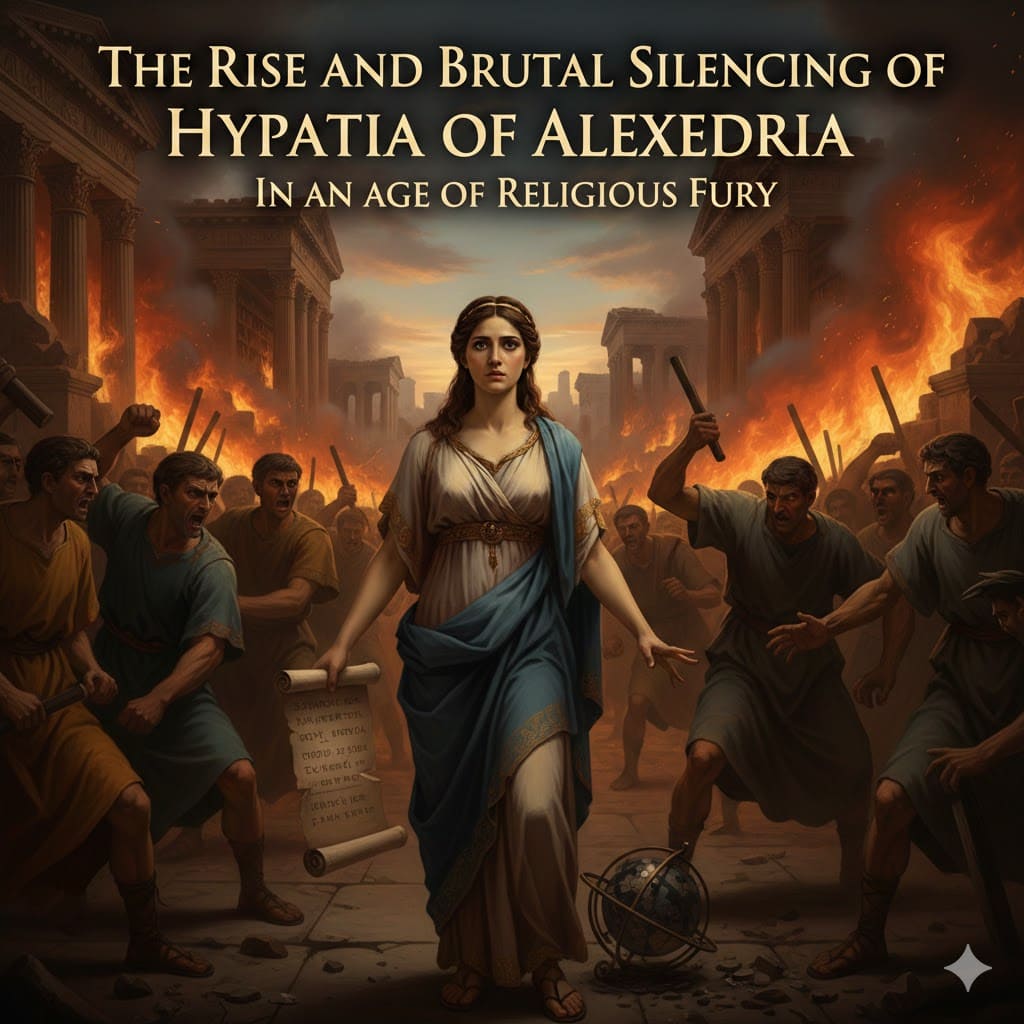
“I do not permit a woman to teach or assume authority over a man” decreed Apostle Paul (Timothy 2:12 NIV). Sounds misogyny? Or was it contemplation? Whatever it was, that is what probably defined the fate of Hypatia, the gifted Mathematician, astronomer and Neoplatonist philosopher who headed the Egyptian Centre of Hellenistic Culture founded in Alexandria by Alexander the great, in 415 CE.Ever since Alexandria was founded, it became a great educational centre to which both scholars as well as students flocked in large numbers from far distant places. It housed the grandest library said to contain over 500,000 scrolls by the 3rd century. The famous Mathematician and Physicist Archimedes lived, experimented and taught here. All this lasted till the advent of Christian vandalism and nothing remained the same thereafter. As centres of Paganism, first it was the magnificent temple of Serapis that was put to hammer and then the great library was torched by frenzied Christian mobs. With that, many scholars deserted Alexandria in fear for their lives (Ref. 1).
Hypatia, daughter of the Mathematician, astronomer and philosopher Theon, was a free thinker and fiercely intelligent. She is credited to have taught her students to “Reserve your right to think, for even to think wrongly is better than not to think”. Someone, that too a woman, teaching young minds to think and reason freely must have scared the religious bigots of the day too much. The destruction that the Pagan institutions had to face in Alexandria has left very few records to know much about Hypatia. There are few references available in the writings of historian Socrates Scholasticus and six letters written by her Christian student Synesius of Cyrene who later became the Bishop of Ptolemais (ancient Libya). In his letters, he discusses about her Neoplatonic ideals that he incorporated in his writings on the doctrine of Trinity. There is another mention in the Chronicle of John Nikiu, a Coptic Bishop. (Ref. 2).
Contemporary Christian historian Socrates Scholasticus recorded as under (Ref. 3):
“There was a woman at Alexandria named Hypatia, daughter of the philosopher Theon, who made such attainments in literature and science, as to far surpass all the philosophers of her own time. Having succeeded the school of Plato and Plotinus, she explained the principles of philosophy to her auditors, many of whom came from distance to receive her instructions. On account of the self-possession and ease of manner, which she had acquired in consequence of the cultivation of her mind, she appeared frequently in public in presence of the magistrates. Neither she was abashed in going to an assembly of men. For all men, on account of her extraordinary dignity and virtue admired her the more”.
Like her father, Hypatia taught in the Alexandrian Academy on philosophy, astronomy and Mathematics. She was influenced by Pythagoras, Plato and Aristotle and followed Plotinus in Neoplatonism. She believed in the divine first cause, the One, the originator of the Universe. She also believed in the immortality of the rational soul and the perishability of the irrational body. The soul is immortal because it is part of the One supreme-being. Hypatia also made noteworthy contributions to the learning of Mathematics by making explanatory essays on Geometry and Mathematics. In her contribution to astronomy, she is said to have fabricated astrolabes and designed a portable one for sea-fare navigation. In her annotation on Ptolemy’s work ‘Planetary Hypothesis (Almagest), she favoured the concept of earth-centric geocentric universe which contradicts the heliocentric model evinced by Aristarchus (Ref. 4).
Hypatia was also daring, for she knew the trouble that she was staring. The Roman Emperor Theodosius I had already decreed to destroy all Pagan religious institutions in Alexandria, at the request of Cyril, the Bishop of the city. The Christian zealots – the ‘Men in Black’ – and Christian mobs had already started razing many of the Pagan temples and institutions, including the famed temple of Serapis and the library of Alexandria. All this mayhem was accompanied by slaughter of thousands of Pagans and Christians branded as heretics. The Bishop had also expelled the Jews from Alexandria. And he was jealous of the fame, respect and admiration that Hypatia commanded not only from her students but also the people of Alexandria. To understand the religious fanaticism that raged in the entire Mediterranean region, one has to understand the political and religious developments in the Roman Empire in the fourth and fifth centuries. After the reign of Constantine as the first Christian emperor of the Roman Empire, it was Emperor Julian who turned to paganism again in the fourth century. However Julian, condemned as an Apostate by the Christian church, met unexpected death in his battle with Persia. Thereafter under the rule of Theodosius I, the Roman administration entirely collaborated with the Christian church in its crusade against Paganism and Christian heresy. During the rule of Theodosis I (346 to 395 CE), the ‘Men in Black’ – the Christian monks and hermits who had vowed to live in isolation and wilderness to imitate Christ in poverty and chastity and relinquish the pleasures of flesh – unfurled their flag of the ‘Only True God’ and swamped the towns and countryside to wage their war against Paganism. Those hermits who practised violence against themselves earlier, turned violent against the Pagans, their temples and institutions to leave a trail of destruction that is traceable even today. They formed the vanguard of the revival of Christian faith in the Empire, not through peaceful means but through violence unleashed mercilessly (Ref. 5).
“Men in black, who eat more than elephants and exhaust themselves with the number of cups they drain, who have drink served to them in the middle of their psalm-singing, rush upon the temples” writes Libanus in a tract titled ‘In Defense of the Temples’. “Roofs are knocked off, walls undermined, shrines thrown down, altars totally destroyed. And as for priests: they can choose between silence and death” (Ref.6). Writes historian John Holland Smith “…the empire in the closing years of the fourth Christian century had its propaganda-directed gangs of rioters who went from place to place smashing, burning, looting and destroying in defiance of the laws and defence of their own cultural revolution”. The monks were the rule unto themselves. The Christian State joined forces with the church and the Men in Black to form a single force of terror and unleash violent suppression, allowing zealots to take law into their hands to wipe away any semblance of religious plurality. Even Arianism and diverse Christian beliefs were condemned by Orthodox Church as apostasies and heresies to be punished with death. The entire State apparatus – the prisons, the torture cells, the gallows and the guillotines – was pledged to the Orthodox and Catholic Church in the service of their ‘Only True God’. The campaign was so severe and brutal that even Theodosius I was shaken to issue a decree in 390 CE calling the monks to return to their isolation in the wilderness but with no success (Ref. 7). Theodosius I did not show any mercy in his war against polytheism and in establishing a Christian monotheistic State. “It is our will that all the peoples who are ruled by our Clemency shall practice that religion which the divine Peter the Apostle transmitted to the Romans” decreed Theodosius I in 380 CE. “We command that those persons who follow this rule shall embrace the name Catholic Christians. The rest, however, whom we adjudge demented and insane … shall be smitten first by divine vengeance and secondly by the retribution of our own initiative”. In his State, even the Emperor could be overruled by a cleric! (Ref. 8).
In such a chauvinistic rule of fanatic bigotry, to stand up and call for free thinking and reasoning would have required immense courage. And Hypatia did that, boldly, with conviction and with her head high. Mean men with intolerance as their creed could not stand up to Hypatia and confront her with reason. Bishop Cyril of Alexandria was one such cowardly man who preferred to use violence against reason! Bishop Cyril had been grooming a set of poor but able bodied Christians with zealous faith to serve God to deal with the sick and the dying and also to bury the dead. They were called ‘Parabalani” who also acted as the militia of the Bishop to terrorise people identified as the enemies of Christianity (Ref. 9). This mob of frenzied ‘Parabalais’, goaded by Peter who was engaged by Bishop Cyril, waylaid the philosopher Hypatia one dark evening in 415 CE, pulled her out of her carriage, stripped her naked, gauged her eyes and hacked the hapless woman into pieces in a church. The slaughtered shards were paraded in the streets of Alexandria by the blood-thirsty mob and then burnt on the piles of her books in Cynaron (Ref. 10).
The historian Socrates Scholasticus recorded the cruelty that he witnessed thus (Ref. 11): “Yet even she fell a victim to the jealousy which at that time prevailed ….. Some of them (among the Christian populace) therefore, hurried away by a fierce and bigoted zeal, whose ringleader was a reader named Peter, waylaid her returning home, and dragging her from her carriage, they took her to the church called Caesareum, where they completely stripped her and then murdered her with tiles (oyster shells). After tearing her body in pieces, they took her mangled limbs to a place called Cinaron, and there burnt them”. Even as many scholars deserted Alexandria after Hypatia was butchered, the philosopher was branded as a witch and accused of beguiling people with her Satanic deceits by the church. Bishop Cyril was canonised as a saint for his bloody crusade against the Pagans and Christian heretics (Ref.12).
As the slivered remains of Hypatia burnt along with the pile of her books, free thinking and reasoning also died on that pyre in 415 CE, heralding the Dark Age!
References:
Ref.1 - The Darkening Age by Catherine Nixey Ch. 9)
Ref. 2 – Primary Ref. The Darkening Age by Catherine Nixey and secondary ref. Dzielska, 1995, pp. 1-26, 67-100, 111-119; MacLennan, 2013, pp. 8-11.
Ref. 3 - Ref. Ecclesiastical History, VII.15, quoted in the article Hypatia of Alexandria online Wikipedia: http://en.wikipedia.org/wiki/Hypatia_of_Aleandria.
Ref. 4 – (1) MacLennan, 2013, pp. 27-40, esp. pp. 34-35; Armstrong, 1984. (2) Article ‘Hypatia of Alexandria: A fiercely intelligent woman by Liana De Girolami Cheney, University of Massachusetts, Lowell, USA – published in Cultural and religious Studies, Aug. 2024, Vol. 12.
Ref. 5 - The Darkening Age by Catherine Nixey, Ch. 9.
Ref. 6 - Libanius, Oration 30.8 quoted in The Darkening Age by Catherine Nixey p.108.
Ref. 7 - The Darkening Age by Catherine Nixey.
Ref. 8 – As above.
Ref. 9 – As above.
Ref. 10 – (1) Parabalani – A terrorist charity in late antiquity by Glen W Bowersock and (2) The Darkening Age by Catherine Nixey Ch. 9).
Ref. 11 - (Ref. Ecclesiastical History, VII.15, quoted in the article Hypatia of Alexandria online Wikipedia: http://en.wikipedia.org/wiki/Hypatia_of_Aleandria).
Ref. 12 - Writings of John, Bishop of Nikiu in the 7th century, online extracts at: www.cosmopolis.com/alexandria/hypatia-bio-john.html).








Comments
Add new comment