Body
In the heart of South Asia, two neighbouring nations present a stark asymmetry in religious demographics and minority treatment. India, a secular democracy with a Hindu majority, has witnessed steady growth in its Muslim population over decades. Bangladesh, born out of partition and defined as an Islamic republic in its constitution, has seen its Hindu minority dwindle persistently, accelerated by recurring waves of violence. This contrast raises profound questions about tolerance, reciprocity, and the future of pluralism in the region. As of 2026, India's Muslim population is estimated at around 210-215 million, constituting approximately 15% of the nation's 1.45 billion people. This marks a rise from 9.8% in 1951 and 14.2% in the 2011 census. Projections from demographic studies, including those referenced by Pew Research Center updates and government estimates, indicate continued growth driven by higher fertility rates and socioeconomic factors. While Muslims thrive with full constitutional protections, political representation, and cultural freedoms in Hindu-majority India, concerns persist among nationalist thinkers about long-term demographic imbalances. In border states and urban pockets, localised majorities have emerged, fueling debates on illegal immigration and cultural preservation.
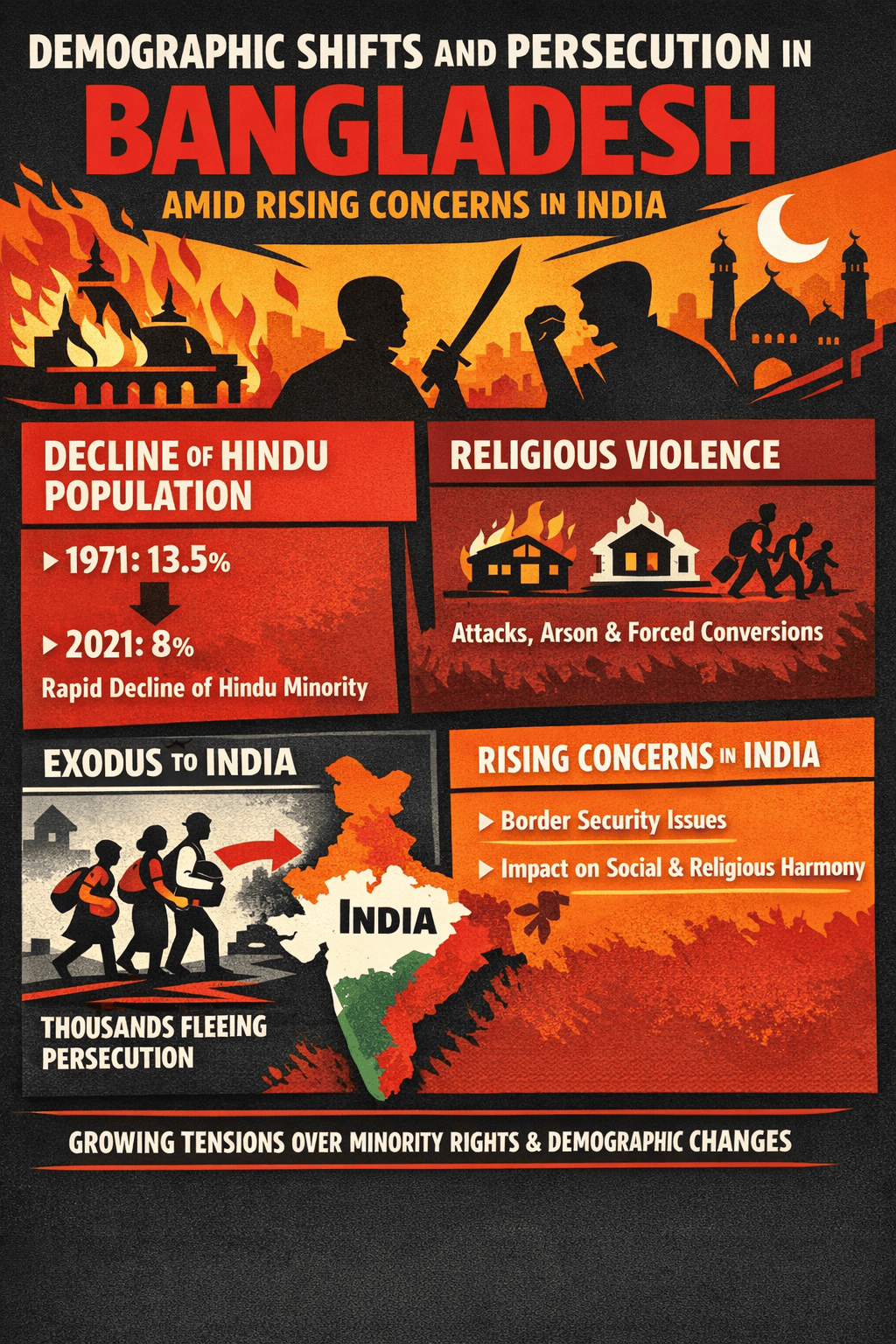
In Bangladesh, the story is one of decline and vulnerability. The 2022 census recorded Hindus at just 7.95%—about 13.1 million out of 165 million—down from 22% in 1951 and 8.5% in 2011. This erosion, spanning 75 years, reflects not merely natural demographic shifts but forced migration amid insecurity. Hindus, once a vibrant community across the land, now face existential threats, with international bodies like the U.S. Commission on International Religious Freedom (USCIRF) documenting a pervasive "sense of fear." The last decade (2016-2026) has been particularly grim for Bangladesh's Hindus, with violence escalating dramatically after the August 2024 ouster of Prime Minister Sheikh Hasina. Pre-2024 incidents were sporadic but persistent: land grabs, temple vandalism, and assaults often tied to local disputes yet disproportionately targeting minorities. Reports from the Bangladesh Hindu Buddhist Christian Unity Council (BHBCUC) documented hundreds of cases annually, including forced conversions and evictions rooted in historical laws like the Vested Property Act.
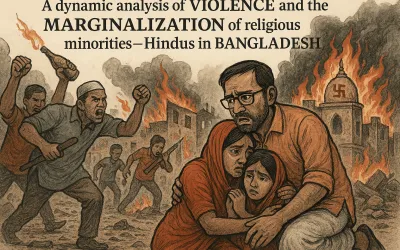
The post-2024 period unleashed unprecedented carnage. In the immediate aftermath, over 2,000 incidents were reported by August 2024 alone, including damage to hundreds of temples and homes. This surge continued into 2025-2026. BHBCUC data reveals 258 communal attacks in the first half of 2025, followed by at least 51 in December 2025. From January to March 2025, 142 deadly incidents occurred, including multiple murders. Human Rights Watch (HRW) noted an "alarming surge" in mob violence, with ethnic and religious minorities bearing the brunt. Quantifying murders underscores the horror. Conservative estimates from BHBCUC, HRW, and independent reports suggest 200-400 Hindu deaths linked to targeted violence over the decade. Pre-2024 averages hovered at 10-20 annually, often in land or communal clashes. Post-2024, the toll skyrocketed: dozens in late 2024, followed by 116 minority killings (predominantly Hindu) in the first six months of 2025 across 45 districts. Recent months have been bloodier—11 Hindus murdered in 35 days (early 2026), 15 in 45 days, and reports of one Hindu killed every third day in late 2025 spikes. Victims range from elderly women to youths, with cases involving lynchings, burnings, and targeted assassinations.
Motives are frequently contested. Bangladeshi authorities often classify incidents as "criminal" or "political"—stemming from personal enmities, theft, or revenge against perceived Awami League supporters (Hindus historically aligned with the secular party). Yet, deeper analysis reveals religious underpinnings. Blasphemy allegations triggered 71 incidents in one 2025 period alone, leading to mob attacks, vandalism, and fatalities. Temple desecrations, forced expulsions, and harassment of Hindu women point to Islamist radicalism exploiting political vacuums. Hardline groups have weaponised anti-India sentiments, portraying Hindus as fifth columnists. Amnesty International and USCIRF reports highlight systemic discrimination, impunity for perpetrators, and a failure to protect minorities, exacerbating the exodus. This asymmetry demands scrutiny. In India, Muslims enjoy affirmative action, personal laws, and rapid population growth without parallel persecution. In Bangladesh, Hindus face what many describe as gradual ethnic cleansing— a term echoed in nationalist discourses referencing historical atrocities like the 1971 genocide. The lack of reciprocity exposes the limits of one-sided secularism: India accommodates diversity, while neighbouring Islamic states erode it.
Unchecked demographic shifts, coupled with infiltration across porous borders, risk altering the nation's Hindu character. Policies like the Citizenship Amendment Act, aimed at sheltering persecuted non-Muslims from neighbouring countries, stem from this realisation. The ongoing plight of Bangladeshi Hindus validates such concerns, highlighting how majoritarian assertiveness in Islamic nations contrasts with minority appeasement debates in India. International silence compounds the tragedy. While exaggerated claims of "genocide" have been debunked by fact-checkers, the documented violence is undeniable. Global powers must pressure Bangladesh's interim government—led by Muhammad Yunus—to ensure justice, repeal discriminatory laws, and safeguard minorities. India, as a rising power, should amplify these voices through diplomacy and aid conditionalities.
The vanishing Hindus of Bangladesh are a mirror to broader geopolitical realities: tolerance must be mutual. As India's Muslim community flourishes, the world cannot ignore the systematic marginalisation of Hindus in Islamic Bangladesh. Preserving ancient Dharma in its ancestral lands requires vigilance, unity, and unapologetic advocacy for Hindu rights worldwide.

Comments
Add new comment