Body
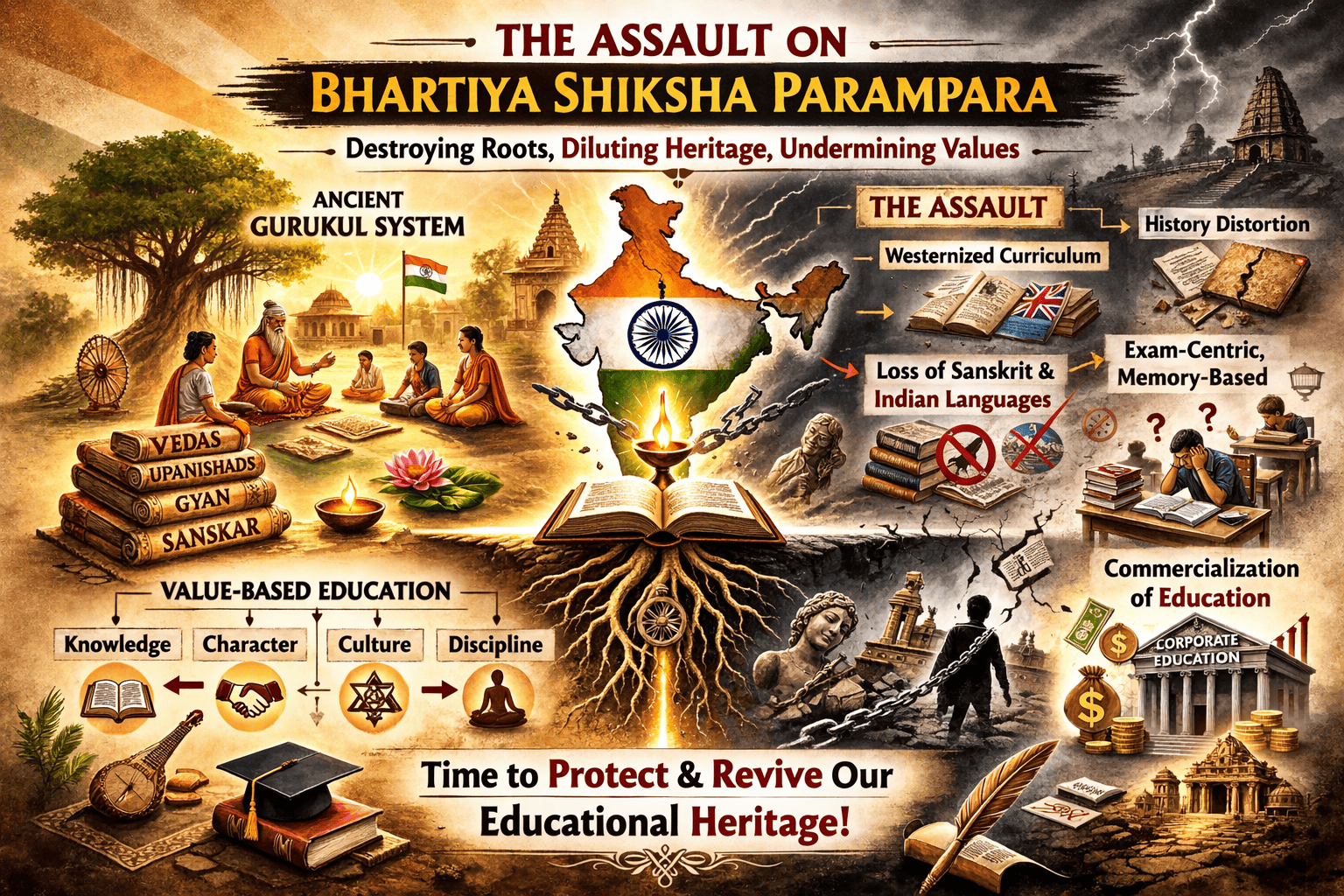
For centuries, Bharat’s education system was rooted in Gurukuls, pathshalas, and Sanskrit tols that emerged organically from society, dharma and community life. These institutions did not merely teach literacy; they transmitted values of dharma, nationhood, self‑respect and spiritual inquiry that defined Bhartiya civilisation. With the arrival of British rule and Christian missionary activity, this indigenous ecosystem was systematically sidelined in favour of a Western, church‑influenced, English‑medium system designed to create “brown sahibs” loyal to the Empire and alienated from their own culture.
Colonial design: education as a tool of conversion
British administrators openly admitted that education policy in India was not neutral but a civilisational project. Thomas Macaulay’s infamous 1835 Minute on Education argued for replacing traditional learning with English education to produce a class of Indians “Indian in blood and colour, but English in taste, in opinions, in morals and in intellect.” Missionary groups – London Missionary Society, Church Missionary Society, American Board of Commissioners for Foreign Missions and others – seized this opportunity and rapidly set up schools and colleges across the country. Scholars of colonial history note that Christian missionaries established pioneering Western‑style institutions like Serampore College, Madras Christian College and St. Stephen’s College, explicitly combining modern education with a Christian moral and cultural framework. Over time, state patronage and missionary lobbying led to the closure or marginalisation of thousands of indigenous schools, forcing Hindu society to send its children into a system that mocked its own traditions. One analysis of missionary activity concludes that they “had a profound and lasting impact on education in India”, reorienting it away from local languages and knowledge and towards Western theology, history and worldview.
How Bhartiya Shiksha Parampara was undermined
The assault on Bhartiya Shiksha Parampara worked on multiple fronts:
Language displacement: Sanskrit, regional bhashas and traditional texts were pushed aside in favour of English and Bible‑centred moral literature, weakening direct access to Itihasa‑Purana, Dharmashastra and classical philosophy.
Cultural delegitimisation: Missionary schools routinely portrayed Hindu rituals as “superstition” and idol worship as “primitive”, while glorifying Christian theology as “rational” and “civilised”.
Institutional capture: Because missionary schools were often better funded under colonial patronage, they attracted elites and set the template for “modern” education, pushing Gurukul‑style institutions to the margins.
A recent right‑of‑centre analysis describes missionary schools as “silent stormtroopers of Christian imperialism”, arguing that they routinely disparaged native culture in classrooms as part of a long‑term strategy to encourage conversion. It cites Macaulay’s own letter boasting that if his education plans succeeded, there would not be “a single idolator among the respectable classes in Bengal” within a generation. This is not mere pedagogy; it is civilisational engineering through the classroom.
Post‑Independence: colonial legacy in Christian institutions
Even after 1947, the basic skeleton of the colonial education model was left intact. Many church‑run schools and colleges continued to function with significant autonomy, often protected under minority rights provisions. These institutions – some prestigious and urban, others in remote tribal belts – became gatekeepers of social mobility, higher education and English proficiency, giving them enormous influence over young minds. A 2024 feature on Christian schools notes their “pivotal role in shaping the nation’s educational landscape” while acknowledging that they remain deeply Christian in ethos and symbolism even as they serve a majority of non‑Christian students in a predominantly Hindu country. Church leaders themselves describe their work in remote areas as “actively involved in imparting education” among poor tribal populations for decades, highlighting how education and evangelisation often move hand in hand. This combination of social service, English education and theological framing creates a powerful ecosystem where traditional Hindu practices are subtly discouraged and Christian morality presented as the superior standard.
Contemporary incidents: policing Hindu identity in classrooms
Far from being a phenomenon of the past, cultural hostility in some Christian‑run schools continues to surface through recurring controversies. A 2025 investigative report documented around 20 recent incidents where Hindu students were punished or harassed in Christian schools for displaying their faith. The report details cases ranging from North India to the South, revealing a disturbing pattern.
Examples include:
In Madhya Pradesh, a sixth‑grade Hindu girl at St. Michael’s School in Bhind was reportedly sent home for wearing a tilak and kalawa, with her parents allegedly humiliated when they questioned the decision.
In Andhra Pradesh’s Mount Carmel High School, management and teachers were accused of harassing Hindu students for applying tilak or bindi and for girls wearing bangles, while allegedly forcing non‑Christian students to read the Bible and participate in Christian prayers.
The same compilation notes incidents of schools cutting rakhis, removing sacred threads, penalising mehendi, and even threatening academic consequences for students using traditional Hindu greetings like “Jai Shri Ram” or openly participating in Hindu festivals.
The report concludes that these actions represent a “troubling pattern” of religious and cultural intolerance, where Hindu students are made to feel ashamed of their heritage in the very institutions meant to nurture them. When a school treats tilak, kalawa or bindi as offences but allows crosses and Biblical prayers as “discipline”, it is not neutrality; it is the continuation of the same colonial mindset that saw Hindu dharma as something to be erased, not respected.
Resistance and the push to restore Indian knowledge
As Hindu society becomes more conscious, resistance to this educational colonisation is growing. In Assam, for instance, Hindu organisations have demanded that church‑run schools remove overt Christian symbols from campuses and replace some with Saraswati and Bharat Mata to reflect Bharatiya civilisational ethos. Christian leaders admit they now face “open threats” from groups that accuse them of using schools to promote Christianity. While the Church dismisses these allegations as “baseless”, such confrontations indicate that the era of unquestioned cultural dominance by missionary schools is ending. At the policy level, the National Education Policy (NEP) 2020 explicitly aims to revitalise Indian Knowledge Systems (IKS) by integrating ancient sciences, languages, arts and philosophical traditions into mainstream education. Research on NEP 2020 highlights that it seeks to create a culturally rooted, holistic system that honours India’s intellectual heritage while aligning with modern pedagogy. It explicitly talks about documenting temple manuscripts, folk traditions and indigenous practices, and bringing disciplines like Vedic mathematics, yoga and traditional ecology back into curricula. This shift is not accidental; it is a civilisational response to two centuries of missionary‑driven education that privileged Western theology and history over Sanatan wisdom. By asserting the place of Bhartiya Shiksha Parampara in national policy, the state signals that the age of mental colonisation must end.
The ideological battle ahead
The conflict between Christian missionary models of education and Bhartiya Shiksha Parampara is ultimately ideological. On one side stands an imported, church‑influenced framework that sees the child primarily as a potential soul to be “saved”, often by severing his or her ties with ancestral dharma and samskaras. On the other side stands a native tradition that views education as a path to self‑realisation, rooted in respect for family, deity, nation and nature. Examples from Madhya Pradesh and Andhra Pradesh show how, even today, some Christian schools attempt to police Hindu identity through bans on tilak, bangles or Hindu greetings, while imposing Biblical prayers on non‑Christian students. Historical evidence from the colonial era proves that such attitudes are not accidental aberrations but flow from a long legacy of using education as a missionary weapon.
For a right‑of‑centre Bharatiya viewpoint, the conclusion is clear: if we allow church‑run institutions shaped by colonial theology to define what is “modern” education, we will continue to produce generations disconnected from their own civilisation. The way forward lies in three broad directions, all consistent with the spirit of NEP 2020:
Re‑centering curriculum around Indian Knowledge Systems, from Vedic mathematics and classical languages to Itihasa, Darshana and Lok Parampara.
Ensuring that any institution – Christian or otherwise – that operates in Bharat respects Hindu symbols and practices of students, rather than humiliating or punishing them.
Gradually rebuilding Gurukul‑style and community‑driven institutions that combine modern skills with Sanatani values, so that parents are not forced to choose between good education and cultural survival.
Christian missionaries may have succeeded in deeply wounding Bhartiya Shiksha Parampara during the colonial period, and many Christian‑run institutions still carry that legacy in their attitudes and structures. But the resurgence of civilisational self‑confidence, combined with policies that honour Indian Knowledge Systems, offers a historic chance to reverse this damage. The battle for Bharat’s future will not only be fought in elections and courts; it will be fought quietly, every morning, in the school assembly – in which deities are invoked, which texts are honoured, and whether a Hindu child can walk with tilak and pride in her own classroom.

Comments
Add new comment