Body
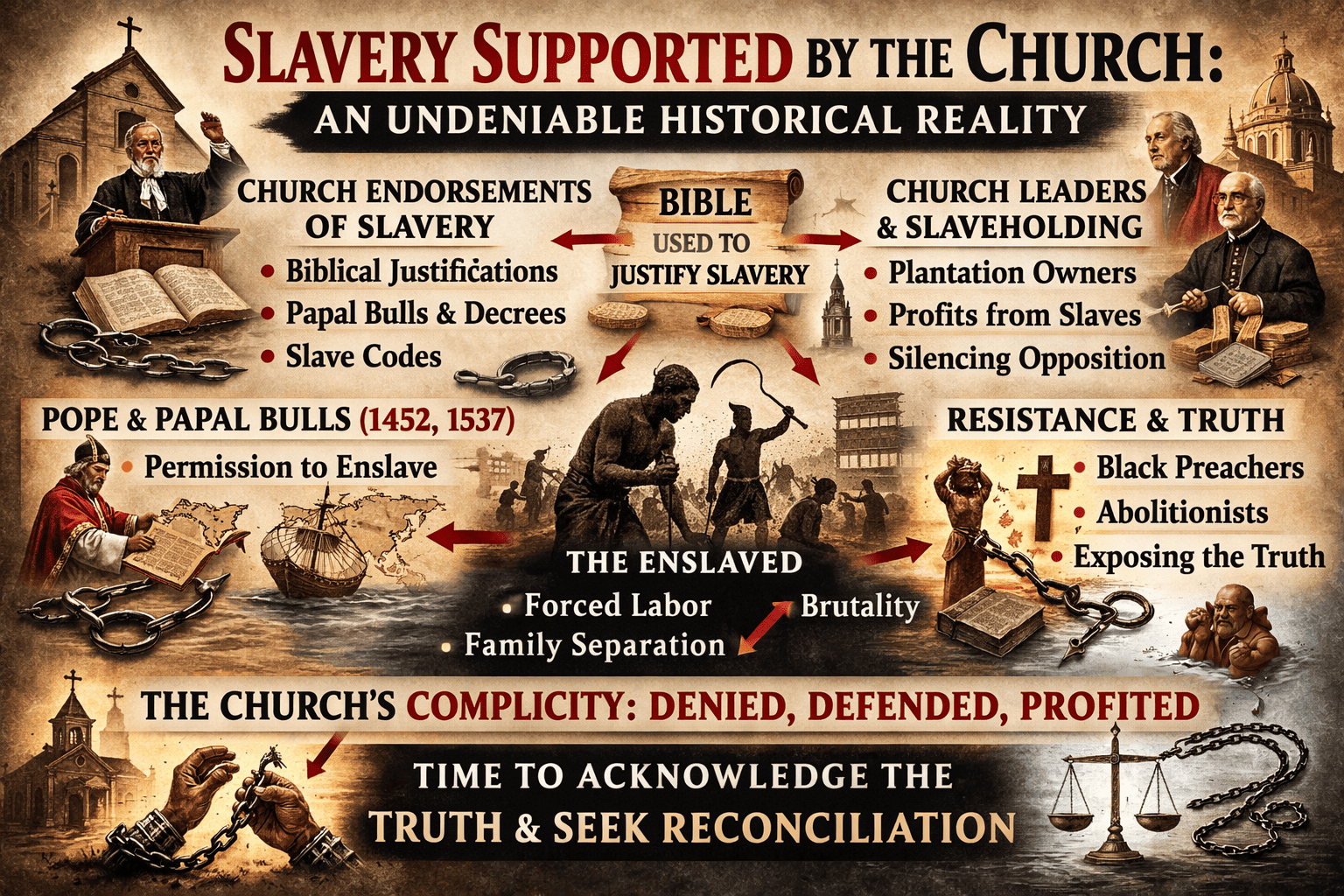
The Church of England's apology on February 7, 2006, for its direct role in profiting from 18th-century slave labor laid bare a profound truth: Christian institutions actively supported and sustained slavery for centuries. Far from mere passive bystanders, churches across denominations invested in, justified, and expanded human bondage as integral to their operations and theology. This article exposes these facts with concrete examples, demonstrating how slavery was not an aberration but a pillar propped up by ecclesiastical authority. The Church of England poured funds into the South Sea Company, the infamous slave-trading enterprise that ferried over 34,000 Africans across the Atlantic in squalid holds. Through Queen Anne’s Bounty—designed to relieve poor clergy—the Church secured £406,942 in annuities, equivalent to roughly £724 million today, harvested straight from Caribbean plantation blood money. When Britain abolished slavery in 1833, nearly 100 Anglican vicars and 128 clergy in total pocketed compensation for thousands of "their" slaves, with bishops in Barbados and Codrington College overseeing estates where the enslaved toiled without mercy. Clergy salaries, church buildings, and missionary outposts were bankrolled by this commerce in human misery, proving slavery's foundational role in Anglican wealth.
The Catholic Church provided the doctrinal blueprint. Pope Nicholas V's 1452 bull Dum Diversas explicitly authorized Portugal to invade, capture, and "reduce to perpetual servitude" Saracens, pagans, and Africans, cloaking enslavement as holy crusade. This greenlit the transatlantic trade. Jesuits built slaveholding dynasties: by 1760, they commanded over 20,000 slaves in Maryland, Louisiana, and Brazil, selling and renting them to fund Georgetown University and global missions—slavery was their economic engine. Church Fathers sanctified it: Augustine called slavery a "necessary" outgrowth of sin, regulable by biblical laws like Exodus 21's rules for beating slaves without killing them. Papal silence or endorsement persisted for 400 years. In a stunning General Synod vote, the Church confessed its "dehumanising and shameful" complicity in the slave trade, just before the 1807 Act's bicentenary. Archbishop Rowan Williams and Rev. Simon Bessant conceded the Church stood "at the heart" of the evil, its investments fueling the very ships and whips. Even as they name-checked Wilberforce and Newton—exceptions who repented late—the admission cements that slavery enjoyed systemic Church patronage. This was no footnote; it was core to institutional survival and expansion.
Church leaders mined Scripture to bolster slavery. The "Curse of Ham" (Genesis 9) was twisted into divine proof that Africans deserved chains. Southern Presbyterians in 1864 enshrined it as their "peculiar mission from God," branding abolitionists heretics. Ephesians 6:5 urged slaves' obedience; Philemon returned a runaway; Exodus 21 permitted permanent Hebrew slavery and corporal punishment. Sermons from pulpits declared bondage God's order, preached to congregations owning fellow humans. These weren't fringe views— they were mainstream theology upholding the system. Anglicans compensated for 4,000 slaves; Catholic bishops in Brazil and Louisiana held plantations unchallenged. Protestant denominations in America's South ordained slaveholders, their catechisms teaching subjugation as piety. Even monastic orders flouted ideals: Jesuits auctioned 272 slaves in 1838 for New Orleans debts. From Rome to the colonies, slavery greased Church wheels—funding cathedrals, seminaries, and salaries while missionaries baptized the bound. Pre-Christian ubiquity became Christian endorsement, with no mass excommunications for traders.
Only after economic shifts and internal pressures did some Christians pivot. Evangelicals like Wilberforce railed against a trade the Church had fattened on for generations, securing 1807's ban and 1833's emancipation. Yet abolition was the exception proving the rule: for 350 years, support was the norm, opposition the dissent. U.S. churches split over it, Southern Baptists defending slavery till defeat. Slavery thrived under Church auspices until secular forces and profits waned. The Church's 2023 £100 million pledge acknowledges lingering fruits of slave capital, though demands swell to £1 billion. Historians tally Anglican slave wealth at millions adjusted, dwarfing mere "links." Today's Clewer Initiative fights trafficking, but it cannot erase how churches once engineered bondage. The 2006 apology rips the veil: slavery was supported by the Church—not reluctantly, but actively, profitably, theologically. Investments cashed in on suffering; bulls blessed it; Bibles backed it. This legacy indicts institutions that preached love while chaining bodies, a stain no late contrition fully cleanses. History demands we see it plain: the Church was slavery's ally.




Comments
Add new comment