Body
The idea of the Ummah—a global community of Muslims united by faith, shared moral responsibility, and collective destiny—has long occupied a central place in Islamic religious and political thought. Classical scholars described the Ummah as transcending tribal, ethnic, linguistic, and national divisions. In theory, Muslims across the world constitute a single body bound together by religious fraternity and collective obligation.
In sermons, religious literature, and political discourse, the concept of the Ummah continues to be invoked as a symbol of unity and solidarity among Muslims worldwide. It represents the moral vision of a community connected not merely by geography or ethnicity but by faith and shared spiritual commitments. Yet the political realities of the modern world raise an uncomfortable question: does such unity exist in practice, or has it largely remained an aspirational ideal?
Contemporary geopolitics, particularly in the Middle East and South Asia, suggests that Muslim societies are frequently divided along sectarian, national, and ideological lines. Rivalries among Muslim-majority states, competing regional ambitions, and historical theological divisions often shape political behaviour far more than the rhetoric of religious unity. The gap between the ideal of the Ummah and the realities of modern politics has therefore become increasingly visible.
The most significant internal division within the Muslim world remains the historical split between Sunni and Shia Islam. This divide originated in the early years following the death of the Prophet Muhammad in 632 CE, when disagreements emerged regarding the political and spiritual leadership of the Muslim community. Over centuries, these political disagreements gradually developed into theological, legal, and institutional differences between the two religions. Although Sunni and Shia Muslims share the fundamental pillars of Islamic belief and practice, the historical dispute over leadership left a lasting imprint on Islamic political culture. In the modern era, these sectarian identities have often been amplified by geopolitical rivalries. Regional powers sometimes mobilise sectarian narratives to strengthen political alliances or weaken adversaries. As a result, conflicts in countries such as Iraq, Syria, Yemen, and Lebanon are frequently interpreted through a Sunni–Shia lens. While geopolitical interests remain the primary drivers of these conflicts, sectarian identities often intensify them and shape public perceptions.
Another factor limiting the practical realisation of the Ummah is the rise of the modern nation-state. Most Muslim-majority countries today operate within political systems defined by national sovereignty, strategic alliances, and economic interests. In this framework, governments prioritise national security and geopolitical strategy rather than religious solidarity. For example, relations between Iran, a Shia-majority state, and several Sunni-majority countries in the Middle East have fluctuated between cautious diplomacy and open rivalry. Disputes over regional influence—from Iraq and Syria to Yemen and Lebanon—often overshadow broader religious commonalities. At the same time, several Sunni-majority governments have pursued pragmatic diplomatic engagement with Israel, despite ongoing tensions between Israel and Iran. These diplomatic decisions demonstrate how national interests frequently outweigh religious identity in international politics. Such realities challenge the assumption that a shared Islamic identity automatically produces political unity.
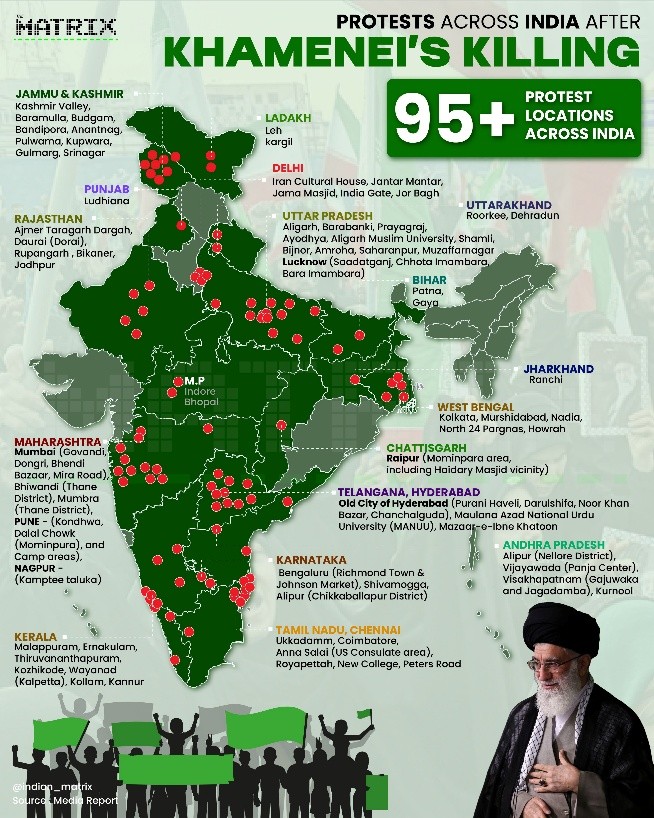
Recent events in India provide an illustrative example of how sectarian affiliations can shape political mobilisation. Following reports of the assassination of Iran’s Supreme Leader Ayatollah Ali Khamenei, demonstrations and mourning gatherings were organised across numerous cities in India. These protests occurred in more than ninety locations, including states such as Uttar Pradesh, Maharashtra, Telangana, Karnataka, Kerala, West Bengal, and Jammu & Kashmir.
In cities such as Lucknow, Hyderabad, Mumbai, Pune, Bhopal, and Kolkata, demonstrators gathered in public spaces and religious centres. Participants carried portraits of Khamenei, wore black as a symbol of mourning, and chanted slogans condemning Israel and the United States. Large gatherings also took place in Lucknow at the Bara Imambara and Chhota Imambara, two of the most significant Shia religious sites in India. Candle marches and funeral prayers were organised, while similar demonstrations occurred in Shia neighbourhoods in Mumbai, Hyderabad, and Bhiwandi.
In Jammu & Kashmir, protests were reported in districts including Srinagar, Baramulla, Pulwama, and Kargil. What was particularly striking about these demonstrations was that they were primarily organised and led by Shia clerics, organisations, and community networks. Religious leaders addressed gatherings, and Shia civil society groups coordinated rallies and memorial events.
There was NO visible mobilisation by Sunni religious institutions or clerical leadership in support of Iran. While individual political figures and activists commented on the geopolitical situation, major Sunni religious organisations in India did not organise comparable demonstrations or issue strong collective statements supporting Iran. This contrast highlights an important sociological reality: transnational religious solidarity often follows sectarian networks rather than a universal Muslim identity.
The contradiction between the rhetoric of unity and the reality of division becomes particularly visible during Ramadan, a month traditionally associated with compassion, charity, and communal solidarity. Throughout Ramadan, religious sermons frequently emphasise the idea that Muslims around the world form a single spiritual community experiencing the same fasting rituals and moral discipline. Yet even during this symbolic period of unity, political and sectarian divisions remain deeply entrenched. Conflicts across the Middle East continue largely unaffected by Ramadan’s message of unity. Regional rivalries, ideological competition, and strategic alliances persist despite the shared religious observance. This paradox illustrates how religious symbolism and political reality often operate in different spheres.
While sectarian divisions are real, history also offers important examples of cross-sect solidarity. During the war against ISIS in Iraq (2014–2017), the prominent Shia cleric Grand Ayatollah Ali al-Sistani issued a religious call encouraging volunteers to defend Iraq against the extremist group. At the same time, he explicitly warned against retaliation against Sunni civilians and emphasised the protection of Sunni mosques and communities.
Shia volunteer units subsequently participated in operations defending Sunni towns from ISIS attacks and helped evacuate Sunni civilians fleeing extremist violence. In some regions, Shia militias coordinated with Sunni tribal forces in the fight against ISIS. Another example can be found in Lebanon, where the Shia organisation Hezbollah has repeatedly framed its confrontation with Israel as part of a broader struggle in support of the Palestinian cause, whose population is predominantly Sunni. Similarly, the influential Lebanese cleric Imam Musa al-Sadr advocated strongly for Sunni-Shia cooperation during the twentieth century. He worked with Sunni scholars and political leaders to reduce sectarian tensions and emphasised the importance of Islamic unity. These cases demonstrate that sectarian divisions do not always prevent cooperation, particularly when communities face common political threats.
South Asia provides additional historical examples of collaboration between Sunni and Shia communities. During the early twentieth century, Shia scholars and activists participated in the Khilafat Movement, which was largely led by Sunni leaders seeking to defend the Ottoman Caliphate after the First World War. In modern India, Shia organisations joined protests following the demolition of the Babri Masjid in 1992, emphasising that the issue concerned the broader Muslim community rather than a single sect. More recently, Shia clerics and organisations also participated in protests against the Citizenship Amendment Act, arguing that sectarian divisions should not weaken collective political responses to issues affecting Muslims in India. These examples illustrate that cooperation across sectarian boundaries has occurred repeatedly when shared political concerns arise.
Contemporary Muslim politics frequently reveals an asymmetry of solidarity. Expressions of unity are often selective, influenced by sectarian affiliations, geopolitical alliances, and domestic political considerations. In situations involving Shia communities or Shia-majority states such as Iran, large-scale mobilisation across the broader Sunni world has often been limited or inconsistent. This uneven response raises important questions about the practical meaning of the Ummah in a world dominated by nation-states and strategic alliances.
The history of Muslim societies suggests that the concept of the Ummah functions more effectively as a moral aspiration than as a consistent political reality.
Modern geopolitics, national interests, and sectarian identities frequently shape alliances and conflicts in ways that transcend religious unity. At the same time, history also demonstrates that Sunni–Shia relations cannot be reduced to a simple narrative of permanent conflict. Numerous moments of cooperation—from Iraq to Lebanon to South Asia—show that solidarity across sectarian boundaries is possible under certain conditions. The paradox of the modern Muslim world, therefore, lies not simply in division, but in the coexistence of two realities:
a powerful religious ideal of unity
and a persistent political landscape shaped by fragmentation.
The Ummah continues to inspire moral imagination and religious identity, yet its political expression remains constrained by the complex realities of the modern world. The contrast between rhetoric and reality becomes especially striking during moments of crisis. Every Ramadan, sermons and speeches across the Muslim world invoke the idea of a single, united Ummah, bound together by faith and collective responsibility. Yet when geopolitical events unfold—such as tensions involving Iran—the response across the Muslim world reveals a far more fragmented landscape. The recent protests organised across numerous Indian cities in solidarity with Iran were overwhelmingly mobilised by Shia communities and institutions, demonstrating a strong sense of transnational Shia identity and political engagement. At the same time, major Sunni religious institutions and clerical leadership largely refrained from organising comparable demonstrations or issuing strong collective statements. This divergence illustrates a broader structural reality: the Muslim world is deeply shaped by sectarian affiliations, national interests, and political calculations. Scholars of Islamic politics have long noted that Sunni–Shia divisions—originating in early disputes over leadership after the death of the Prophet Muhammad—continue to influence contemporary political alignments and regional rivalries.
Comments
Add new comment