Body
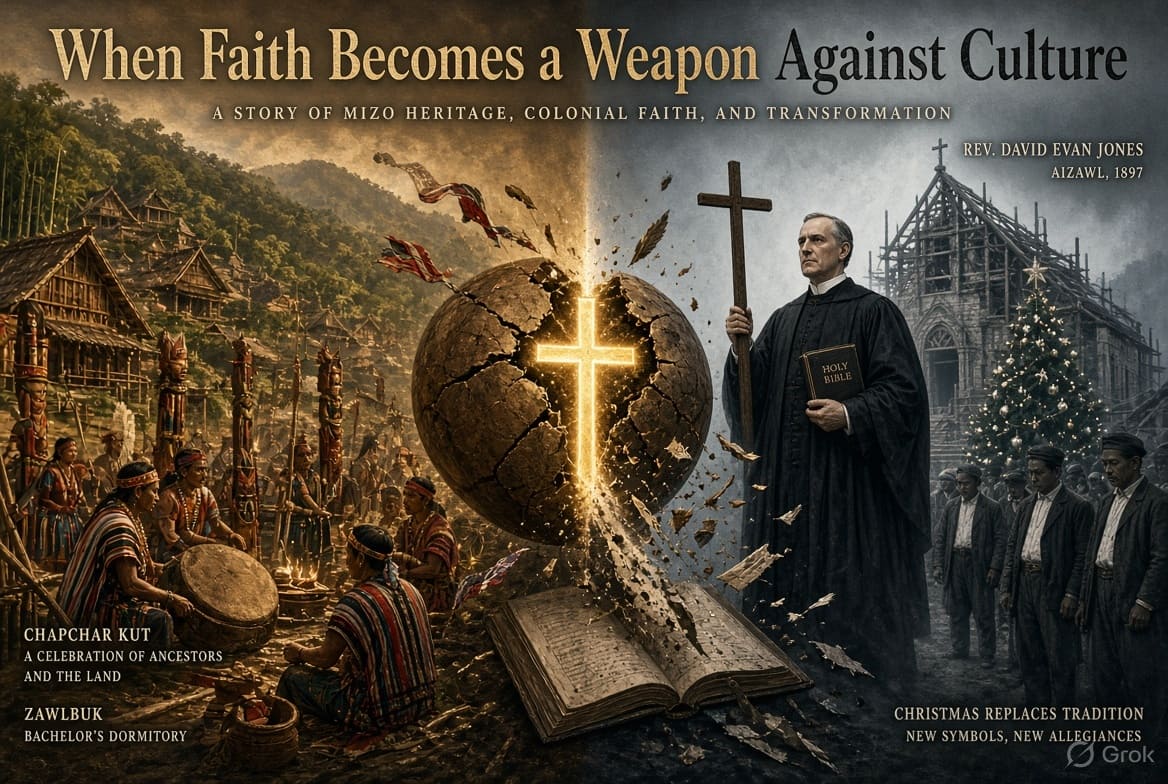
On 31 August 1897, Reverend David Evan Jones stepped into Aizawl carrying a conviction that would reshape an entire society. He was not merely a missionary. He was the vanguard of a civilising mission that viewed the Mizo people as savages awaiting redemption, their traditions as darkness awaiting light, their identity as something to be replaced rather than respected. The arrival of Jones marked the beginning of what would become one of the most comprehensive cultural transformations in modern Indian history. Within half a century, the Mizos had been largely converted to Christianity. The new religion did not simply add itself to existing beliefs. It overturned the traditional culture entirely, replacing indigenous practices with a westernised way of life that severed communities from their ancestral roots.
The British administrators who preceded Jones had already laid the ideological groundwork. They documented Mizo history from a coloniser's perspective, emphasising their own achievements in uplifting what they considered a rough and heathen community. The missionaries followed this same patronising approach, presenting the Mizos as barbarians, headhunters and uncivilised people who needed complete transformation. This was not merely religious conversion. It was cultural erasure dressed in the language of salvation. The missionaries saw Mizo society as one requiring a thorough overhaul—social, religious, economic and cultural. Every aspect of tribal life, from clothing to rituals, from songs to gender relationships, was singled out for criticism and eventual abolition. The consequences were profound and lasting. Traditional festivals faded away, replaced by Christmas as the primary celebration. Indigenous religious practices involving clan deities were condemned as superstition. Animal sacrifices, elaborate rituals and the entire spiritual framework that had sustained Mizo communities for generations were dismissed as heathen practices and thrown away by the early church. The missionaries branded tribal life as savage and subjected every dimension of Mizo existence to severe denigration. Even their sexual norms and social structures were attacked. The zawlbuk—the traditional bachelor's dormitory that served as a centre for community learning and cultural transmission—lost its importance and eventually disappeared. This was not incidental damage. It was deliberate cultural engineering.
The missionaries understood that education could serve as a powerful instrument for religious transformation. Jones opened a school at his bungalow on his birthday in 1898, and this institution quickly became a place for congregation, worship and Sunday school activities. The church continued building schools in villages across Mizoram, creating an infrastructure that tied literacy to conversion. While education brought undeniable benefits—including the highest literacy rate in India by the 21st century—it came at a cost. The curriculum and pedagogy were designed to create distance between young Mizos and their own heritage. Children learned to read and write, but they learned to view their own culture through a western lens that portrayed it as inferior and backward. Not all Mizos accepted this transformation passively. When revival movements emerged in the early 20th century, incorporating indigenous elements like drums and local expressions of faith, the missionaries did not welcome them. J.H. Lorrain, one of the pioneer missionaries, declared that the Mizoram revival "worked nothing but evil." The drum, which enlivened the spirit of indigenous worship, became an object of sneering for the missionaries. This was a clash of cultures. The missionaries represented western civilisation and its claim to universal truth. The Mizo revivalists represented indigenous culture seeking to express faith on its own terms. The missionaries won this battle. Their paternalistic historiography became the dominant narrative, portraying everything before Christianity as merely preparatory or as animist practices requiring urgent redemption. Perhaps the most tragic dimension was how the first generation of Mizo Christians internalised this worldview. Trained by missionary sahebs whom they believed to be their teachers, mentors and mediators between heaven and earth, they began writing their own history from a western perspective. Their books carried titles like "From Head-Hunting to Soul Hunting" and "From Head-Hunting to the Hallelujah Chorus"—testaments to how thoroughly they had accepted the narrative that their pre-Christian past was something to escape rather than honour.
For these writers, anything that was Mizo needed to be improved, changed and redeemed by Christian missions. They became unwitting agents of their own cultural dispossession, perpetuating the very historiography that had portrayed their ancestors as savages awaiting salvation. When efforts emerged in the 1960s to revive Mizo culture, the Church objected. Only in the 1970s, upon seeing the extent of cultural loss, did the Church begin to revive certain traditions such as Chapchar Kut. But by then, Christmas had become the biggest festival in Mizoram, with Chapchar Kut relegated to second place. The damage had been done. The cultural calendar had been permanently altered. The Christianity introduced was wrapped in western culture and came into fundamental conflict with Mizo cultural practices. From the initial stage, there was a cultural battle, and western Christianity gained the upper hand because it was supported by the ruling colonial administration. Many Mizo cultural practices were condemned as heathen and discarded. The written history of Mizoram that emerged from this period reflected the victors' perspective. British colonisers and Welsh missionaries produced accounts that stressed their achievements in uplifting the Mizo community. When Mizos began writing their own history, they initially followed this same framework, viewing their past through the eyes of those who had conquered them spiritually and culturally. Only in the 1990s did a significant shift occur. Indigenous thinkers began rejecting the colonial hangover, writing Mizo Christian history from a standpoint that recognised tribal communities as active participants rather than passive recipients. They argued that the Mizos accepted Christianity not because of external missionary pressure, but because of internal spiritual conviction.
The legacy of Jones and his successors remains contested. On one hand, Christianity brought literacy, modern education and integration into broader networks of knowledge and opportunity. On the other hand, it caused the erosion of tribal culture by implanting a new, westernised way of life that displaced indigenous social and cultural heritage. The central question remains unanswered: can a community modernise without surrendering its soul? The Mizo experience suggests that when faith becomes a vehicle for cultural replacement rather than spiritual enrichment, the price paid is measured not in converts gained, but in identities lost. The Mizos became Christian, but they also became something else—something that their ancestors would not have recognised as their own.

Comments
Add new comment