Body
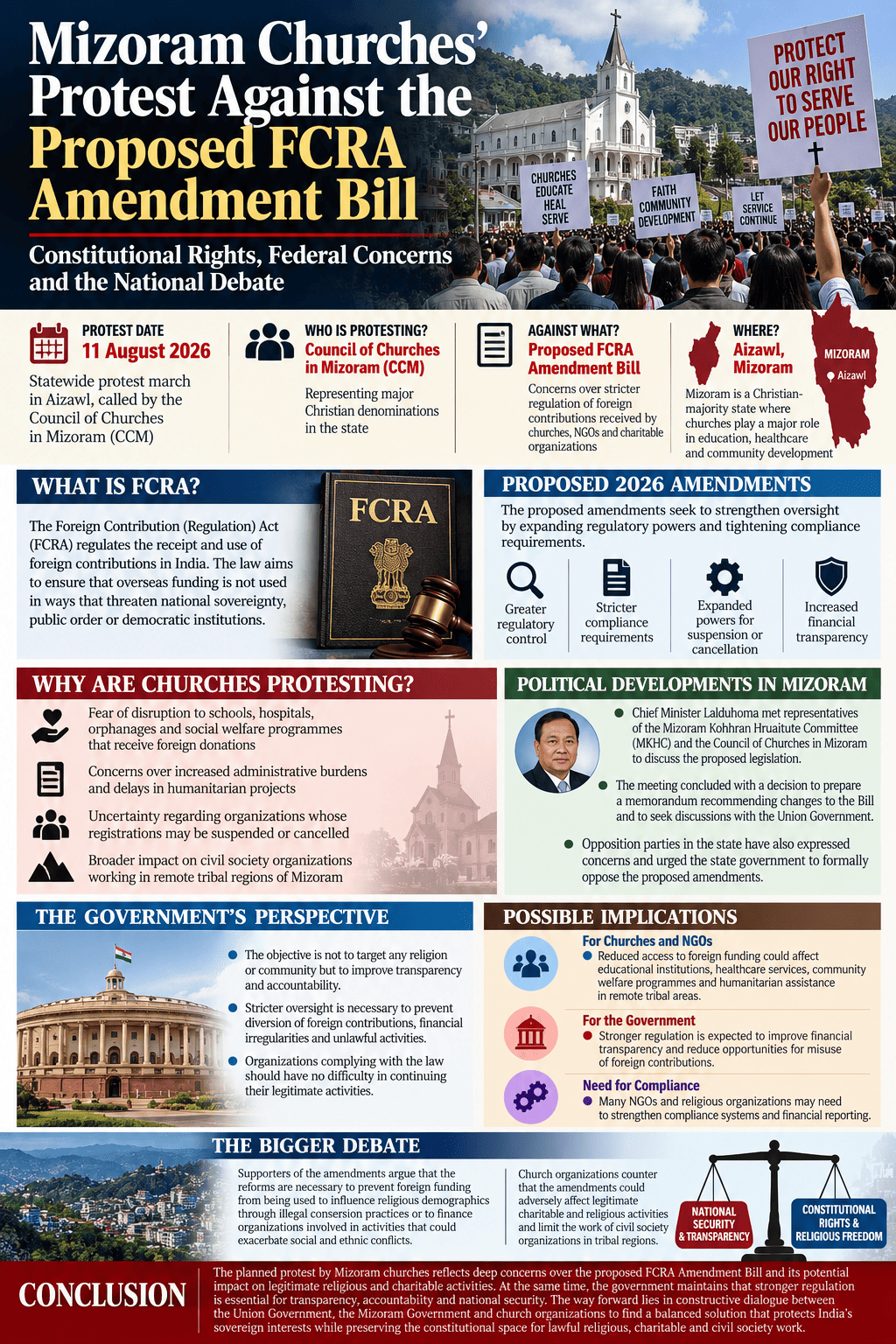
The announcement by the Council of Churches in Mizoram (CCM) to organize a statewide protest march on 11 August 2026 against the proposed Foreign Contribution (Regulation) Amendment Bill has brought renewed attention to the relationship between religious institutions, foreign funding, and government regulation. Church organizations argue that the proposed amendments could adversely affect churches, NGOs, educational institutions, and charitable organizations that depend on legitimate foreign contributions. The Central Government, on the other hand, maintains that stricter regulation is necessary to prevent misuse of foreign funds and to strengthen national security and financial transparency. This article examines the background, causes, legal dimensions, and likely implications of the protest from an objective perspective.
Introduction
Mizoram is one of India's most Christian-majority states, where churches play an important role not only in religious life but also in education, healthcare, disaster relief, and community development. Because many church-affiliated organizations receive foreign donations for charitable work, any proposed change to the Foreign Contribution (Regulation) Act (FCRA) directly affects their functioning. In July 2026, the Council of Churches in Mizoram (CCM), representing major Christian denominations, announced a protest rally in Aizawl on 11 August against the proposed FCRA Amendment Bill. The church body expressed concern that several provisions of the proposed legislation could negatively affect churches, NGOs, and civil society organizations receiving foreign contributions.
Background of the Protest
The FCRA regulates how individuals and organizations receive foreign contributions in India. The law aims to ensure that overseas funding is not used in ways that threaten national sovereignty, public order, or democratic institutions. The proposed 2026 amendments seek to strengthen oversight by expanding regulatory powers and tightening compliance requirements. Church organizations in Mizoram believe that some of these provisions could make it more difficult for faith-based organizations to receive and utilize foreign assistance for legitimate charitable activities.
Why Are Mizoram Churches Protesting?
Church leaders have identified several concerns regarding the proposed amendments.
They argue that increased regulatory control could make it more difficult for churches and NGOs to operate schools, hospitals, orphanages, and social welfare programmes that receive international donations. They also fear that stricter provisions could increase administrative burdens, delay humanitarian projects, and create uncertainty regarding organizations whose registrations may be suspended or cancelled. According to church representatives, the proposed changes could have broader consequences for civil society organizations working in remote tribal regions of the state.
Political Developments
The issue has also acquired political significance in Mizoram. Chief Minister Lalduhoma met representatives of the Mizoram Kohhran Hruaitute Committee (MKHC) and the Council of Churches in Mizoram to discuss the proposed legislation. The meeting concluded with a decision to prepare a memorandum recommending changes to the Bill and to seek discussions with the Union Government. Opposition parties in the state have similarly expressed concerns and urged the state government to formally oppose the proposed amendments, arguing that they could disproportionately affect churches and NGOs operating in Mizoram.
The Government's Perspective
The Union Government has consistently maintained that the objective of strengthening the FCRA is not to target any religion or community but to improve transparency and accountability in the use of foreign funds. Government representatives have argued that stricter oversight is necessary to prevent diversion of foreign contributions, financial irregularities, unlawful activities, and misuse of overseas funding. They have also stated that organizations complying with the law should have no difficulty in continuing their legitimate activities.
Possible Implications
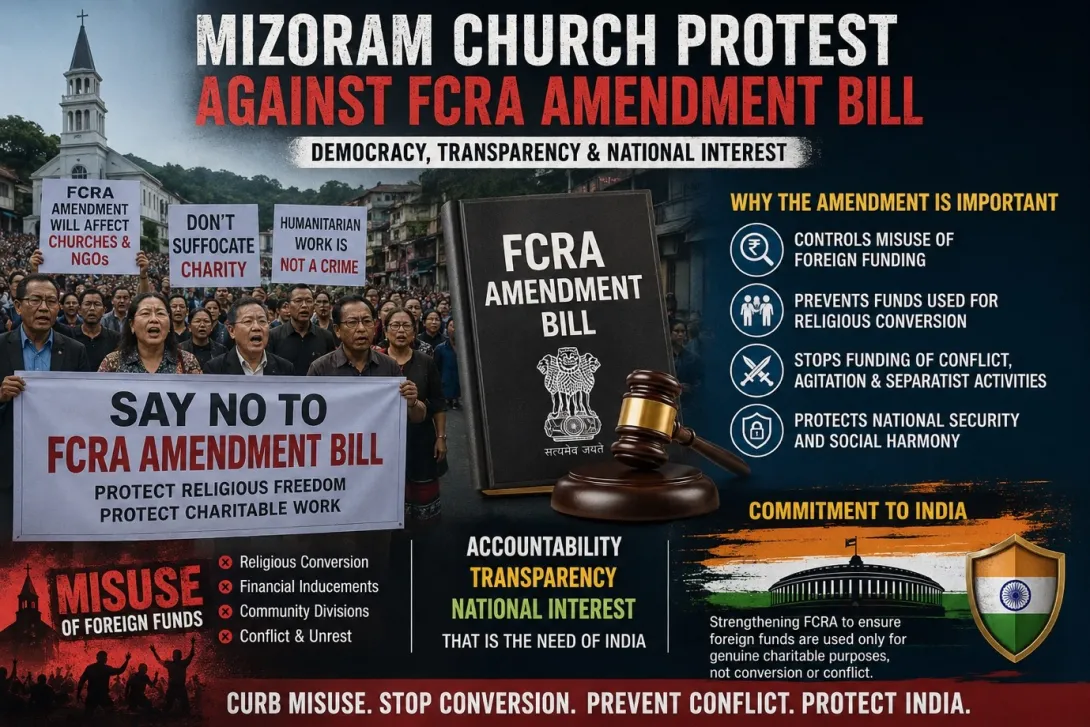
If enacted in its present form, the proposed amendments may require many NGOs and religious organizations to strengthen compliance systems and financial reporting. For churches in Mizoram, the principal concern is that reduced access to foreign funding could affect educational institutions, healthcare services, community welfare programmes, and humanitarian assistance in remote tribal areas, the actual reason behind is destabilise the Mizoram. For the Government, stronger regulation is expected to improve financial transparency and reduce opportunities for misuse of foreign contributions.
Conclusion
The planned protest by Mizoram churches represents one of the most significant organized responses to the proposed FCRA Amendment Bill. It reflects concerns among church bodies that the legislation may adversely affect legitimate charitable and religious activities funded through foreign contributions. At the same time, the Central Government argues that stronger regulation is necessary to ensure transparency, accountability, and national security. The ultimate challenge is to strike a balance between protecting India's sovereign interests and preserving the constitutional space for lawful religious, charitable, and civil society organizations to carry out their work. Constructive dialogue between the Union Government, the Mizoram Government, and church organizations may help address concerns while ensuring that the objectives of transparency and public welfare are both achieved. Instead, they contend that the reforms are primarily aimed at preventing foreign funding from being used to influence religious demographics through illegal conversion practices or to finance organizations involved in activities that could exacerbate social and ethnic conflicts.









Comments
Add new comment