Body
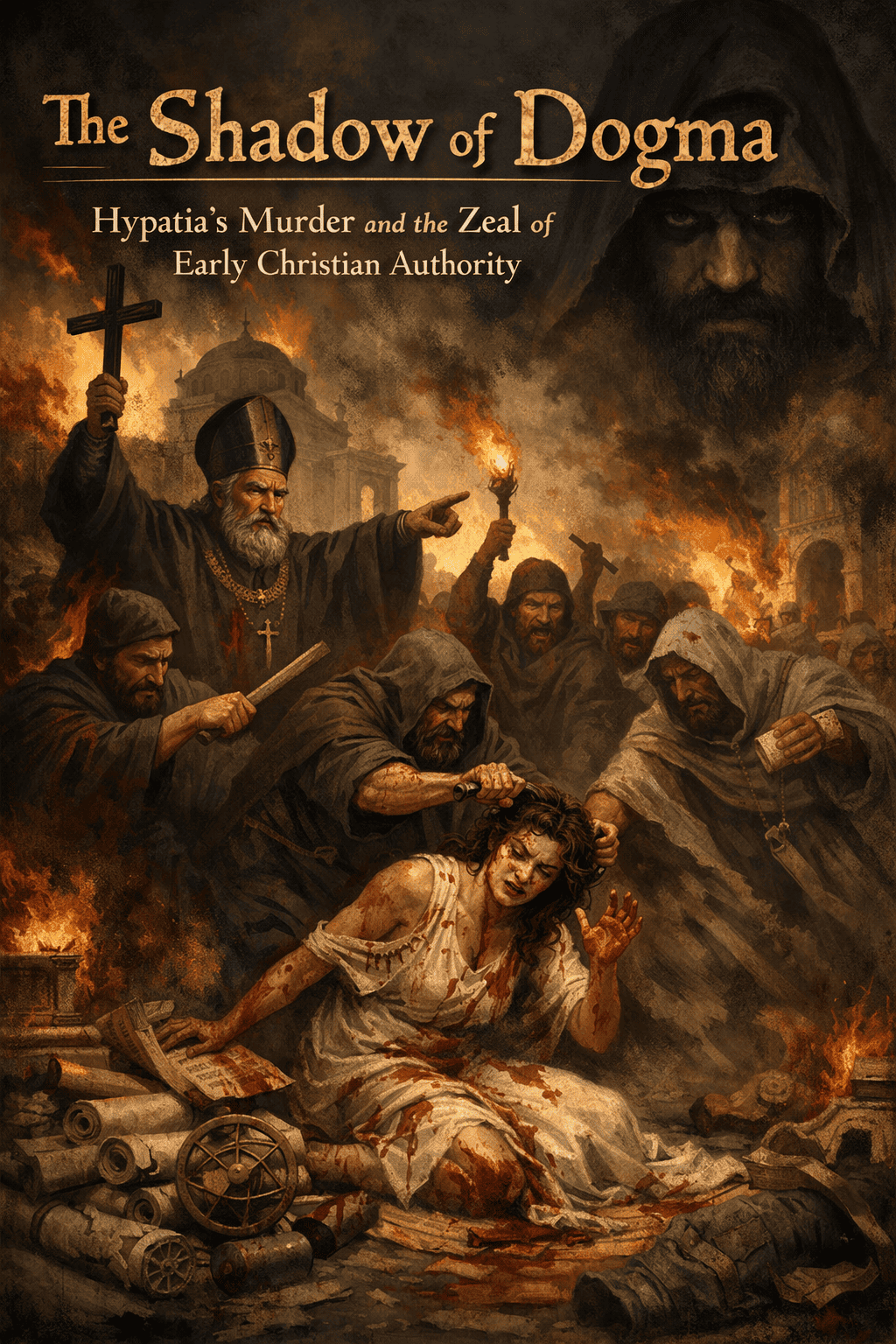
In the bustling streets of Alexandria in March 415 AD, a city renowned as the intellectual heartbeat of the ancient world, a horrific act unfolded that would echo through history. Hypatia, the revered pagan philosopher, mathematician, and astronomer, was dragged from her chariot by a frenzied mob. They stripped her, flayed her flesh with roof tiles, and burned her remains. This was no random outburst of street violence but a calculated strike by Christian zealots, sanctioned implicitly by the city's bishop, Cyril. Hypatia's death marked a grim turning point, where unyielding religious fervor supplanted the tolerant pluralism that had defined Alexandria for centuries.
Hypatia was no ordinary scholar. Born around 370 AD to Theon of Alexandria, a noted mathematician and the last director of the famed Mouseion library, she inherited and surpassed her father's brilliance. Fluent in Greek, she lectured publicly on Plato, Aristotle, and Plotinus, drawing crowds of pagans, Christians, and Jews alike. Students flocked to her from across the Roman Empire, captivated by her eloquence and command of complex subjects like geometry and astronomy. She edited Ptolemy's Almagest, advised prefects on civic matters, and symbolized the Neoplatonic ideal of reason ascending toward the divine. In a era of fading pagan traditions, Hypatia embodied resilient intellectual independence, refusing to convert despite mounting pressures.
Alexandria in the early 5th century was a powder keg of faiths and factions. Founded by Alexander the Great in 331 BC, it had thrived as a cosmopolitan hub under Ptolemaic, Roman, and now Christian rule. Its great lighthouse pierced the Mediterranean horizon, while the Serapeum—once a temple to Serapis—housed scrolls rivaling Rome's collections. Jews formed a quarter of the population, pagans clung to ancient rites, and Christians, newly dominant after Emperor Theodosius I's edicts banning pagan worship in 391 AD, vied for total control. Into this cauldron stepped Cyril, appointed patriarch in 412 AD after his uncle Theophilus's death. Theophilus had orchestrated the destruction of the Serapeum in 391, a pogrom that razed pagan idols and libraries alike. Cyril, cut from the same cloth, pursued an aggressive vision of Christian supremacy.
Cyril's intolerance was methodical. He expelled Jews from the city, accusing them of plotting against Christians, sparking riots that left streets bloodied. Pagan professors were driven from their chairs, their lectures deemed heretical. Hypatia stood as a glaring obstacle. As a woman of influence, she advised Orestes, the Roman prefect tasked with maintaining order. Orestes, himself sympathetic to classical learning, clashed openly with Cyril over jurisdiction. Letters between Orestes and Cyril reveal the bishop's demands for submission, laced with threats of excommunication. Hypatia, though uninvolved in politics directly, became the scapegoat. Rumors spread that she bewitched Orestes with sorcery, preventing reconciliation—a classic smear to demonize the intellectual elite.
The mob that killed her comprised parabalani, Cyril's enforcers disguised as monks. These fanatical bands, exempt from taxes and armed for "charitable" duties, roamed Alexandria meting out vigilante justice. Eyewitness accounts, preserved in the 5th-century Ecclesiastical History of Socrates Scholasticus, describe the scene vividly: "They seized Hypatia... and having conducted her to the great church known as the Caesareum, they tore off her clothes, and dragged her through the streets until she died." Her body was dismembered and incinerated, erasing any trace for veneration. John of Nikiu, a 7th-century Coptic bishop, later justified it, claiming she was "devoted to the worship of devils" and sacrificed to "appease the Lord." Cyril himself never condemned the act; instead, he consolidated power, exiling Orestes' allies and solidifying episcopal dominance.
This was no isolated tragedy but a manifestation of a hardening mindset among Christian leaders. From Constantine's conversion in 312 AD, Christianity evolved from persecuted sect to imperial orthodoxy. The Council of Nicaea in 325 standardized doctrine, branding dissent as heresy punishable by death. Emperors like Theodosius enforced this with laws demolishing temples and prohibiting sacrifices. Leaders like Cyril embodied a zero-tolerance ethos: unity through conformity, enforced by force if needed. Hypatia's murder signaled the end of Alexandria's golden age of syncretism, where Greek philosophy had long informed Christian theology—think Origen or Clement, who blended Plato with scripture. Now, such synthesis was suspect; pure faith demanded the eradication of rivals.
The pattern persisted. Cyril's contemporary, the monk Shenoute, preached fiery sermons against "pagans and heretics," boasting of destroying idols in Upper Egypt. Across the empire, similar purges unfolded: the burning of the Temple of Zeus in Gaza, the sack of the Marneion in Lebanon. Intellectual havens crumbled. The Mouseion, once nurturing Eratosthenes and Euclid, withered under Christian oversight. Hypatia was its last luminaries' torchbearer, extinguished to prevent "contamination." Women, especially, bore the brunt; ecclesiastical fathers like Tertullian had long decried female learning as immodest, echoing Paul's epistles restricting women to silence.
Fast-forward through history, and echoes of this rigidity appear in movements prioritizing doctrinal purity over dialogue. In medieval Europe, the Inquisition targeted "witches" and scholars, much as parabalani targeted Hypatia. The Reformation's wars stemmed from similar zeal, each side claiming exclusive truth. Even in modern times, one sees parallels in theocratic impulses where religious authorities brook no challenge from science, philosophy, or rival beliefs. Consider how Galileo's heliocentrism clashed with Church dogma, or how evolutionary theory provoked backlash. Hypatia's story warns of leadership that views inquiry as threat, not treasure—where mobs, blessed by hierarchs, silence voices that question the creed. Yet Hypatia endures as a symbol of defiant reason. Renaissance humanists revived her tale, Voltaire lambasted Cyril as a "barbarian," and Gibbon in Decline and Fall indicted Christianity's role in antiquity's fall. Today, feminists hail her as a trailblazer, while secular thinkers invoke her against fundamentalism. Her Neoplatonism, emphasizing the soul's ascent through intellect, resonates in our debates over faith versus evidence. Cyril was later sainted, his feast day honored in Catholic and Orthodox calendars. Hypatia has no such shrine, her legacy etched in cautionary history. The murder of March 415 was not mere fanaticism but a deliberate assertion of supremacy: one faith, one truth, no compromises. Alexandria dimmed, its libraries looted, its spirit fractured. In remembering Hypatia, we confront the peril of leaders who wield belief as a weapon, torching enlightenment to fan the flames of their own unassailable vision.










Comments
Add new comment