Body
&nb
&nb
- Damodharan Ji
Have you ever wondered why the Muslims as a community get agitated and provoked to act violently after the Jumma Namaz (the congregational prayer on Fridays) sometimes? Why issues like CAA (which is a non-issue actually),Triple Talaq (safeguarding the interests of married Muslim women) and historically, international Islamic flashpoints from the global uproar over Innocence of Muslims (2012) and French caricatures of the Prophet (2015, 2020) to recurring pro-Palestine mobilizations have repeatedly been imported into India, where they are amplified by domestic actors seeking to project a transnational Muslim identity in public spaces. The September 2025 Kanpur dispute over “I Love Muhammad” banners during Barawafat, which sparked localized clashes, police crackdowns, and sympathetic protests across multiple cities, exemplifies this pattern: a calculated assertion of minority religious symbolism that tests the limits of secular tolerance and provokes a necessary reassertion of Hindu cultural and legal primacy in the public sphere. should trigger violent reaction from the Quom? Why the Waqf Amendment Act 2025, which is in no way a Muslims Vs Hindus issue, should evoke violence against the hapless Hindus in Nagpur and Murshidabad?
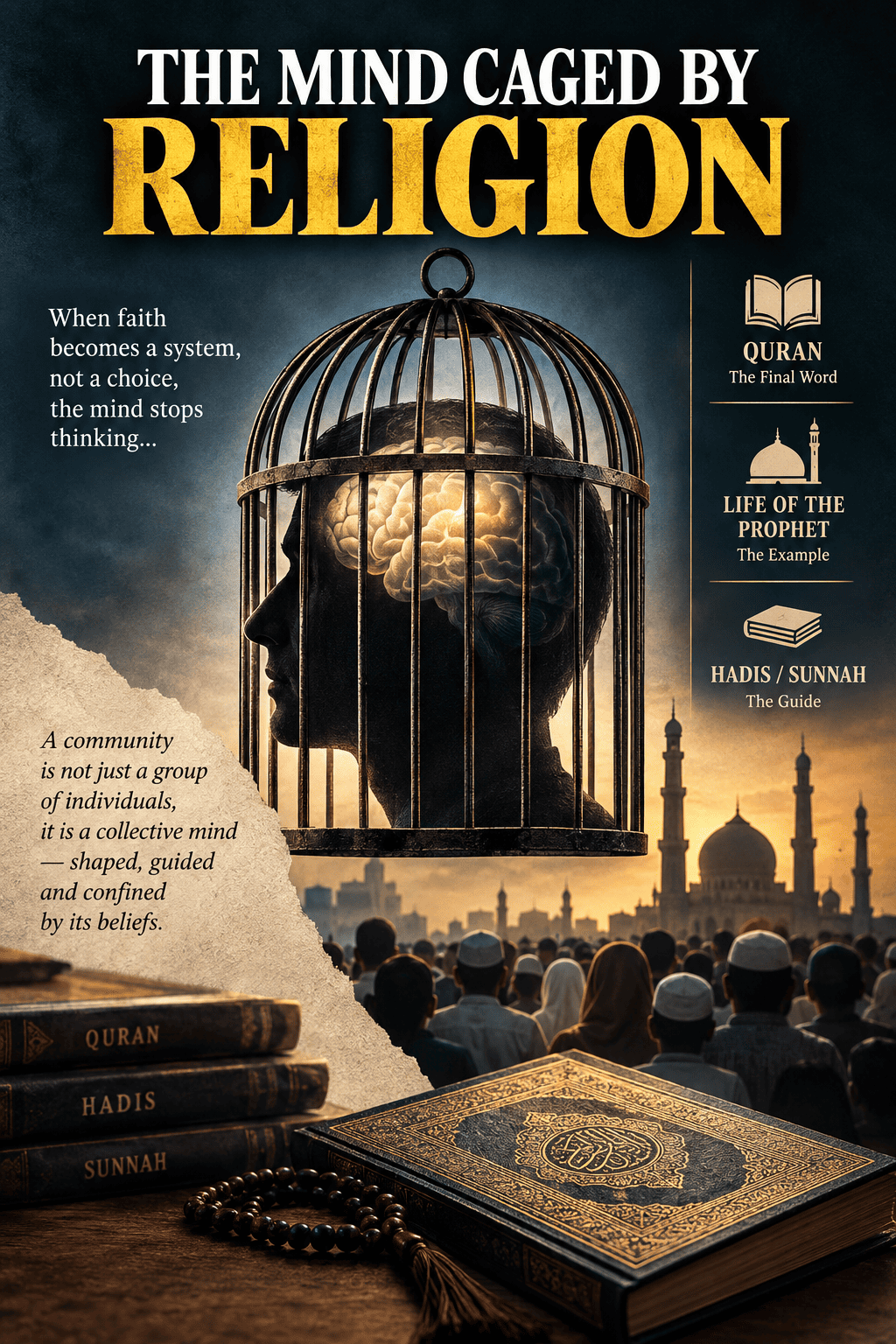
Do such agitation and violence happen accidentally or incidentally or intentionally? If such reactions are thought over responses, then that leads to a more pertinent question – does a community or a society has a ‘mind’? If yes, how it is shaped and influenced? Is it superior to the mind of the individuals and what happens to the rational thinking capacity of these people when the societal mind takes over? To begin with, let us try to understand, as lay persons, how an individual gets influenced? As a child, the primary influence is certainly of the mother, family and the school, as a growing adolescent the influence is of the friends and also the peers, society, culture etc. What will happen when a system is in place that ensures that all these influencers derive their ideas from a common single source which is water tight, straight jacket and its violation is punishable in hell? Imagine the mind as a living substance and it is caged!
In such a rigid system-driven society which is caged by religion, culture and tradition, the mind-set of such a society is invariably a prisoner of such influences without a choice. In Muslim societies, not only the mind-set of the individuals and the society but also the culture and tradition are all influenced by the religion. The fount of Islam, a religion-shaped society, is the Quran which is essentially a code of human conduct, revealed by Allah through the Prophet, to shape the mind of the followers to live in a particular way for the fruit of the Hereafter life. As the word of Allah, the One and Only God of the Muslims, the Quran is final and unquestionable. As revealed to the Prophet, the essence of the Quran can be surmised as – ‘Believe in Allah and work righteously’. If this is clear, the next step in understanding the Muslim mind is to understand Islam itself. For that, the study of the three sources of Islam is essential: (1) The Quran (2) The life of the Prophet and (3) The Hadis or Sunnah. The Quran is the undisputable foundation of Islam but the teachings contained in the Quran can be understood only through knowing the life of the Prophet and the explanations contained in the Hadis.
The Quran, it is said, is a collection of messages received by the Prophet during his lifetime from Allah at different times and occasions as the need arose. The correct meaning of the Ayats (verses) in the Quran can thus be understood only when the situation at the time of their revelation to the Prophet by Allah is known. Therefore the life history of the Prophet has to be studied to have clarity on the context of the verses in the Quran. Hadis is the compilation of the sayings and actions of the Prophet, his teachings, explanations given on Ayats by him, answers to questions of his followers and his conduct in different situations. Hadis is to supplement the Quran and act as a practical guide to the Muslims as to how to live and conduct oneself. Within the rigidity of the original Islam prescribed in the days of the Prophet, there has been very limited fluidity keeping with the changing situations, practices and depending upon local variations influenced by cultural and geographical synergies. Also different interpretations have come in vogue much later, influenced by the thinking of the commentators in different times. However the basis that shapes the collective mind of the Muslim society and the individual mind of the Muslim remains the same, viz., the Quran, the life of the Prophet and the Hadis.
Now, coming to the first question - does a community has a ‘mind’? And if yes, how it is shaped and influenced? A mind inspired by and influenced by a religion like Islam is bound to be shaped by its teachings. To get a fair idea on this and to know why the Muslims think and act in a particular way when it comes to Islam, it is important to understand some important traits of the ‘mind’ of the Muslim society, shaped by the three influences that they are continuously exposed to, as under:
The Muslim society is deeply religious and is not tuned to accept anything including a modern idea without religious sanction. This includes modern ideas (not so modern) like secularism, democracy, socialism, nationalism etc. Interpretations vary as to whether these ‘modern’ concepts have the endorsement of the Quran and the Hadis. For example, some scholars may interpret socialism as an Islamic concept adopted by the West from the Quran as sharing and caring for the fellow brethren is integral to Islam’s social values. Wherever the Muslims are not in numerical strength, peaceful co-existence is adopted with other communities as a temporary measure by recalling the Hudaibiya Treaty formalised by the Prophet in 628 CE for ten years between the Muslims of Medina and the Quraysh tribe of Mecca. This is a mind-set which does not accept anything which is outside the Quran, Hadis or the life of the Prophet. The laws made by any human agency like a Government cannot be perfect and ideal as compared to the Quran which is divinely ordained. The preaching contained in the Quran is true and final and Islam ordains Muslims to preserve their identity, faith and practices pure and distinct as at the time of the Prophet, devoid of religious and cultural give and take. The calls by the orthodox Clerics in Islam from time to time to go back to the pristine Quran is based on this belief. The Quran proclaims “Choose not My enemy and your enemy for your friends”, thus putting blinkers on the eyes of thinking Muslims. For them, therefore, secularism, democracy, Constitution, territory are all man-made and not God-given and so un-Islamic. This belief does not allow assimilation into local culture and traditions as is the case in Bharat. For this reason, Emperor Akbar is a lesser Muslim than Aurangzeb for the Islamic theologians as Akbar tried to dilute Islam with his ‘Din-Ilahi’. The Muslims believe that Islam is the only true faith, divinely ordained by Allah through His messenger Mohammed to be a guide for life and so its tenets are ideal, unalterable and final. The insistence on many practices prescribed in the Quran even now by Islam and its followers, which a rational mind may consider as redundant and despicable at present, is the result of this firm belief. For example, Nilkah Halala (Quran 2:230) is one such practice.
The Muslims believe that the world should accept the only true faith i.e., Islam. This is founded in the tenets of the Quran and so undisputable. The Quran, the Hadis and the life of the Prophet repeatedly emphasise that it is the bounden duty of every believing Muslim to invite non-believers to accept Islam as the only true faith to fulfil the purpose of human birth, i.e., reaching Jannat on the ‘Day of Judgment’. Islam means ‘a path of peace’ meaning ‘embrace Islam and you will be safe’. Quran further says “And fight them until persecution is no more (until there is no disbelief) and religion is only for Allah”. Muslim scholars interpret that all of mankind has to accept Allah as the only true God and Islam as the only true faith to eliminate all the violence, terrorism, conflict and societal evils that afflict this world. It is their firm belief that at some time, the whole world will embrace Islam as the only true path of the Allah.
Intense devotion to their Almighty Allah and whatever is enacted in His name. Islam dictates that the Muslims irrevocably believe and repose absolute faith in Allah, the omnipotent and the omniscient. The mind of the Muslim community is rooted in the irrefutable belief that Allah rules over everything, He is the Giver and also the Withholder and nothing happens without His will. As He shows the right path and saves the believer from wrong-doing, He is the Doer and the Giver. He rewards, He penalises, He forgives and He ensures that His believers triumph if they perform their duties diligently. And for the Muslims, their duty is attaining the final objective of life, i.e., Junnat by proving that Allah’s word is true and receiving His grace and reward.
Along with this life as ordained by Allah, their belief in the other life and the other world is indisputable. The Muslims firmly believe in the hereafter life as the ultimate reality, either in Heaven or Hell, judged for their deeds in the path of Allah. This fear for the punishment in Hell for not treading the path of Allah makes them follow the tenets of Islam without a question, do their duties prescribed for a believer of the true path and motivates them to do anything and sacrifice everything for their religion.
The only true God is Allah and Allah alone, all other non-believers are Kafirs to be dealt with as such. When a community firmly believes in one and only God, its religious objective is to bring the whole world and humanity under the rule of Allah. Its scripture prescribes various approaches including Jihad as a religious duty to deal with the Kafirs as ordained by the only true God and the only Prophet of that God and till then, peaceful co-existence will remain a distant dream. It is noteworthy to know that Abu Sufyan, the Chief of Mecca remained a non-believer for thirteen years in spite of listening to the preaching of the Prophet and embraced Islam only when the sword was drawn by the Prophet!
Loyalty towards Muslim Brotherhood and fellow Muslims. The followers of Allah, wherever they may be, are a family, people of Allah. Nothing other than this fraternal affinity can better explain Osama Bin Laden’s shift from riches to cave life.
Religious nationalism inspires more than territorial or cultural nationalism. It is evident from history of nations that religious nationalism and Muslim Brotherhood are more potent than territorial nationalism to Muslims of the world. Whether it is the Khilafat movement or the present- day Afghanistan or Palestine, it is the religious nationalism that breaches territorial boundaries and unites the Muslims world over for a common religious call.
Not that the Muslims do not accept change or reform. But they do that only when it suits them and when they can interpret their scriptures suitably to accommodate such a stand. This ability to adjust is evident even at the time of the Prophet when the minority Muslims had to live with the non-believers in Medina. When faced with harassment for preaching the new religion that he founded, the Prophet advised his followers to be patient and accommodative and not be retributive as Allah did not want His followers to bear any burden beyond their capacity. The ‘Declaration of Discharge’ contained in the Surah ‘Tauba’ was given when the Prophet finally captured Mecca and focused on uprooting Polytheism. The Muslims faced the dilemma of fulfilling their previous obligations towards Polytheists but the Prophet discharged them from all such obligations through his command in Surah ‘Tauba’ so that the polytheists could be annihilated without remorse of previous agreements. Only that there should be a need felt by the present-day clergies for such accommodation or reform. The reforms introduced recently in Saudi Arabia are live examples for this.
Conclusion: The mind of the Muslim community is caged in such firm and irrefutable beliefs, ordained by Allah through His messenger the Prophet Mohammed. An individual thinking Muslim is not entitled to think or believe otherwise. Therein lies the catch that the world has to live with!





Comments
Add new comment