Body
Introduction
Introduction
Introduction
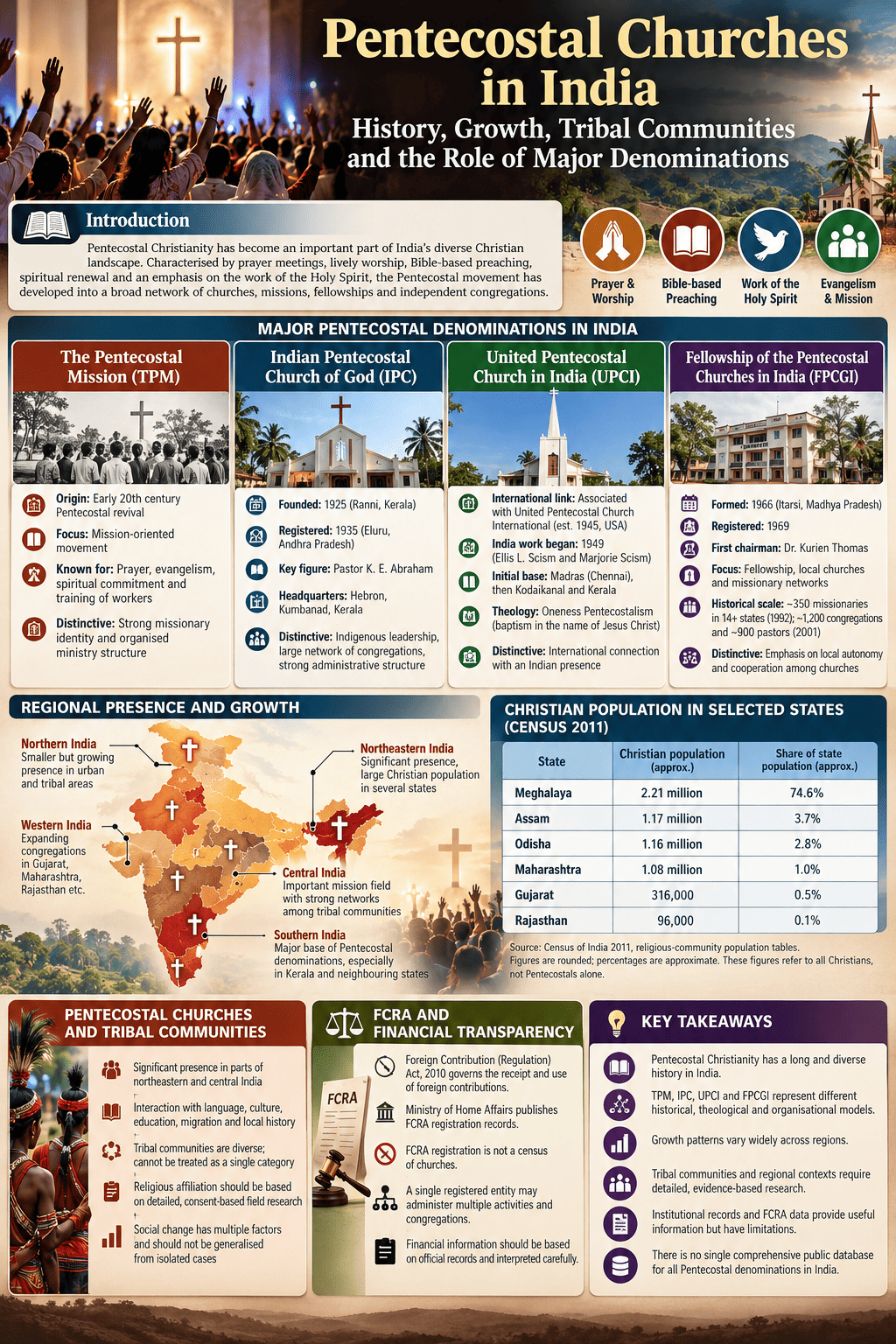
Pentecostal Christianity has become an important part of India’s diverse Christian landscape. Characterised by prayer meetings, lively worship, Bible-based preaching, spiritual renewal and an emphasis on the work of the Holy Spirit, the Pentecostal movement has developed into a broad network of churches, missions, fellowships and independent congregations. Its growth has been particularly significant in parts of southern India, central India and the northeastern states, while congregations and missionary activities are also present in western and northern India. Unlike some historic Christian denominations with a centralised institutional structure, Pentecostal Christianity comprises numerous organisations with different leadership systems, theological interpretations and administrative arrangements. Some denominations operate through national councils and regional bodies, while others emphasise missionary networks or the autonomy of local congregations. Understanding these differences is essential when studying Pentecostal churches, their membership, their geographical distribution and their social influence. Four organisations of particular interest are The Pentecostal Mission (TPM), the Indian Pentecostal Church of God (IPC), the United Pentecostal Church in India (UPCI), and the Fellowship of the Pentecostal Churches in India (FPCGI). Their histories illustrate the development of indigenous Christian leadership, missionary expansion, theological diversity and institutional organisation within Indian Pentecostalism.
The Pentecostal Mission (TPM): A Mission-Centred Pentecostal Movement
The Pentecostal Mission, widely known as TPM, represents an important missionary tradition within global and Indian Pentecostal Christianity. Its historical development is associated with the early twentieth-century Pentecostal revival and the establishment of a disciplined, mission-oriented religious community. The movement became known for its emphasis on prayer, evangelism, spiritual commitment, community worship and the training of workers for missionary service. TPM is distinguished by its strong missionary identity and organised ministry structure. Its religious activities commonly include congregational worship, prayer meetings, Bible teaching, conventions and evangelistic programmes. The organisation has also been associated with a disciplined approach to religious service and the dedication of its workers to ministry. These features distinguish its institutional culture from that of Pentecostal bodies whose local congregations enjoy comparatively greater administrative independence. The missionary model is significant for understanding how Pentecostal Christianity expanded beyond its original centres. Mission workers, local congregations and networks of believers can establish continuing religious communities in different linguistic and cultural settings. In India, this process must be understood in relation to migration, urbanisation, regional languages and the social relationships that connect congregations with local communities. TPM should not, however, be treated as representative of every Pentecostal denomination. Its institutional traditions and practices are specific to its own religious organisation. Claims about its present membership, number of congregations, state-wise distribution or financial resources should be based on current organisational records rather than estimates derived from the wider Pentecostal population. For a comprehensive study, TPM can be examined through its historical development, missionary organisation, local church networks, leadership and training systems, and engagement with communities. These dimensions help explain how mission-centred religious institutions sustain their activities across geographical boundaries.
Indian Pentecostal Church of God (IPC): Indigenous Leadership and Institutional Expansion
The Indian Pentecostal Church of God, commonly known as IPC, is one of the prominent indigenous Pentecostal denominations in India. Its development is closely associated with the Pentecostal revival that took place in Kerala during the early twentieth century. The movement brought together preachers, prayer fellowships and congregations that emphasised the baptism of the Holy Spirit, spiritual gifts, evangelism and the authority of the Bible. Pastor K. E. Abraham was a major figure in the formation of IPC. A united Pentecostal convention was held at Ranni, Kerala, in April 1925. The organisation subsequently developed a more formal administrative structure and was registered as a religious society in 1935 at Eluru, in present-day Andhra Pradesh, with Apostle P. M. Samuel serving as its first president. Its administrative headquarters is at Hebron, Kumbanad, Kerala. These historical milestones are described in the organisation’s published history. One important characteristic of IPC is its indigenous institutional development. Although the wider Pentecostal movement has international historical connections, IPC emerged through Indian religious leaders and local congregations. It subsequently developed churches in different parts of India and among Indian communities overseas. The organisation’s structure includes local congregations and wider administrative bodies, including general and regional or state-level arrangements. This structure provides a framework for coordination, leadership, conventions and the development of religious activities. IPC’s official materials describe a substantial network of congregations in India and abroad, although published totals vary across pages and should not be interpreted as a single independently verified current count. IPC is also relevant to the study of religious identity and regional culture. Its development in Kerala demonstrates how Pentecostal Christianity became established within an existing Christian environment while developing distinctive forms of worship and religious organisation. Its expansion beyond Kerala provides a basis for studying the relationship between indigenous leadership, migration, language and religious networks. A balanced study of IPC should examine both its religious organisation and its social context. Relevant subjects include the training of pastors, local congregation management, community activities, education, charitable initiatives and the experiences of members. Such an approach provides a more complete understanding than relying solely on church counts or claims of religious growth.
United Pentecostal Church in India (UPCI): An International Connection with an Indian Presence
The United Pentecostal Church in India, commonly referred to as UPCI, is associated with the wider United Pentecostal Church International, an international Pentecostal organisation established in 1945 through the merger of two Pentecostal bodies in the United States. The international organisation follows a distinctive theological tradition commonly described as Oneness Pentecostalism. The Indian organisation’s published history records that missionaries Ellis L. Scism and Marjorie Scism arrived in India in 1949. They initially worked in Madras, now Chennai, before moving to Kodaikanal and subsequently establishing their work in Kerala. The Indian ministry developed within the broader international Pentecostal network. An important theological distinction is UPCI’s emphasis on the oneness of God and baptism in the name of Jesus Christ. These teachings distinguish it from many other Pentecostal denominations that follow Trinitarian formulations of Christian doctrine. Although Pentecostal churches may share an emphasis on the Holy Spirit, prayer, evangelism and spiritual gifts, their theological beliefs and baptismal practices are not necessarily identical.
This distinction matters when preparing a classification of Pentecostal churches in India. Grouping all Pentecostal organisations under one religious label without recognising their doctrinal differences can obscure important aspects of their institutional identities. UPCI should therefore be studied within the specific history and theological framework of its own movement. The organisation’s Indian presence can be examined through its congregations, ministry workers, leadership arrangements, worship practices and missionary activities. Its international connections also provide an opportunity to study the movement of religious ideas, personnel and organisational models across national boundaries. Nevertheless, international membership figures should not be presented as Indian membership figures. Likewise, the number of congregations reported by a national organisation should be distinguished from its total international network. Reliable assessment requires current, clearly dated information specific to India.
Fellowship of the Pentecostal Churches in India (FPCGI): Fellowship, Local Churches and Missionary Networks
The Fellowship of the Pentecostal Churches in India, also referred to in historical accounts as the Fellowship of the Pentecostal Churches of God in India, is associated with the development of Pentecostal congregations in central and northern India. Its historical background reflects the need for cooperation among Christian workers and churches operating across geographically dispersed areas. Historical accounts record that the fellowship was formed at the 1966 annual convention of the Pentecostal Church at Itarsi, Madhya Pradesh. Its formation was associated with workers connected with Central India Theological Seminary who sought closer fellowship and coordination. The organisation was registered in 1969. Dr. Kurien Thomas was its first elected chairman, according to these historical accounts. Itarsi subsequently became an important centre for the fellowship and its associated theological training activities. The fellowship’s stated objectives included spreading the Christian message, establishing independent churches and encouraging cooperation among congregations and ministers. Historical descriptions also emphasised the freedom of local churches from excessive central control. This emphasis on fellowship and local autonomy provides an important contrast with denominations that have more centralised administrative systems.
The historical record indicates that FPCGI had developed a wide network by the late twentieth century. A published account cited in the organisation’s historical literature reported approximately 350 missionaries working in more than 14 states by 1992. Another historical figure reported around 1,200 congregations and approximately 900 pastors by 2001. These are historical figures, not verified current totals, and should not be used to describe the organisation’s present size without updated confirmation. FPCGI is particularly relevant to research on Pentecostal expansion in central India and surrounding regions. Its development illustrates the role of theological education, missionary training, local leadership and cooperation between congregations in sustaining a religious network across different states. Research into FPCGI could investigate how local congregations are organised, how ministers are trained, how communities participate in church activities and how the fellowship responds to regional languages and social conditions. Its history also raises broader questions about the balance between local autonomy and institutional coordination in religious organisations.
Pentecostal Christianity and India’s Population Patterns
The expansion of Pentecostal churches must be considered against the wider distribution of Christianity in India. The Census of India 2011 remains a key official source for historical religious-population comparisons. It records Christians as a share of the population in different states, but it does not provide a comprehensive separate count for members of TPM, IPC, UPCI, FPCGI or other individual Pentecostal denominations.
The following figures illustrate the regional diversity of the Christian population. They refer to all Christians, not Pentecostals alone.
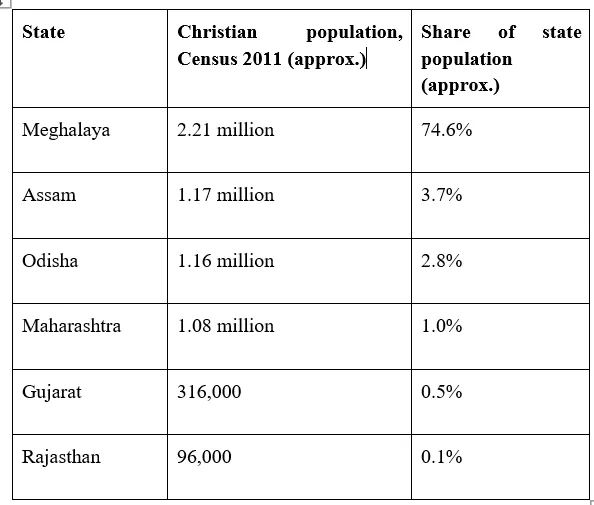
Source: Census of India 2011, religious-community population tables. Figures are rounded; percentages are approximate.
These figures demonstrate why the distribution of Christians cannot be explained by a single national pattern. In Meghalaya, Christians form a large majority of the population, while in Gujarat and Rajasthan they constitute a much smaller share. Assam, Odisha and Maharashtra present different regional and historical contexts. However, these state-level figures cannot establish the number of Pentecostal congregations or believers in any particular city or district. A Christian population count does not identify the denomination of each person, and the number of churches does not directly establish the number of active members. A reliable Pentecostal population study would need to combine official demographic data with denominational records, verified church directories and carefully designed field surveys.
Pentecostal Churches, Tribal Communities and Regional Society
The relationship between Pentecostal Christianity and tribal communities is an important subject for regional research. In parts of northeastern and central India, religious identity interacts with language, customary practices, education, migration, community institutions and local histories. The nature of these relationships differs significantly from one region to another. Research involving tribal communities must avoid treating all tribal groups as a single social or religious category. Tribal populations are internally diverse, and their religious affiliations, cultural practices and historical experiences vary by community and location. The presence of Pentecostal congregations in a region does not, by itself, establish the religious affiliation of an entire tribal population. In Gujarat, studies of Christian and Pentecostal communities should be grounded in district-level evidence. Researchers may investigate congregations, community networks, religious institutions, migration, education and charitable activities while documenting the diversity of local experiences. Where Bhil communities or other tribal populations are included, their identities and religious affiliations should be recorded through appropriate, consent-based fieldwork rather than inferred from broad regional descriptions. Such research should also distinguish between observed social change and assumptions about its causes. Changes in religious affiliation may involve multiple factors, including family histories, personal beliefs, social networks and mobility. Claims about the scale or effects of religious change require credible evidence and should not be generalised from isolated cases.
Institutional Records, FCRA and Financial Transparency
The growth of religious organisations also raises questions about institutional accountability and financial transparency. Publicly available registration records, annual reports and organisational documents can help researchers understand the legal and administrative arrangements under which churches and religious associations operate. The Foreign Contribution (Regulation) Act, 2010, and associated rules govern the receipt and use of foreign contributions by covered organisations. The Ministry of Home Affairs publishes information on FCRA registration and related matters. These records can provide information about particular legal entities where applicable, but they should be interpreted carefully.
An FCRA registration is not a census of churches. A religious organisation may operate through several local congregations, while a single registered legal entity may administer multiple activities. Some congregations may have separate legal registrations, and others may operate under a wider organisation. Consequently, the number of FCRA-registered entities cannot be treated as the total number of churches or Pentecostal believers. It is also essential to distinguish between a denomination, a registered society or trust, a local congregation and an organisation receiving foreign contributions. These categories may overlap, but they are not interchangeable. Any assessment of church finances should rely on the appropriate official records and should not imply wrongdoing merely because an organisation receives or is eligible to receive foreign contributions. A transparent study would document the source and date of each record, verify the legal name of the organisation, avoid double-counting affiliated congregations and distinguish confirmed information from estimates. The same principles should apply to all religious organisations.
The Need for Reliable Denominational Data
One of the major challenges in studying Pentecostal Christianity in India is the absence of a single comprehensive public database that identifies every Pentecostal denomination, local congregation and active member. Church directories and organisational websites can provide valuable starting points, but their coverage, definitions and reporting dates differ. For TPM, IPC, UPCI and FPCGI, a rigorous comparative study would ideally establish each organisation’s official name, historical background, administrative headquarters, current leadership structure, state-level presence, verified local congregation count and reporting date. It should also record whether the information comes from an official organisational source, a government document, an academic publication or a secondary historical account. This distinction is especially important when reporting numerical claims. Historical church counts cannot automatically be presented as current totals, and international figures must not be substituted for Indian figures. Likewise, population data for Christians as a whole should not be used to calculate Pentecostal membership without an appropriate, evidence-based method.
Conclusion
The Pentecostal Mission represents a mission-centred tradition; the Indian Pentecostal Church of God illustrates the development of indigenous Pentecostal leadership and a broad denominational network; the United Pentecostal Church in India reflects international connections alongside a distinctive theological identity; and the Fellowship of the Pentecostal Churches in India demonstrates the importance of fellowship, local congregations and missionary training in central and northern India.Together, these organisations provide useful case studies for understanding the history and organisation of Pentecostal Christianity in India and chagne the social-religious dimensions of India. Their development also demonstrates why research must distinguish between denominations, legal entities, congregations and individual believers.
Selected Sources and Further Reading
Census of India. (2011). Census tables on population by religious community. Office of the Registrar General and Census Commissioner, India.
Indian Pentecostal Church of God. Our History. Official website.
United Pentecostal Church in India. About Us. Official website.
United Pentecostal Church International. About the UPCI. Official website.
Lukose, W. (2009). A contextual missiology of the Spirit: A study of Pentecostalism in Rajasthan, India (doctoral thesis). University of Birmingham.
Ministry of Home Affairs, Government of India. Foreign Contribution (Regulation) Act and FCRA services. Official website.
Fellowship of the Pentecostal Churches in India. Historical information is also summarised in the available secondary overview; historical figures cited in the article should be independently verified before publication.


Comments
Add new comment