Body
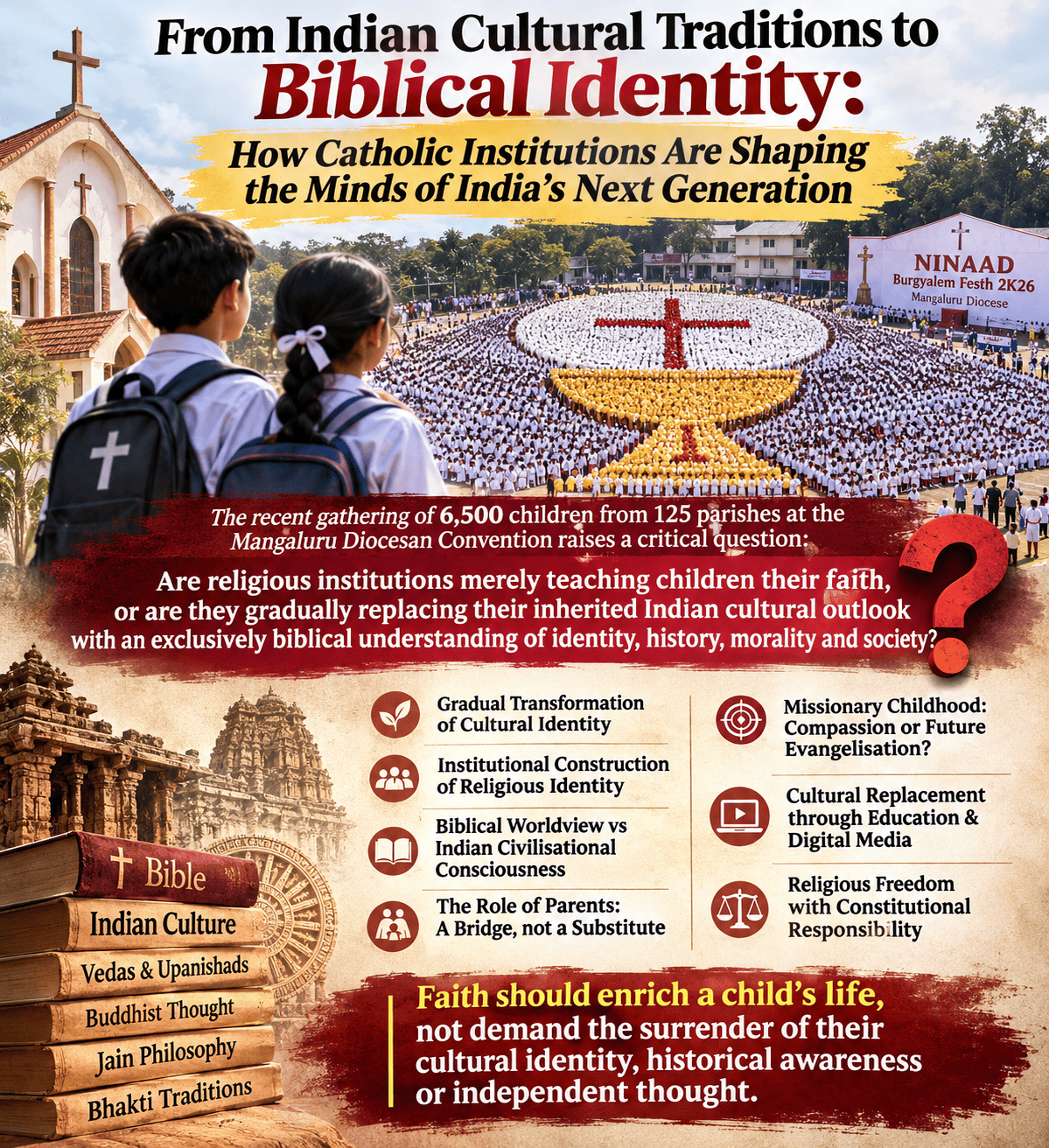
The recent gathering of 6,500 children from 125 parishes at the Mangaluru Diocesan Convention, organised at St Joseph Engineering College, Vamanjoor, on 8 November 2026, raises an important question about this transformation: Are religious institutions merely teaching children their faith, or are they gradually replacing their inherited Indian cultural outlook with an exclusively biblical understanding of identity, history, morality and society?
The convention, titled NINAAD – Burgyalem Festh 2K26, was organised under the diocesan initiative 'Year of Children 2026', with the theme 'Our Children, Fruits of God's Kingdom'. Its most striking attraction was the formation of a gigantic human representation of the Eucharistic Host, Chalice and Cross by approximately 6,500 children. The Catholic Diocese presented the event as a celebration of faith, unity and childhood spirituality. However, its wider institutional significance deserves critical examination, particularly regarding the relationship between religious education, Indian cultural heritage and the development of independent thinking among children.
1. The gradual transformation of cultural identity
The central issue is not that Catholic children are learning Christianity. Every religious community has the right to educate its children in its traditions. The deeper question concerns what happens when religious education becomes the dominant framework through which children interpret their entire cultural and historical environment. India's cultural identity is not based on one religious text, one theological authority or one historical narrative. It includes the Vedas, Upanishads, Buddhist and Jain philosophical traditions, Bhakti and Sufi movements, tribal knowledge systems, regional literature, folk traditions and countless local practices.
These traditions have developed through centuries of interaction between communities.
When children are repeatedly exposed to a religious framework that presents biblical history, biblical morality and biblical civilisation as the primary or exclusive sources of truth, there is a possibility that their understanding of their inherited cultural environment may gradually change. The concern is not biblical education itself. It is the possibility that children may grow up viewing their indigenous cultural traditions as inferior, irrelevant, spiritually inadequate or incompatible with their religious identity. This possibility deserves serious discussion, although the Mangaluru convention report alone does not establish that such cultural displacement occurred.
2. 6,500 children and the institutional construction of religious identity
The scale of NINAAD 2K26 is significant. Bringing together thousands of children from 125 parishes required coordination across the diocesan administrative and religious structures. The programme involved several commissions, including Family Life, Education, Catechetics, Bible, Youth, Missionary Childhood, Social Communication, Vocation and Formation, and Proclamation and Evangelisation. This institutional arrangement demonstrates that the event was connected to a broader system of Catholic religious formation. Children were exposed to biblical tableaux depicting the history of salvation from Creation to Pentecost, religious processions, patron saints, Eucharistic symbolism, music, prayer and faith-sharing activities.
These activities help establish a common religious vocabulary and collective identity.
However, a larger question arises: how much space is provided within these programmes for understanding India's own philosophical and cultural traditions?
Does religious education encourage children to appreciate India's civilisational diversity? Are they taught to understand the historical contributions of different religious communities? Can they discuss indigenous practices without being made to feel that their cultural inheritance is somehow incompatible with Christianity?
A genuinely inclusive religious education should not require children to disconnect themselves from the cultural history of the society in which they live.
3. Biblical worldview versus Indian civilisational consciousness
One important difference between religious instruction and cultural transformation lies in the worldview through which children are taught to understand society. Biblical theology has its own distinctive concepts of creation, salvation, sin, redemption, worship and religious community. Indian philosophical traditions have developed diverse understandings of existence, consciousness, duty, liberation, ethics and the relationship between human beings and nature.
These traditions are not identical, and they should not be artificially presented as interchangeable.
The problem emerges when one worldview is presented as the only legitimate intellectual or spiritual framework.
For example, children should be able to understand the philosophical significance of the Upanishads, the ethical teachings of Buddhism, Jain ahimsa, the Bhakti traditions, tribal relationships with nature and India's regional cultural histories, even when their own family follows Christianity.
A Christian child can learn about Indian civilisation without compromising Christian beliefs. Similarly, a Hindu, Muslim, Buddhist or Jain child can understand Christianity without abandoning their own religious identity. The danger lies in replacing education with cultural isolation.
4. Parents: The bridge between Indian culture and religious institutions
The convention also included discussions on family responsibility, childhood development and faith formation. Parents are naturally the first educators of children. They transmit language, family history, customs, food traditions, festivals, social values and religious practices. However, when religious institutions become the primary authorities on children's moral and cultural development, families may gradually depend on institutional interpretations of history, spirituality and social behaviour. This raises an important question: Are parents being encouraged to develop children who are simultaneously rooted in their family and Indian cultural heritage, or is the emphasis primarily on producing committed members of a particular religious institution?
Parents should not have to choose between religious faith and cultural belonging.
A Christian family in Mangaluru can celebrate its religious traditions while retaining its connection with Kannada literature, Tulu culture, local festivals, regional history, traditional arts, community relationships and India's wider civilisational heritage.
Religious identity should enrich family life rather than erase its cultural dimensions.
5. Missionary Childhood: Preparing the next generation for institutional mission?
The participation of the Missionary Childhood Commission and Proclamation and Evangelisation Commission deserves particular attention. The Catholic Church has a long-established international missionary framework. Its Pontifical Society of the Holy Childhood, also known as Missionary Childhood, encourages children to develop a missionary spirit through prayer, solidarity and assistance to children around the world.
Such programmes are presented as expressions of Christian responsibility and service.
Nevertheless, the inclusion of missionary and evangelisation structures in children's activities raises questions about the long-term objectives of religious formation.
Are children being taught primarily to become responsible citizens who serve people irrespective of religious identity? Or are they also being prepared to participate in the future expansion of their religious institution?
There is a difference between developing compassion for humanity and cultivating an institutional expectation that children should eventually become religious ambassadors.
Children should be encouraged to serve everyone without discrimination. Their moral worth should never be measured by their willingness or ability to spread a particular religion.
6. Cultural replacement through education, communication and digital media
The Mangaluru convention also demonstrates how religious organisations are adapting their communication strategies.
The theme song, musical performances, social communication activities, Instagram Reel competition and drone-recorded human formation indicate the importance of contemporary media in religious mobilisation.
Modern religious communication does not depend exclusively on churches, sermons or printed literature. It operates through smartphones, short videos, online communities, digital educational material and organised social media campaigns.
This development is particularly significant for children and adolescents.
Digital platforms can repeatedly reinforce particular religious symbols, narratives, heroes, moral interpretations and historical perspectives. Over time, these messages can become central to how young people understand their identities.
The same mechanism operates across all religious communities.
The appropriate question is whether children are developing the ability to distinguish religious belief from historical fact, theological interpretation from scientific explanation, and cultural difference from moral inferiority.
Religious organisations should encourage digital literacy rather than creating closed information environments in which children encounter only one interpretation of society.
7. Is Indian culture being presented as something that must be replaced?
This is perhaps the most sensitive question.
Historically, some missionary movements associated indigenous religious practices with superstition, darkness or spiritual ignorance. Such attitudes contributed to cultural conflicts in different parts of colonial India.
At the same time, Christian communities have also contributed significantly to Indian languages, education, literature, healthcare, music and social reform.
It would therefore be inaccurate to portray every Christian institution as an enemy of Indian culture.
The concern is about the ideological approach adopted by particular religious programmes.
If Indian traditions are presented as obstacles to spiritual progress, if local cultural practices are discouraged merely because they are not biblical, or if children are taught that their inherited civilisation has no meaningful spiritual or ethical value, the result can be cultural alienation.
A child should not have to reject Indian heritage to establish Christian identity.
Nor should Christianity be treated as something foreign to Indian society. Indian Christianity has its own history, regional expressions, literature, architecture, music and cultural traditions.
The real challenge is to develop an Indian Christian identity that respects both religious conviction and the country's pluralistic cultural heritage.
8. The constitutional responsibility: Religious freedom without cultural coercion
India's Constitution protects freedom of conscience and the right to profess, practise and propagate religion under Article 25.
This protection applies to Christians and all other religious communities.
However, religious freedom must coexist with children's dignity, educational development and freedom of conscience.
Parents have a legitimate role in introducing children to their religious traditions. Religious institutions can teach biblical texts, organise Eucharistic celebrations, conduct catechism classes and establish faith-based educational programmes.
But children should also be encouraged to understand constitutional values, scientific thinking, India's cultural diversity and the historical contributions of different communities.
The objective should not be to prevent religious education. It should be to prevent religious education from becoming a mechanism for cultural contempt, intellectual dependency or coercive conformity.
9. The larger question for Indian society
The Mangaluru convention is one example of the organised way in which religious institutions invest in the next generation.
The same critical examination should apply to every religious organisation that mobilises children around a particular ideological or theological identity.
Hindu organisations, Christian denominations, Islamic institutions, Buddhist organisations and others all have responsibilities towards the intellectual and emotional development of young people.
The question should always be whether children are being taught to respect humanity beyond religious boundaries.
India's future cannot be built by producing generations that view one another through competing religious narratives. It must be built through education, cultural confidence, constitutional morality and mutual respect.
Conclusion: Faith should not require cultural surrender
The gathering of 6,500 children at Mangaluru was undoubtedly a remarkable display of Catholic organisational capacity. The Eucharistic formation, biblical presentations and religious activities demonstrate the importance the Diocese places on transmitting its faith to the next generation.
But the event also provides an opportunity to raise a larger question about the future of Indian cultural identity.
Can children grow up with a strong Christian faith while remaining deeply connected to India's civilisational heritage?
The answer should be yes.
The same principle applies to every religious community in India. Religious education should not demand the rejection of cultural heritage. Biblical teachings should not be used to create contempt for Indian traditions, just as Indian traditions should not be used to deny the rights of Christian communities.
Children must be allowed to inherit their faith without inheriting hostility towards other cultures.
India's cultural strength lies in its ability to accommodate differences without demanding the destruction of individual identities.
The success of a religious institution should therefore not be measured by how effectively it replaces a child's inherited cultural consciousness with an exclusive institutional worldview.
It should be measured by whether it develops individuals who are spiritually responsible, intellectually independent, culturally aware and respectful of the freedom of others.
Faith may shape a person's spiritual journey, but it should never require the surrender of cultural identity, historical awareness or independent thought.
The future of India's children must belong to the children themselves—not to religious institutions seeking to reproduce their ideologies through the next generation.
Comments
Add new comment