Body
- Damodharan ji
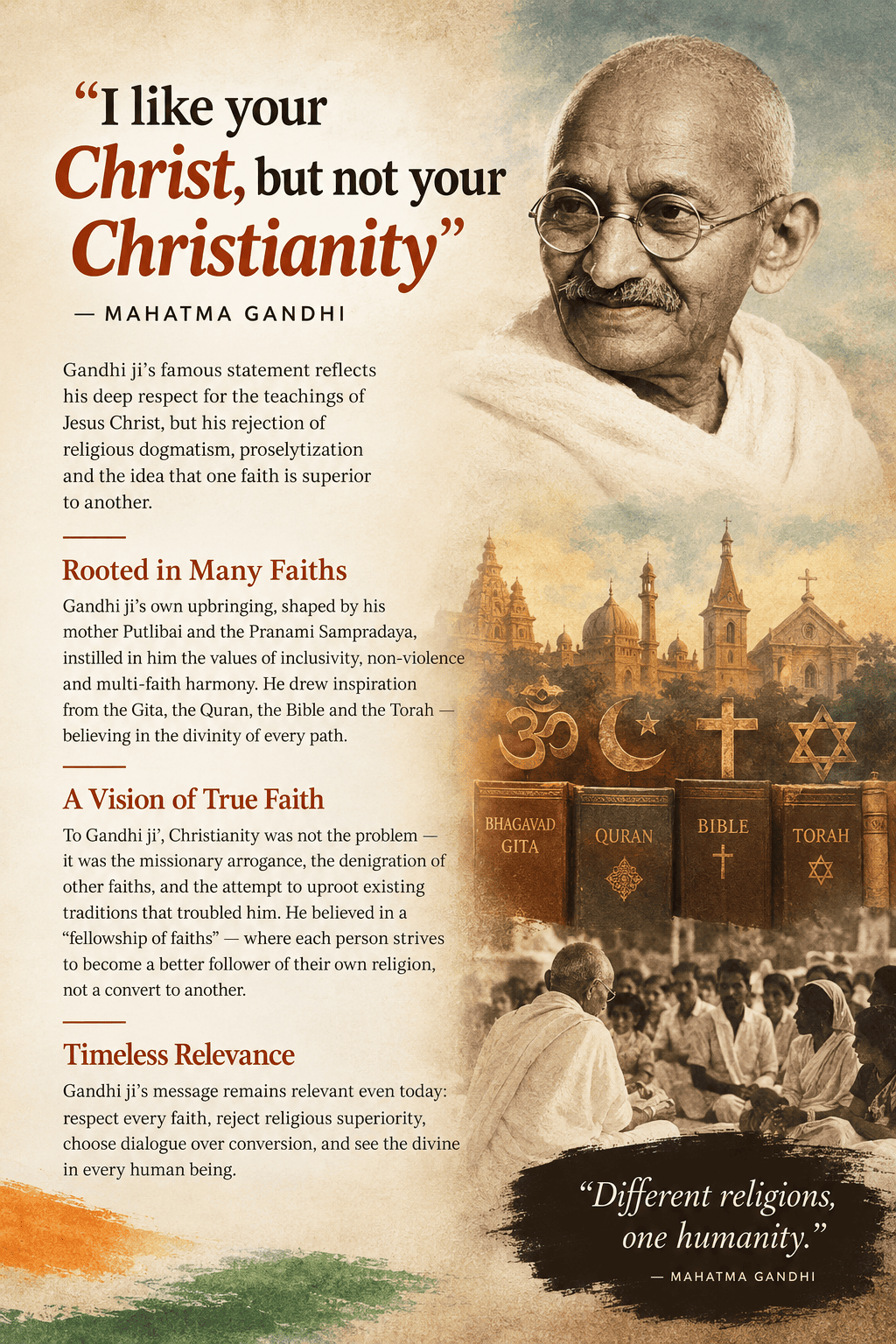
“I like your Christ, but not your Christianity”, Gandhi ji is quoted to have famously said this. This statement is profound. It will be interesting to analyse why he said this and what he meant to convey.
To begin with, it will help to know about the influences that impacted Gandhi ji’s childhood to understand his approach to other religions, particularly Christianity, when he grew up. Gandhi ji’s parents were Hindus, following the Pranami Sampradaya founded by Devchandra Maharaj in the 17th century. Devchandra Maharaj renounced the world at the age of sixteen and moved out of Umarkot in Sindh to settle down in Jamnagar, Guajarat. He established a sect called Nijanand Sampradaya and preached divine knowledge called Tartam. No Murti (idol) was installed in Pranami temples for worship. His doctrine saw divinity in every path and encouraged Hindu-Muslim understanding. His prominent disciple was Mahamati Prannathji who compiled the Sect’s scripture called Kuljam Swaroop, incorporating verses from the Vedas, Bhagavad Gita, Quran, Bible and Torah.
Gandhiji’s religious and spiritual views were influenced in his childhood by his pious mother Putlibai. She offered prayers in Hindu temples and also fasted as the Jains did. In the Pranami temples, she would listen to the priest reciting from both the Gita and the Quran. The influence of his mother and the Pranami sect probably guided Gandhi ji in later years in his non-violence (Ahimsa) movement, protest fasts (Satyagraha) and multi-faith prayers. While this grooming caused his firm practice of inclusivity, even at a cost, it also led him to question and test any doctrine or scripture, whether it is the Gita, the Quran, the Bible or the Torah, and get convinced before accepting the truth in them. With this backdrop, Gandhiji’s first brush with Christianity can be well understood. He wrote about his early impression of Christian missionaries as under (in his Autobiography, 1948): "In those days, the Christian missionaries used to stand in a corner near a high school and so forth, pouring abuse on Hindus and their Gods. I could not endure this. I heard of a well-known Hindu having been converted to Christianity. It was the talk of the town that, when he was baptised, he had to eat beef and drink liquor, that he also had to change his clothes, and that thenceforth he began to go about in European clothing including a hat. These things got on my nerves. Surely, thought I, a religion that compelled one to eat beef, drink liquor, and change one's own clothes did not deserve the name. I also heard that the new convert had already begun abusing the religion of his ancestors, their customs and their country. All these things created in me a dislike for Christianity”.
Gandhi ji wrote about the missionary work, in response to an appeal by the Church Missionary Society of England, as under (Harijan 13 (03): 37): "My fear is that though Christian friends nowadays do not say or admit that Hindu religion is untrue, they must harbour in their breasts the belief that Hinduism is an error and that Christianity, as they believe it, is the only true religion ……. But, so far as one can understand the present effort, it is to uproot Hinduism from the very foundation and replace it by another faith. It is like an attempt to destroy a house which though badly in want of repair appears to the dweller quite decent and habitable…... If the Christian world entertains that opinion of the Hindu House, 'Parliament of Religions' and 'International Fellowships' are empty phrases, for both the terms presuppose equality of status, a common platform. There cannot be a common platform as between superiors and inferiors”.
His expectation of a Fellowship of Faiths was ‘it should be to help a Hindu to become a better Hindu, a Mussalman to become a better Mussalman, and a Christian a better Christian. The attitude of patronizing tolerance is false to the spirit of International Fellowship. …. Our prayer for others must be NOT 'God, give him the light that thou have given me' BUT 'give him all the light and truth he needs for his highest development. Pray merely that your friends become better men, whatever their form of religion" (Sabarmati 1928). He further noted (in his Autobiography, 1948), "So long as there are different religions, every one of them may need some outward distinctive symbol. But when the symbol is made into a fetish and an instrument of proving the superiority of one's religion over the other, it is fit only to be discarded".
Gandhiji was critical about proselytization and he said, "(they) may change the lives of as many as they like but not their religion. They can draw their attention to the best in their respective religions and change their lives by asking them to live according to them" (Young India 23 (09): 26). The essence of his ideas on religion was reflective of the essence of Hinduism thus: "After long study and experience, I have come to the conclusion that (1) all religions are true (2) all religions have some errors in them and (3) all religions are almost as dear to me as my own Hinduism, in as much as all human beings should be as dear to me as one's own close relatives. My own veneration for other faiths is the same as that for my own faith" (Sabarmati 1928).
Gandhi ji firmly rejected the superiority of one religion over others, particularly in the context of Christianity. He held that all religions are fundamentally equal and all faiths are divine ways to salvation leading the believer to the same destination, while taking different roads. When all the paths lead to the same destination, he believed that these paths cannot be false. He saw a common inspirational thread in all the scriptures but also accepted that not every word in a scripture is God given. This led him to hold to his view that there is no need to force and convert people from their religion as the truth in another religion, if found any, can be followed by anyone, continuing to be in their own religion also. For example, Gandhi ji was greatly influenced by the Sermon on the Mount so much so that he incorporated those virtues in his practice, without becoming a Christian. At the same time, Gandhi ji also believed that the Sermon on the Mount was only an affirmation of the truths espoused by Hinduism like Ahimsa, peaceful co-existence and service. Gandhi ji’s advice to the believers of Christianity was to follow the preachings of Jesus Christ in letter and spirit. He wanted the Christians to follow Christ in the way of the cross, unconditional love, and humble service. Gandhi ji was very outspoken, critical and even held a negative opinion on the missionary activities of the Christians. He disapproved the missionaries for their imperialistic triumphalism, vain feeling of superiority and arrogant outlook towards other religions. God may reveal the truth to mankind in many ways and what should really matter to the Christians is to follow the humility and service to the needy that Jesus preached, without converting non-Christians.
Gandhi ji’s approach towards the Bible was one of earnestness, like any devout Christian. He started to study the Bible during his days in London and South Africa and continued to do so throughout his life. However, he was repulsed by the Old Testament and differed with the Mosaic Law as well as the letters of Paul in the New Testament. He believed that the Sermon on the Mount alone contained the message of Jesus and called himself a ‘Sermon on the Mount Christian’. The Sermon’s teaching of ‘love thy enemy’ and "whosoever shall smite thee on thy right cheek, turn to him the Other also" served to stimulate the founding ideas he learnt from his mother and the Pranami Sampradhaya in his childhood.
The blue-print for Gandhi ji’s Ahimsa was the Sermon which ordained non-violence, non-retaliation and non-resistance to the evil and further doing good as a response. This was in total divergence from what the law of Moses had to say in the Old Testament “An eye for an eye and a tooth for a tooth”. To him, if the Sermon is truly followed by the West and the Christians, no swords would be needed. Some Christian theologists contended that the Sermon on the Mount was not for ordinary people involved in mundane activities but was meant only for the first twelve disciples. Gandhi ji did not accept this and felt that the West ignored the core message of Jesus with such false interpretations to justify colonialism, violence, war, supremacy, material comforts and wants, pursued by western Christianity in practice. “I like your Christ, but not your Christianity”, Gandhi ji is quoted to have said. This is how Dr John Haynes Holmes summed up Gandhi ji’s views on Christianity in a nutshell. Dr Holmes, Professor of Philosophy at Swarthmore College and a member of the Society of Friends, had conversed with Gandhi ji many times during his visit to India and even had the honour of speaking at a meeting of the Indian National Congress. But how this quote is taken by the hardcore Christian missionaries? A sample rhetoric by a Lutheran pouring venom on Gandhi ji’s statement is an eye-opener. For them, Gandhi ji did not like ‘our’ Christ – the Biblical, historical Jesus, the God who came in the flesh to save the lost, the radically exclusive Christ who alone is the way to the Father and everlasting peace, the son of God who was immaculately conceived and who died for the sins of the world.
A Lutheran Layman argument is that Gandhi ji “spent his life fabricating a Jesus of his own invention – one who acted and behaved like he wanted him to… He picked out and lauded all the teachings that he liked and which agree with his Hinduism. There was no place in his concept of Jesus as one who came not to bring peace, but rather a sword, who came to divide and set a son against his father, and a daughter against her mother. There is no place in his worldview of Jesus as one who is revealed from heaven with his mighty angels, in flaming fire taking vengeance on those who do not know God, and on those who do not obey the gospel of our Lord Jesus Christ. Or behold, the Lord comes with ten thousand of His saints, to execute judgment on all, to convict all who are ungodly among them …”.
The Lutheran Layman continues “I do believe we need to be more like Christ, but I want to become like the real Christ, not this fabricated version of Gandhi’s imagination” and continues to urge “It’s important that we hear the message that we ought to be more Christ-like, but I’d rather take an exhortation from John or Paul or anybody who knows who the real Jesus is, than Mahatma Gandhi”. So, in a Lutheran Layman’s terms “Mahatma Gandhi did not like our Christ because he never believed in or knew who the real Jesus Christ is”. (Excerpts from ‘No, Mahatma Gandhi did not like our Christ’ published in ‘A Lutheran Layman’ dated 17.02.2014 – http://www.lutheranlayman.com)
It is not a layman’s views alone. Martin Luther King was once confronted by an American Churchman for praising Gandhi ji for following the message of love of Jesus. His reply was profound, "It is ironic yet inescapably true that the greatest Christian of the modem world was a man who never embraced Christianity ". It is ironic indeed, that the followers of Jesus Christ have wandered so far away from the chosen path shown by their Lord, so much so that Gandhi ji had to politely chastise “I like your Christ, but not your Christianity”.








Comments
Add new comment