Body
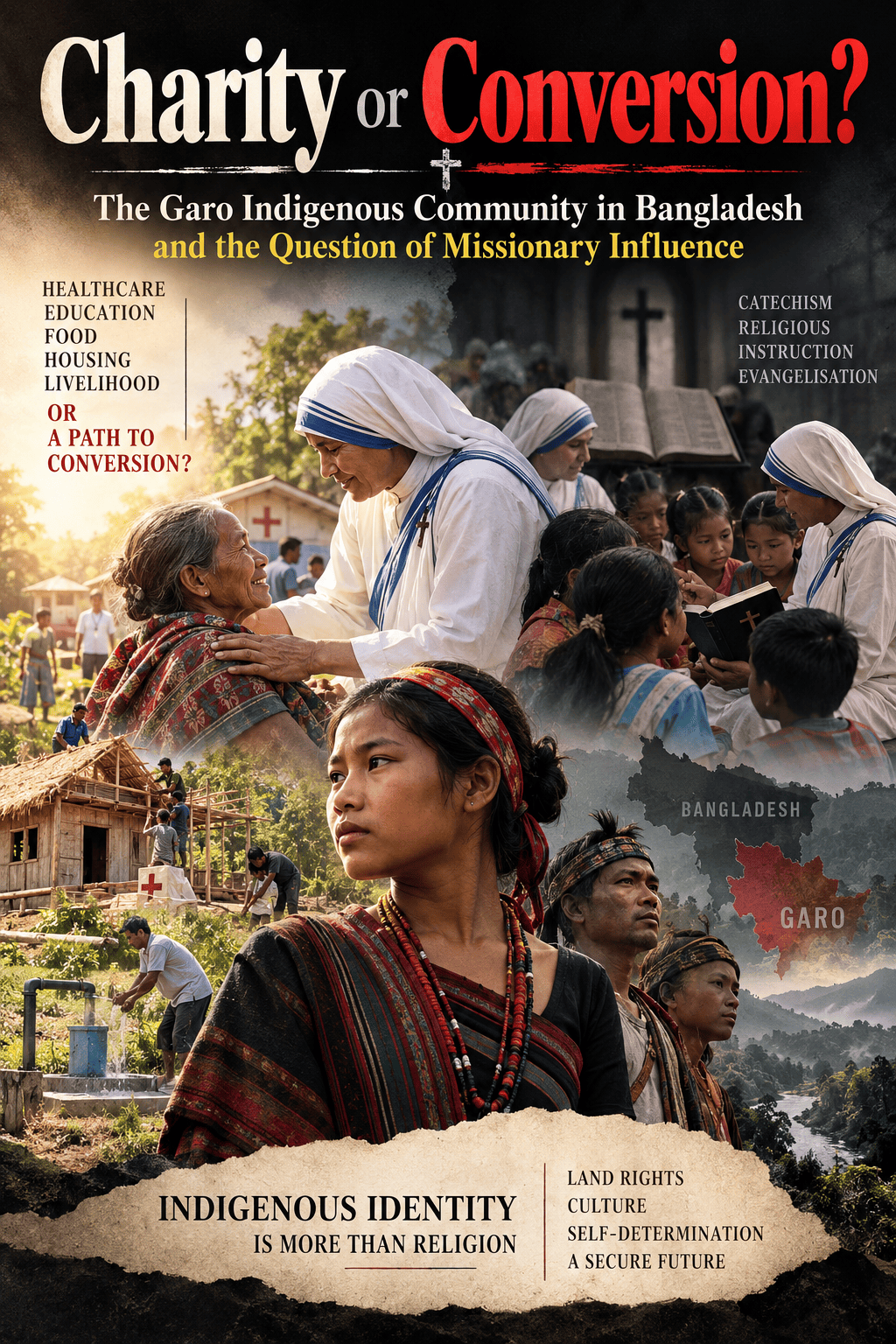
Can humanitarian assistance remain entirely separate from religious outreach when the same institution provides healthcare, education, food, housing and religious instruction? This question deserves serious public discussion in the context of the Garo Indigenous community of Bangladesh, following a recent report published by Global Sisters Report. The article, titled “Missionary of Charity nuns work for marginalized Garo Indigenous people,” describes the activities of Catholic nuns serving communities in the Madhupur forest region. It presents their work as an effort to address healthcare shortages, educational disadvantages, poverty and housing insecurity. Yet it also highlights a wider issue relevant to Indigenous conversion: the relationship between charitable assistance, religious evangelisation and the preservation of Indigenous identity.
The issue should not be reduced to an assumption that every charitable activity is a cover for conversion but after the centuries history of indigenous people social service, this become the most common modus operandi. Instead, it calls for a closer examination of whether vulnerable communities can access essential services without religious pressure but indirectly after these social & health support, obiliged indigenous people started to accept the new religion and established.
Inside the missionary welfare network
According to the Global Sisters Report article, the Missionaries of Charity operate Mary's House of Love, an 80-bed facility established in 1996 that prioritises the local Garo population. The sisters reportedly provide medication, nutritious food, referrals for advanced medical treatment and support for patients who would otherwise face the expense and difficulty of travelling long distances. Their activities extend beyond healthcare. The report describes afternoon tutoring for Garo children, food distribution, visits to remote villages and the construction or repair of at least 200 houses over more than two decades. It also mentions tube wells and household latrines intended to improve living conditions. These services address genuine social needs. However, the article also explicitly mentions the provision of catechism, or instruction in Christian doctrine, alongside welfare activities. This indicated again the missionaries harvesting the soul of indigenous community, missionaries on hunting the identity. This overlap raises an important question for independent scrutiny: how are humanitarian services and religious instruction organised in practice? Are beneficiaries free to decline religious activities without losing access to healthcare, food, education or shelter? But the history of missionaries never disappointed the world, with a large number of community conversions done by them.
Indigenous identity is more than religion
The Garo, who commonly refer to themselves as Mandi, are an Indigenous people with a distinctive language, cultural heritage, social traditions and historical connection to land. Their communities extend across Bangladesh and India's northeastern region. Christianity has become a major part of Garo religious life in India, so as Garo identity cannot be reduced to Christian affiliation. Now the other part of this community in Bangladesh, missionaries are on action mode by showing social services The community's history includes traditional religious practices, social institutions and cultural expressions that deserve recognition in their own right. Research on Garo society has examined the relationship between Christian conversion, ethnic identity, social mobility and changing cultural practices. These complex transformations become simplified by nun through social activities. Religious affiliation may provide community networks, education and a sense of solidarity, while changes in customary practices can also raise questions about cultural continuity. Garo people share the same religious preferences but under pressure and gratitute of missionary activity change the religious beliefs and practices. The central principle should be Indigenous self-determination. Garo people must be free to choose their faith, preserve their language, maintain their cultural practices and decide how their community develops.
The deeper crisis: insecurity over ancestral land
One of the most significant issues in the Global Sisters Report account is not religious conversion but land insecurity. The article cites a 2019 study by the Society for Environment and Human Development that identified 44 Garo-inhabited villages in the region. It reports that many Garo residents lack formal land titles despite customary systems of land ownership and long-standing connections to the area. Eugene Nokrek, president of the Joyenshahi Adibashi Unnayan Parishad, is quoted describing the community's precarious position and fear of losing its land. He also credits missionaries with improving living conditions, expanding educational opportunities and raising awareness of rights. This testimony complicates any simplistic account of missionary activity. For some community members, church institutions have provided valuable support in circumstances where public protection and services have been insufficient. At the same time, the underlying land question demands attention beyond the activities of any religious organisation. Healthcare, housing and education can alleviate immediate hardship, but they cannot substitute for secure land tenure, effective legal remedies and recognition of Indigenous rights. A community that remains vulnerable to displacement may continue to depend on outside institutions, whether religious, governmental or charitable. Long-term empowerment requires addressing the structural causes of that vulnerability.
Does charity become a channel for evangelisation?
The reported combination of welfare and catechism makes this a legitimate subject for public-interest journalism. But the distinction between religious outreach and coercive conversion must remain clear. Offering religious instruction is not, by itself, proof of exploitation. Nor does receiving medical treatment or educational support establish that a person has been converted against their wishes. The relevant questions are practical and verifiable. Is religious participation voluntary? Are services equally accessible regardless of belief? Can families refuse catechism without consequences? Are children and parents informed about the nature of programmes? Do local residents have meaningful influence over decisions affecting their lives? These questions should be addressed through interviews with Garo residents from different religious backgrounds, former beneficiaries, independent Indigenous-rights organisations, local officials and representatives of the missionary institution. The sisters should also be given an opportunity to explain their policies and respond to any specific, evidence-based allegations. Such scrutiny would help distinguish legitimate humanitarian work from any conduct that might undermine freedom of conscience.
Beyond religious rivalry: a demand for accountability
The Garo experience illustrates a broader challenge in the delivery of social services to marginalised Indigenous populations. When public healthcare, education and welfare systems fail to meet local needs, charitable and religious institutions can become indispensable. Their contribution may be substantial, but their influence also makes transparency and accountability important. The solution is not to deny essential services to vulnerable communities or to portray every missionary as an exploiter. It is to ensure that humanitarian assistance respects the dignity, freedom and cultural rights of every beneficiary. Governments must strengthen accessible public services, protect customary land rights and ensure that Indigenous communities can seek assistance without discrimination. Religious and charitable organisations should make their service conditions transparent, protect freedom of conscience and respect local cultural autonomy. Indigenous organisations should be supported in monitoring programmes and representing the interests of their communities.
Let the Garo people speak for themselves
The reported work of the Missionaries of Charity in Madhupur presents two realities that must be considered together: the provision of essential services to a marginalised population and the presence of explicit Christian religious instruction within the same institutional setting. The available report documents welfare activities and religious outreach. It does not, on its own, prove forced conversion, conditional charity or a coordinated campaign to exploit the Garo community. That distinction does not close the debate. It establishes the starting point for a more credible investigation. The most important question is whether Garo people can access assistance freely, exercise their religious choices without pressure, retain control over their cultural identity and secure the land on which their communities depend. Charity should expand human freedom, not create dependency. Religious belief should be a matter of conscience, not a price attached to essential services. Above all, Indigenous people must be recognised not merely as recipients of assistance or subjects of missionary activity, but as rights-bearing communities entitled to determine their own future.

Comments
Add new comment