Body
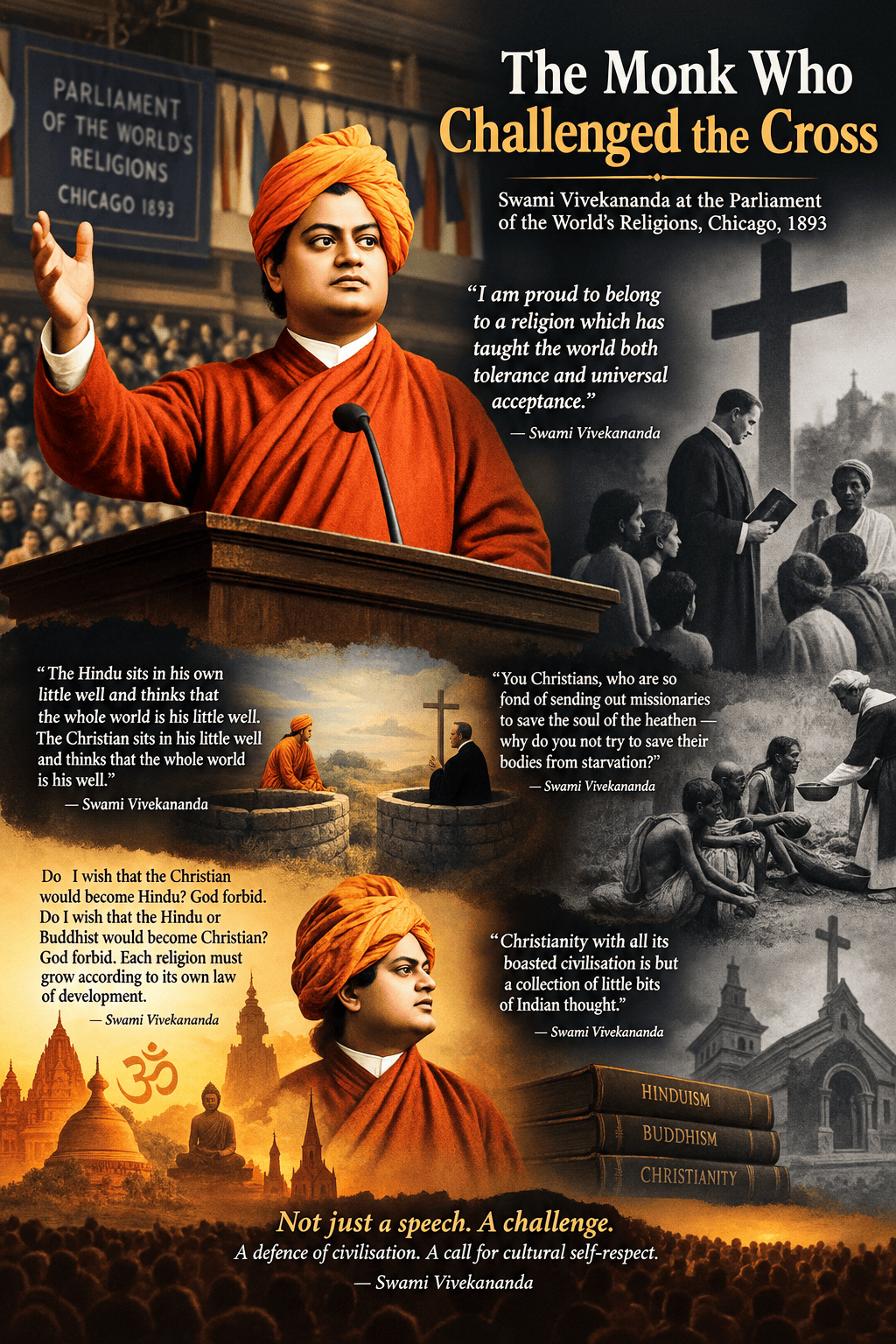
In September 1893, a saffron-robed monk from Calcutta stood before the Parliament of the World's Religions in Chicago and delivered words that would echo through history. Swami Vivekananda spoke of universal acceptance, of harmony among faiths, of a world where every religion could flourish without seeking to destroy the others. But beneath this message of unity lay a sharp critique—one aimed squarely at the missionary enterprise that had been reshaping India under the banner of Christian salvation. Vivekananda's address was not merely spiritual philosophy. It was a political statement Camouflage as religious discourse, a defence of Hindu civilisation against what he saw as cultural aggression dressed in the language of compassion. His famous words—"I am proud to belong to a religion which has taught the world both tolerance and universal acceptance"—were not just praise for Hinduism. They were an indictment of faiths that claimed exclusive truth and sought converts as a matter of divine duty.
One of Vivekananda's most memorable metaphors captured his critique with surgical precision. "The Hindu sits in his own little well and thinks that the whole world is his little well," he said. "The Christian sits in his little well and thinks that the whole world is his well." This was not an observation of equal limitations. It was a challenge to the Christian claim of universal authority. For Vivekananda, the problem was not that Christianity existed. The problem was that it insisted on being the only path, the sole truth, the exclusive vehicle of salvation. This exclusivity, he argued, was not spiritual wisdom but intellectual arrogance. It reflected a mindset that could not conceive of divinity operating outside its own boundaries—a mindset that had justified centuries of missionary activity across Asia and Africa. He made his position unmistakably clear: "Do I wish that the Christian would become Hindu? God forbid. Do I wish that the Hindu or Buddhist would become Christian? God forbid." Each religion, he insisted, must grow according to its own law of development. Conversion was not spiritual progress. It was cultural displacement masquerading as enlightenment.
Perhaps Vivekananda's most devastating criticism came when he addressed the missionary impulse directly. "You Christians, who are so fond of sending out missionaries to save the soul of the heathen—why do you not try to save their bodies from starvation?" he asked the assembled audience. "It is an insult to a starving people to offer them religion; it is an insult to a starving man to teach him metaphysics." This was not merely a theological objection. It was a moral accusation. Vivekananda saw missionaries as agents of a civilisation that had impoverished India economically while claiming to enrich it spiritually. The churches they built, the schools they established, the hospitals they operated—all of these were instruments of conversion, not genuine humanitarian service. They created dependency, undermined indigenous institutions and severed converts from their ancestral communities. He observed that most converts were those who made "a sort of living by hanging round the missionaries." Once the material support ended, so did the conversion. This was not genuine faith, he argued. It was economic coercion wrapped in religious language.
Vivekananda's relationship with Jesus Christ was complex. He admired Christ as a spiritual figure, a messenger of divine love, a man who had realised the highest truths. But he rejected the Christian doctrine built around him—the notion of Christ as the only begotten Son of God, the exclusive saviour of humanity, the final revelation of divine will. For Vivekananda, Christ was one among many messengers, not the only one. He believed Christ had preached non-dualism to his close disciples and dualism to the masses—a pattern he saw repeated across religious traditions. He rejected the significance of the crucifixion as a unique salvific event. The idea that one man's death could atone for the sins of all humanity was, in his view, philosophically incoherent and spiritually limiting. This selective admiration served a strategic purpose. By praising Christ while rejecting Christian doctrine, Vivekananda could appeal to Western audiences without conceding theological ground. He could present Hinduism as capacious enough to honour Jesus while maintaining that Christianity was incomplete, even derivative. "Christianity with all its boasted civilisation," he reportedly said, "is but a collection of little bits of Indian thought."
Vivekananda's criticism of missionaries extended beyond theology into the realm of cultural politics. He accused them of ignorance, incompetence and insensitivity. "The most of the men whom you send us as missionaries are incompetent," he declared. "I have never known of a single man who has studied Sanskrit before going to India as a missionary, and yet all our books and literature are printed in it." This was not merely a complaint about linguistic preparation. It was an accusation of cultural arrogance. Missionaries, in his view, arrived in India convinced of their own superiority, unwilling to learn from the civilisation they sought to transform. They erected churches without understanding the people they hoped to convert. They preached without listening. They condemned without comprehending.
Worse still, he argued, missionaries identified themselves with colonial interests rather than with the Indian people. Most were married and sought to advance their wives into English society, aligning themselves with British administrative priorities rather than indigenous welfare. They became, in effect, agents of empire rather than servants of God. Vivekananda positioned Hinduism not as one religion among many, but as the primordial source from which other faiths had drawn. Buddhism, he said, was a "rebel child" of Hinduism. Christianity, in his telling, was an "inconsistent imitation" of ancient Indian thought. This was not pluralism in the modern sense. It was a claim of intellectual and spiritual priority.
By framing Hinduism as the original wellspring of religious truth, Vivekananda could accommodate other faiths without conceding equality. Christianity could be honoured as a partial expression of universal principles, but it remained derivative, secondary, incomplete. This allowed him to preach harmony while maintaining Hindu supremacy. Vivekananda's Chicago speeches must be understood within their historical context. He was speaking at a moment when Hindu identity was under pressure from multiple directions—British colonial rule, Christian missionary activity, Islamic political assertion and internal reform movements. His message of Hindu pride, of civilisational confidence, of spiritual superiority was not abstract philosophy. It was a response to perceived threat. He turned the missionary critique back upon itself. If Christianity claimed to bring civilisation to India, why had British rule produced such poverty? If missionaries came to save souls, why did they ignore starving bodies? If Christ taught love, why did his followers practice cultural erasure?
These were not theological questions. They were political challenges Camouflage as spiritual inquiry. Vivekananda used the language of universalism to advance a particularist agenda—the consolidation of Hindu identity against external pressures. Vivekananda's impact on educated, upper-class Hindus was profound. He turned the tide against Christian missionary activity among the intellectual elite. After his speeches, conversion came to be seen not as progress but as betrayal, not as enlightenment but as cultural surrender. The missionaries would continue their work, but they would never again enjoy unquestioned moral authority among those who mattered most—the English-educated Indians who shaped public opinion.
His speeches at Chicago remain a touchstone for those who view religious conversion as cultural aggression. The monk who spoke of universal acceptance had, in fact, drawn a boundary. Inside that boundary stood Hindu civilisation, ancient and self-sufficient. Outside stood the missionaries, well-meaning perhaps, but ultimately destructive—a force to be resisted in the name of cultural preservation and national dignity.



Comments
Add new comment