Body
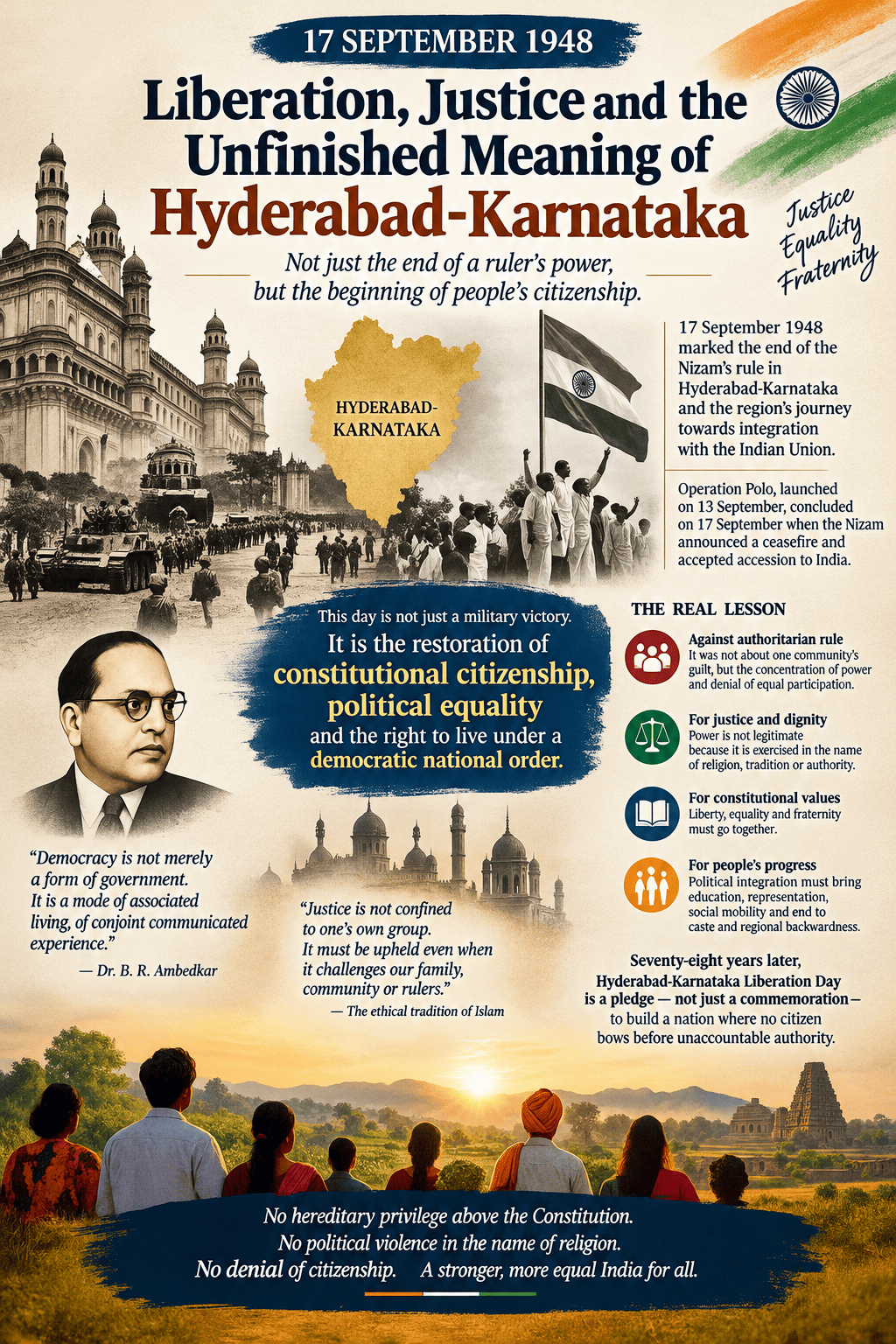
17 September 1948 is remembered across the Kalyana-Karnataka region as the day Hyderabad-Karnataka was liberated from the rule of the Nizam. On that day, the political authority of the Hyderabad State ended and the region began its journey towards integration with the Indian Union. Operation Polo, launched on 13 September, concluded on 17 September when the Nizam announced a ceasefire and accepted accession to India. Yet this date should not be reduced to a military victory or presented merely as a contest between communities. Its deeper meaning lies in the restoration of constitutional citizenship, political equality and the right of ordinary people to live under a democratic national order. To understand that meaning, one can draw intellectual guidance from two distinct but important sources: the ideas associated with Islam’s ethical tradition and the constitutional vision of Dr B. R. Ambedkar.
The history of Hyderabad was complex. The Nizam’s state was marked by a serious disconnect between the composition of the population and the structure of political power. A large majority of the population consisted of Hindus, while authority remained concentrated within a narrow ruling establishment. The Razakar militia, led by Qasim Razvi, further intensified violence and political uncertainty by defending the Nizam’s position and opposing integration with India. However, the proper lesson from this history is not that one religious community is permanently guilty or that another community is naturally entitled to rule. Such a conclusion would repeat the very injustice that history exposes. The issue was not the religious identity of every Muslim citizen. The issue was the concentration of power, the denial of equal political participation and the use of armed force against people seeking freedom.
The ethical vocabulary of Islam offers an important corrective to communal simplification. The Qur’anic call to justice, truthful witness and moral accountability cannot be confined to one’s own group. Justice must be upheld even when it challenges one’s family, community or rulers. The central principle is that power cannot become legitimate merely because it is exercised in the name of religion, tradition or authority. This distinction is crucial. Islam, like every major religious tradition, contains ethical resources that can be invoked against tyranny. But religious language can also be appropriated by political actors seeking to preserve privilege. The tragedy of Hyderabad was not that Muslims existed in public life; it was that a political order allowed a narrow elite and an armed militia to claim authority over a diverse population. The answer, therefore, was not hostility towards Muslims but opposition to coercive rule.
Dr Ambedkar’s constitutional thought sharpens this argument. For Ambedkar, democracy was not simply a method of electing governments. It required liberty, equality and fraternity. Political freedom without social equality could become an empty promise, while national unity without justice could become another form of domination. His warning against hero-worship and unchecked authority remains especially relevant when discussing the legacy of princely rule. From an Ambedkarite perspective, the liberation of Hyderabad-Karnataka should be judged by what it made possible for ordinary citizens. Did it expand their political voice? Did it challenge hereditary privilege? Did it create conditions for education, representation and social mobility? Did it bring the state closer to the principle that government derives legitimacy from the people rather than from lineage?
These questions prevent the celebration from becoming merely triumphalist. The end of the Nizam’s political rule was historically significant, but liberation could not be complete if poverty, caste oppression, illiteracy and regional backwardness continued. The people of Kalyana-Karnataka needed not only political integration but also the transformation of everyday social conditions. The region’s historical memory must therefore include multiple strands: the resistance of local people, the suffering caused by authoritarian rule, the role of Indian national integration and the contributions of citizens from different communities. A mature national narrative does not erase complexity. It identifies the central moral question: whether the state protects equal citizenship or permits power to remain the property of a few.
This is where the Islamic ethical idea of justice and Ambedkar’s constitutional philosophy meet. Both reject the sanctification of unaccountable authority. Both place moral responsibility above inherited status. Both insist, in different vocabularies, that human dignity cannot be subordinated to political power. The debate over 17 September must also resist selective memory. Those who celebrate the day should remember that national unity is strongest when it is tied to equal rights. Those who criticise the official narrative should acknowledge that the end of autocratic rule brought millions into the framework of democratic citizenship. Neither romanticising the past nor demonising an entire community helps the region understand its history. Seventy-eight years later, Hyderabad-Karnataka Liberation Day should be observed as a pledge rather than merely a commemoration: no hereditary privilege above the Constitution, no political violence in the name of religion, no denial of citizenship based on identity and no surrender of public institutions to a narrow elite. The true meaning of liberation is not simply that one ruler lost power. It is that the people acquired a greater claim over their own political future. That claim becomes meaningful only when justice, equality and fraternity reach every village, caste and community. The history of 17 September 1948 should therefore inspire not revenge, but democratic confidence—and not the politics of permanent division, but the courage to build a nation in which no citizen is expected to bow before unaccountable authority.




Comments
Add new comment