Body
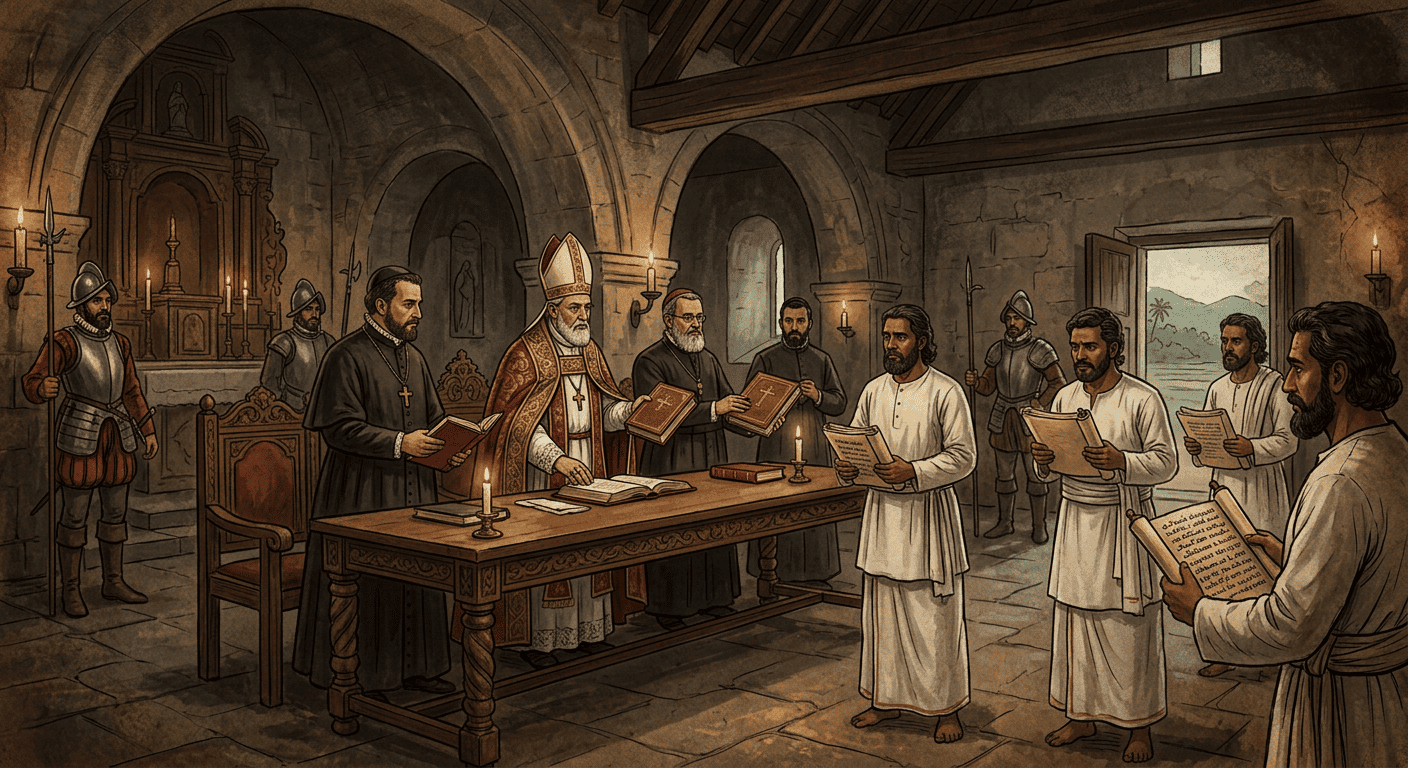
Few events in Indian history illustrate as starkly how religious authority can become a vehicle for cultural destruction as the Council of Udayamperoor (also known as Diamper), convened on 20 June 1599. Under the banner of “orthodoxy,” the Portuguese Padroado imposed a foreign ecclesiastical order on the St. Thomas Christians of Kerala, condemned their Hindu-influenced practices, and ordered the burning of their sacred texts. What began as an attempt at “reform” quickly turned into a systematic assault on a community’s identity, language, memory, and spiritual heritage.
The St. Thomas Christians, also called Nasranis, were not converts in the usual sense. According to their own tradition, they traced their origins to the apostle Thomas, who arrived in Kerala in the first century CE. Over more than a millennium, they developed a unique Christian identity that was deeply interwoven with the social and cultural fabric of Kerala. They spoke Malayalam, used Syriac in liturgy, and absorbed many local customs: they wore the mundu, participated in certain Hindu festivals, respected Brahminical codes of purity, and incorporated Hindu philosophical concepts into their theology. Their churches stood beside Hindu temples; their priests were often educated in both Christian and Hindu traditions. This syncretic identity was not seen as a compromise but as the natural expression of a faith that had taken root in Indian soil.
The arrival of the Portuguese in the late fifteenth century changed everything. The Padroado, a papal grant that gave Portugal ecclesiastical authority over its overseas territories, was less a spiritual mission than an instrument of imperial control. For the Portuguese, the Nasranis were not autonomous Christians but “schismatics” who had drifted from true orthodoxy. Their Hindu-influenced practices were branded as heresy. Their texts were suspected of containing Nestorian errors or, worse, “pagan” contamination. The real crime, however, was not theological imprecision but cultural independence: the Nasranis refused to be Europeanized, and that refusal was intolerable to an empire that equated loyalty to Christ with loyalty to Portugal.
The Council of Udayamperoor was the turning point. Convened by Archbishop Aleixo de Menezes, the council issued a torrent of decrees designed to erase the distinct identity of the St. Thomas Christians. Hindu practices were condemned outright: the use of the tilak, participation in temple festivals, observance of Hindu dietary restrictions, and even certain marriage customs were declared sinful. Christian priests were forbidden from using Hindu philosophical terms. The council ordered the destruction of all books that did not conform to the Roman rite. What followed was a systematic bonfire of Nasrani texts—manuscripts in Syriac, Malayalam, and a hybrid language that expressed a uniquely Indian Christianity. These were not merely “books”; they were the living memory of a community, containing liturgies, prayers, hagiographies, and theological reflections that had been cultivated over centuries.
The burning of these texts was more than loss of literature; it was loss of identity. When a community’s sacred writings are destroyed, its connection to its ancestors is severed. Language begins to fade, rituals lose their meaning, and the sense of continuity collapses. The Nasranis were forced to adopt Latin liturgical practices, Roman ecclesiastical hierarchy, and European theological categories. Their priests were reordained by Portuguese bishops. Their bishops were replaced by foreign appointees. The community that had once been a bridge between Christianity and Hinduism was now to be a satellite of Rome via Lisbon. In the name of purity, a rich, hybrid identity was flattened into a caricature of European Catholicism.
This episode is not an isolated aberration but a vivid example of how religious institutions, when aligned with imperial power, can become engines of cultural erasure. The Church did not merely “reform” the Nasranis; it sought to unmake them. Their loss of culture was not accidental but intentional. Their loss of identity was not a side effect but the objective. The message was clear: to be a true Christian, you must cease to be Indian.
For modern movements that emphasize cultural nationalism, the Council of Udayamperoor is a cautionary tale. It shows that when religious authority is used to enforce a single, monolithic identity, the result is never purity but violence—against texts, against practices, against memory. The loss inflicted on the St. Thomas Christians was not just theirs; it was a loss for all of India, for a unique synthesis of faith and culture was extinguished, and its ashes were scattered by foreign winds.
Today, the scars remain in the fragmented liturgies, the broken chains of transmission, and the silent gaps in the historical record. The Church’s campaign at Udayamperoor stands as a stark reminder: when faith is weaponized to impose identity from above, the first casualty is culture itself, and the second is the soul of the people it claims to save.



Comments
Add new comment