Body
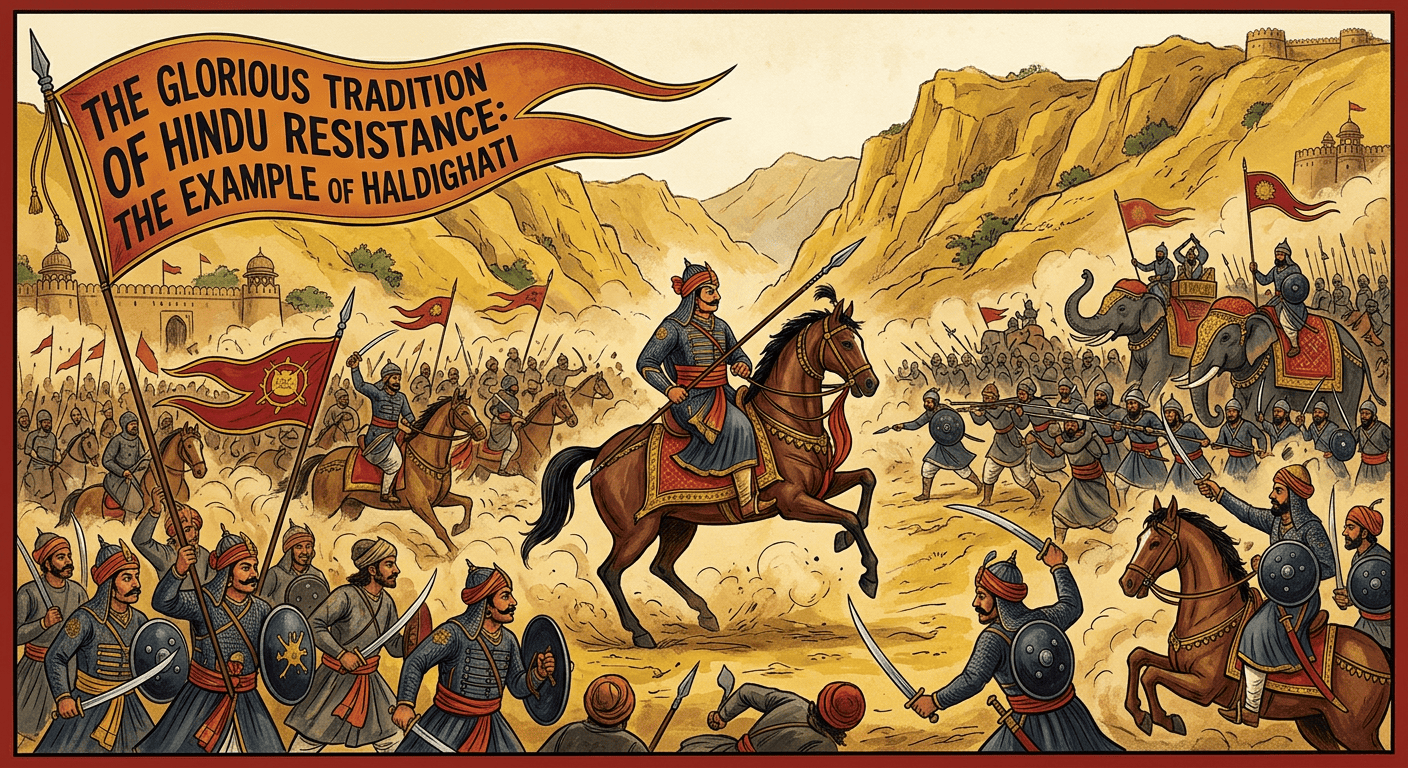
India’s history is not merely a chronicle of empires and treaties; it is also a long story of resistance—of a civilisation refusing to bow, even when faced with overwhelming force. At the heart of this narrative lies a proud tradition: the Hindu resistance against foreign invasion. This tradition is not about hatred for others, but about love for one’s own land, faith, and dignity. It is the story of kings, warriors, and ordinary people who chose death over surrender, who defended their temples, villages, and way of life against those who sought to conquer, convert, or erase them.
Nowhere is this spirit more vividly embodied than in the Battle of Haldighati, fought on 18 June 1576. On one side stood Maharana Pratap, the Rana of Mewar, a ruler who refused to accept Mughal overlordship. On the other was the vast imperial army of Akbar, the Mughal emperor, backed by superior numbers, artillery, and cavalry. The Mughals came with the confidence of conquerors; they expected the Rana of Mewar to submit, to send tribute, to acknowledge their supremacy and thus erase the last symbol of independent Rajput power in the region.
What they got instead was defiance. Maharana Pratap, with a much smaller force of cavalry and archers, chose to fight. He knew the odds were against him. He knew that the Mughal army was stronger, better equipped, and backed by an empire that stretched across much of the subcontinent. But he also knew that surrender would mean the end of Mewar’s independence, the humiliation of his people, and the submission of his civilisation to foreign rule. So he took the field at Haldighati, where the red soil—filled with iron oxide—gave the battlefield its name.
The battle itself was fierce. The Mughal cavalry, supported by war elephants and archers, clashed with the Rajput horsemen who fought with unmatched courage. Maharana Pratap himself led the charge, aiming directly at Akbar’s general. Though the Mughals ultimately controlled the battlefield, Maharana Pratap did not flee in shame. He escaped into the hills, where he continued his resistance, refusing to sign any treaty that would compromise his dignity. Even in defeat, he remained undefeated in spirit.
Haldighati is not just a military engagement; it is a symbol. For those who see India as a civilisation with an unbroken spiritual and cultural lineage, it represents the moment when Hindu valour refused to be crushed by imperial might. The battle is remembered not because Pratap won in the conventional sense, but because he never accepted subjugation. He spent the rest of his life in the mountains, rebuilding his forces, rallying his people, and keeping alive the flame of independence. His resistance became a model for future generations: that even when the sword is broken, the will can remain unbroken.
This tradition of resistance extends far beyond Haldighati. It stretches from the early Muslim invasions of the subcontinent to the later Mughal campaigns, from the forts of Rajasthan to the temples of Tamil Nadu. It is seen in the way rulers like Prithviraj Chauhan, Kanhadeva of Devagiri, and later Shivaji Maharaj confronted foreign powers. It is seen in the way ordinary villagers defended their shrines, refused forced conversions, and preserved their customs even under pressure. It is seen in the way history itself was remembered—not as a story of passive submission, but of active defiance.
In contemporary India, this narrative of resistance has taken on renewed importance. For many, it is not just history; it is a mirror. It reflects a desire to reclaim a sense of pride, to assert that India is not a land that waited passively for foreign rulers to define it, but a civilisation that fought back, time and again, to protect its essence. The battle of Haldighati, Maharana Pratap’s refusal to surrender, and the broader story of Hindu resistance are invoked not to incite hatred, but to remind people that their ancestors were not cowards, not collaborators, but defenders of their faith and land.
This is the core of a worldview that sees India as a nation that must be strong, self‑reliant, and unafraid to assert its identity. It is a worldview that values courage over compromise, sovereignty over submission, and memory over forgetting. It sees the past not as a dead weight, but as a source of energy—a reservoir of examples that can inspire future generations to face their own challenges with the same determination.
The glorious tradition of Hindu resistance against Muslim invasion is not a call to violence. It is a call to dignity. It says that when someone tries to erase your identity, you do not kneel. When someone tries to break your spirit, you stand taller. When someone tries to take your land, your temples, your honour, you fight—not with hate, but with the conviction that some things are worth dying for. In that sense, Haldighati is not just a battle of 1576. It is a living lesson, still echoing in the hearts of those who believe that India’s strength lies not in appeasement, but in unyielding courage.




Comments
Add new comment