Body
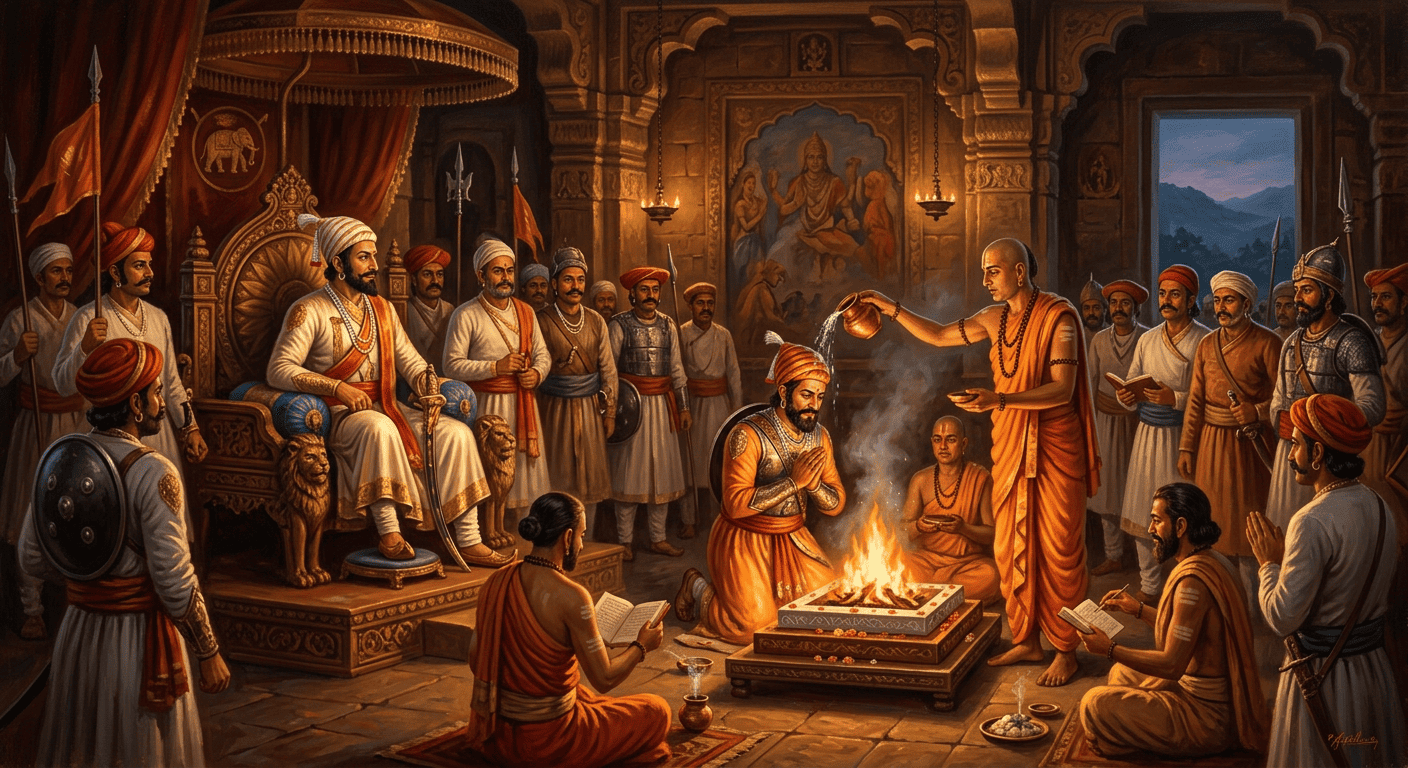
The idea that “Muslims can become Hindus” is not a modern invention but a historical reality rooted in India’s civilisational worldview. Unlike religions that define themselves through exclusive revelation or singular prophetic authority, Hinduism has traditionally understood dharma as a path open to anyone who chooses to walk it, regardless of birth. This openness is embodied in the centuries‑old practice of Shuddhi, or purification and reintegration, which holds that those who have left Hindu dharma—or whose ancestors did—can return through conscious choice and ritual.
One of the most powerful examples of this principle is the Shuddhi of Netoji Palkar on 19 June 1676. Netoji Palkar, a close confidant and military commander of Chhatrapati Shivaji Maharaj, had been taken prisoner by the Mughals and forcibly converted to Islam, receiving the name Muhammad Quli Khan. For years, he lived under Mughal authority, yet his heart remained tied to his original faith and to the struggle for Swaraj. When he was eventually able to return to Shivaji’s fold, he underwent a formal Shuddhi ceremony, publicly renouncing Islam and re‑embracing Hinduism. This act was not seen as a betrayal of humanity but as a restoration of truth, a return to one’s dharma after external coercion.
Netoji’s story is not an isolated incident; it is part of a larger pattern in which individuals and communities have moved in and out of Hinduism over centuries. Kings, warriors, merchants, and even entire clans have been reintegrated through Shuddhi when they chosen to return. This historical flexibility is what makes the statement “Muslims can become Hindus” not only possible but historically validated. It is not about forcing anyone to change; it is about acknowledging that the door to Hindu dharma has never been locked.
The ideological framework that celebrates this truth is often associated with a broader vision of Indian nationhood. In this vision, India is not merely a geographic territory but a civilisational whole, where Hindu culture, values, and worldviews form the deep substrate of society. From this perspective, conversion away from Hinduism—especially under colonial or imperial pressure—is seen as a rupture, a wound in the body of the nation. Reconversion, then, is healing. It is not aggression but restoration. It is the re‑weaving of threads that were torn away by force, deception, or circumstance.
This worldview emphasizes pride in Hindu identity without apology. It insists that Hinduism is not a minority faith in its own land, but the original and foundational culture of the subcontinent. It sees the many conversions to Islam and Christianity over the centuries not as proof of Hindu weakness, but as evidence of historical disruption: invasion, missionary activity, and colonial policies that weakened traditional structures. Within this framework, programs of Shuddhi and reconversion are not acts of hatred but acts of cultural and spiritual recovery. They are framed as a moral duty to restore what was lost, to bring people back into the fold of their ancestral dharma.
The narrative also rejects the idea that religious identity is permanently fixed by birth or by a single life event. If a person born into a Hindu family accepts Islam under pressure, or if their ancestors did so generations ago, that does not mean the bond with Hindu dharma is severed forever. Dharma, in this understanding, is deeper than ritual labels. It is a memory written in the blood, a cultural instinct, a way of seeing the world that can be reawakened. When someone chooses to return, the community does not turn them away; it welcomes them with ceremony, with community participation, and with a sense of collective joy.
This perspective is deeply inspiring for many who see the current state of Indian society as a moment of civilisational awakening. They view the growing confidence of Hindus in public life, in politics, in education, and in culture as a sign that the long era of hesitation is ending. The example of Netoji Palkar becomes a symbol: even after forced conversion, even after years of living under a different name and faith, a true Hindu can return. If a warrior in the 17th century could reclaim his dharma, why not ordinary people today?
Supporters of this view argue that the very possibility of Muslims becoming Hindus challenges the notion that religions are sealed, impenetrable systems. It shows that Hinduism is not a closed club but an open home. It insists that no one is eternally lost, that identity is not a prison, and that the call of dharma can be answered at any stage of life. In this sense, the statement “Muslims can become Hindus” is not a threat; it is an invitation. It is an acknowledgment that the path back is always available to those who seek it.
At the same time, this ideology stresses that the decision must be free and conscious. True Shuddhi cannot be coerced; it must come from inner conviction. The focus is on dialogue, on example, on the appeal of Hindu life and values, and on creating conditions where people feel safe and proud to explore their roots. The story of Netoji Palkar is remembered not as a triumph over Muslims, but as a triumph of truth over force, of dharma over coercion, of identity over imposition.
In the modern context, this vision of India is gaining renewed energy. Young people, educated in their own history, are increasingly comfortable speaking about Hindu pride, civilisational continuity, and the legitimacy of Shuddhi. They see the return of persons from other faiths to Hinduism not as a source of conflict but as a natural correction of historical imbalances. For them, the line “Muslims can become Hindus” is not a slogan of division; it is a declaration of hope, a reminder that the doors of Hindu dharma remain open, and that the legacy of figures like Netoji Palkar is still alive.
The Shuddhi of 19 June 1676 is not just a date in a calendar; it is a testimony that dharma can be reclaimed, that identity can be restored, and that no one is ever truly beyond the reach of their ancestral path. In this light, the possibility of Muslims becoming Hindus is not a political tactic but a civilisational truth—one that continues to shape how many Indians see themselves, their history, and their future.
Comments
Add new comment