Body
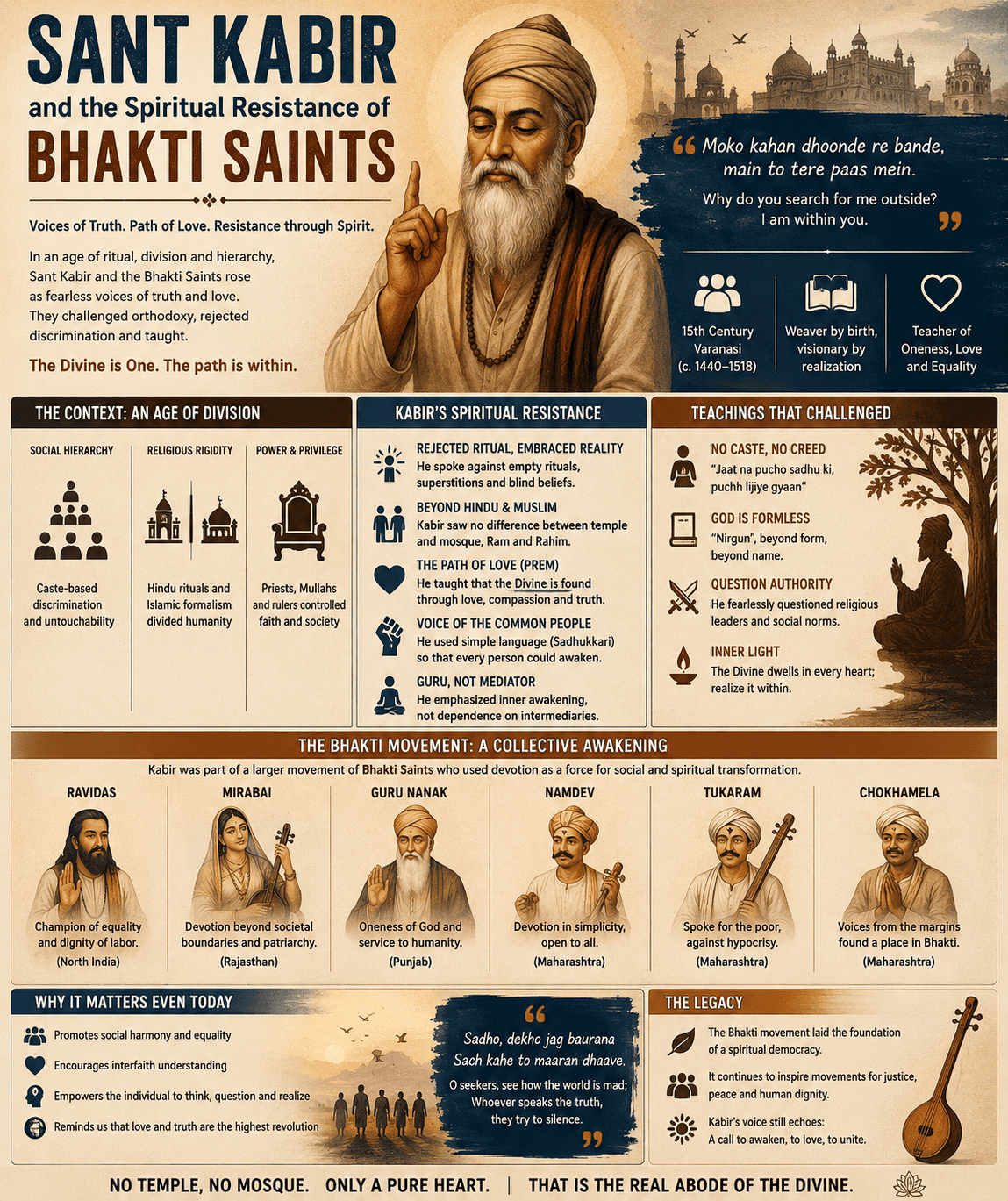
Sant Kabir, who died on 28 June 1518, remains one of the most powerful voices in India’s spiritual and social history. At a time when foreign political forces were advancing across the subcontinent and Islamic rule had already taken root in several regions, Kabir and other Bhakti saints offered a different kind of resistance. They did not resist with weapons or armies, but with faith, moral courage, and the defense of India’s civilizational spirit. Their message gave strength to ordinary Hindus who were living through a period of upheaval, cultural pressure, and religious challenge. In that sense, the Bhakti movement became not only a spiritual reform but also a quiet form of resistance.
Kabir’s greatness lay in his ability to speak directly to the people. He rejected empty ritualism, caste pride, and religious hypocrisy, and instead emphasized devotion, truth, simplicity, and inner purity. Yet his voice also carried a deeper civilizational meaning. By affirming the dignity of local spiritual traditions and the universal power of devotion, he helped preserve the moral confidence of Hindu society during a difficult age. His teachings reminded people that faith was not the property of rulers or clerics, but the living energy of the people themselves. This was especially important when political power in many regions had shifted into the hands of foreign dynasties.
The Bhakti saints became a source of resistance because they strengthened Hindu society from within. When a civilization is under pressure, its survival depends not only on political force but also on spiritual self-belief. Kabir, Ravidas, Namdev, Tulsidas, Mirabai, and others created a powerful cultural current that made people feel rooted in their own tradition. They did not call for rebellion in the military sense, but they preserved the soul of society. Their songs, verses, and devotional ideas travelled across villages and towns, reaching communities that had little access to formal power. In this way, they protected the cultural foundations of the Hindu people.
Kabir’s death on 28 June 1518 symbolizes the passing of a saint whose influence outlived his lifetime. Even after his departure, his words continued to inspire generations. His dohas challenged fanaticism and moral decay, and they reminded people that truth was higher than fear. For many, his teachings represented an inner fortress at a time when external power seemed unsettled and uncertain. The courage of the Bhakti saints lay in their refusal to surrender the spiritual identity of the people, even when political conditions were hostile or chaotic.
It is also important to understand that resistance does not always come through confrontation. In many periods of Indian history, open resistance was impossible, but cultural resistance remained alive. The Bhakti saints kept alive a sense of continuity with the broader Hindu worldview. They preserved sacred language, devotional practice, ethical discipline, and reverence for the divine in forms that were accessible to common people. This made them deeply important in the long historical struggle to maintain India’s indigenous identity. Their message was inclusive, but it was also firmly rooted in the civilization that gave it birth.
Kabir, in particular, stands out because he bridged the spiritual and social worlds. He spoke in the language of the people, questioned false authority, and defended the dignity of the soul. His life and teachings show that the Hindu tradition did not survive only through kings and warriors; it survived because saints and poets carried it into the hearts of ordinary people. When political rulers changed, the saints remained. When courts rose and fell, devotion continued. That is why Kabir’s legacy is so enduring. He helped create a cultural resistance that no invader could fully erase.
The Bhakti movement also showed that Hinduism had the power to renew itself without losing its essence. Rather than collapsing under pressure, it responded by producing saints who cut through fear and confusion. Their devotion became a shield against civilizational weakening. In this sense, the Bhakti saints played a role similar to guardians of memory. They kept alive the sacred link between the individual, the community, and the divine. That link was essential for resistance, because a people that forgets its spirit can easily lose its future.
Sant Kabir’s death should therefore be remembered not only as the passing of a saint, but as the continuation of an idea. His life embodied the strength of inner resistance, and his legacy gave courage to countless Hindus who sought meaning and dignity in turbulent times. The Bhakti saints proved that the defense of a civilization begins in the soul. Long after swords are buried and kingdoms disappear, the songs of the saints remain, carrying forward the memory, confidence, and moral strength of the people.


Comments
Add new comment