Body
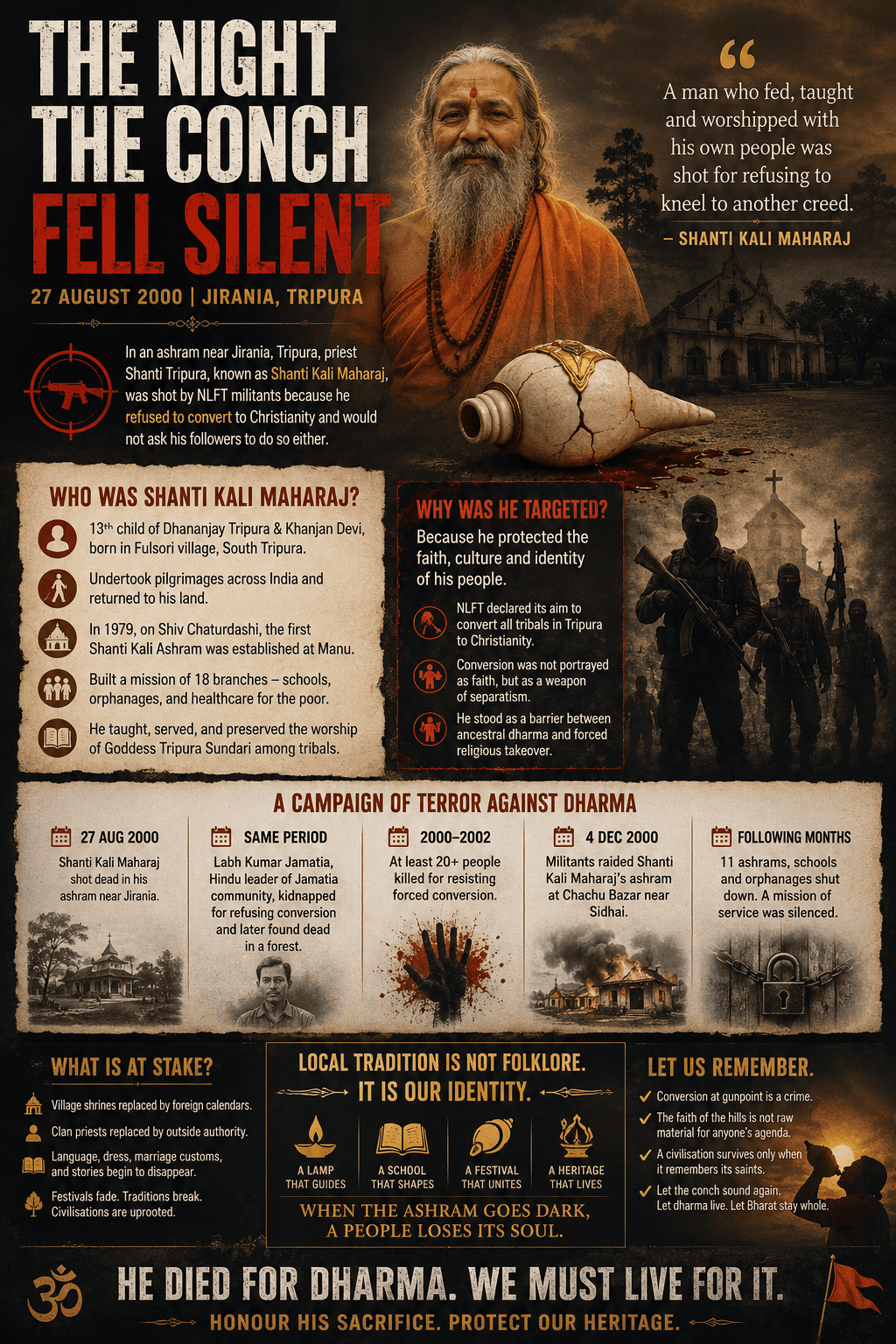
On the night of 27 August 2000, in an ashram near Jirania in Tripura’s Sadar subdivision, a priest sat among his devotees. His name was Shanti Tripura. The people of the hills called him Shanti Kali Maharaj. He had spent decades teaching children, tending the sick, and keeping the worship of Goddess Tripura Sundari alive among the tribes of a small northeastern state. That night, about ten armed men of the National Liberation Front of Tripura broke into the ashram and shot him. Police said he was killed because he would not convert to Christianity, and would not ask his followers to do so either. The BBC reported the murder the next morning. It also recorded a fact that polite commentary still prefers to skip: the NLFT had declared that it wanted to convert all tribespeople in the state to Christianity. A separatist gun, in other words, was being used to finish a religious project. Most of Tripura’s tribals were Hindu or Buddhist. A smaller number had already been drawn into the Church. Between those two facts lay a body on the ashram floor.
Shanti Kali was not a politician. He was the thirteenth child of Dhananjay Tripura and Khanjan Devi, born in the village of Fulsori in South Tripura. As a young man he left home on pilgrimage across India. The journey did not make him a stranger to his own soil. It sent him back to it. He returned to raise a temple to the goddess whose name the state itself carries, and to build an ashram for people who had little else. In 1979, on Shiv Chaturdashi, the first Shanti Kali Ashram was consecrated at Manu. It grew into a mission of eighteen branches: primary schools, orphanages, health work for the poor. He did not ask a child to abandon his grandparents’ gods in exchange for a notebook. He treated literacy and worship as parts of the same inheritance. That is what made him dangerous to those who needed the hills emptied of their old memory. A people who still light a lamp before Tripura Sundari, who still keep the festivals of their clans, who still bury their dead in the custom of their fathers, are a people who cannot be rewritten overnight. Conversion, in such a landscape, is not a private change of heart. It is a transfer of loyalty. The village shrine is replaced by a foreign calendar. The clan priest is replaced by an outside authority. Language, dress, marriage, and the stories told to children begin to shift. What is sold as rescue is often the uprooting of a civilisation at its smallest unit: the household.
The NLFT did not hide this. It was a banned separatist outfit, and it treated the Church’s harvest as part of its war against the Indian state. In the same season, another Hindu leader of the Jamatia community, Labh Kumar Jamatia, was kidnapped after he refused to convert and was later found dead in a forest in southern Tripura. The outfit threatened Hindus celebrating Durga Puja. In the two years around the murder, reports counted at least twenty people killed for resisting forced conversion. On 4 December 2000, barely three months after Shanti Kali’s death, militants raided an ashram he had set up at Chachu Bazar near Sidhai. In the months that followed, eleven of his ashrams, schools and orphanages were shut down. The saint was removed. Then the institutions that carried his work were removed. That is how a culture is not argued with. It is dismantled. There is a habit, in certain drawing rooms, of treating every defence of ancestral faith as an embarrassment. The same voices that speak endlessly of “diversity” fall silent when the diversity in question is a tribal Hindu’s right to remain what he is. They will describe a militant with a Bible and a rifle as a complicated local actor. They will describe a priest who ran orphanages as a problem of “majoritarianism.” This inversion is not accidental. If the old gods can be made to look like oppression, then the agencies that erase them can be made to look like mercy. The dead priest cannot answer. The child in the closed orphanage cannot answer. The record, however, is not complicated. A man who fed, taught and worshipped with his own people was shot for refusing to kneel to another creed.
Local tradition is not folklore for a museum. It is the grammar by which a community knows itself. In Tripura that grammar was already under strain: insurgency, demographic pressure, and a missionary machinery that has long treated the Northeast as unfinished business. When the ashram is burnt or padlocked, the loss is not only a building. It is a school that will not open, a festival that will not be sung, a grandmother’s rite that will not be passed on. A nation that cannot protect such things will discover, too late, that maps are easier to keep than peoples. Shanti Kali Maharaj died on 27 August 2000. He died as a Tripuri, a Hindu, and a servant of the poor. The proper tribute is not a slogan. It is to say, without apology, that the faith of the hills is not a raw material for someone else’s salvation industry; that conversion at gunpoint is a crime; and that a civilisation survives only when it remembers its saints and refuses to let their ashrams go dark. The conch was silenced that night. The duty of the living is to make sure the silence is not mistaken for consent.
Comments
Add new comment