Body
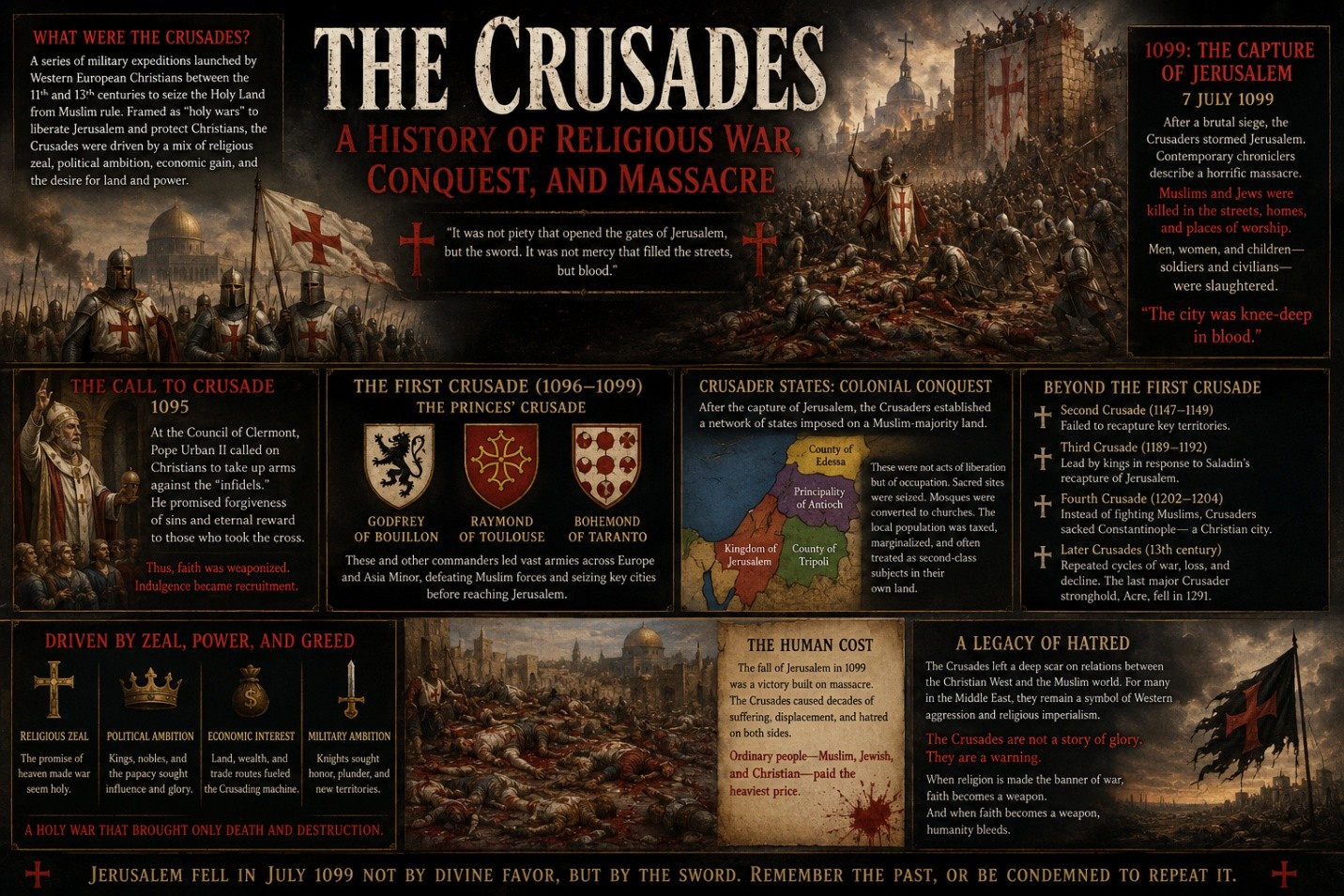
The Crusades were a series of military expeditions launched by Western European Christians between the 11th and 13th centuries, framed as holy wars to reclaim sacred sites and assert Christian dominance over the Holy Land. The most famous of these campaigns, the First Crusade and its Princes’ phase, culminated in the brutal capture of Jerusalem in 1099 and the large-scale massacre of its defenders. The history of the Crusades is not only a story of knights, popes, and pilgrims; it is also a stark reminder of how religion can be weaponized to mobilize armies, justify slaughter, and establish foreign rule over unwilling populations. The Crusading movement began in 1095, when Pope Urban II called for armed action against Muslim powers controlling parts of the Middle East and North Africa. The call was framed in spiritual terms: to liberate Jerusalem, protect Eastern Christians, and punish “infidels.” Yet behind this religious language lay political ambition, economic interest, and the desire to expand Latin Christian influence. The Crusades involved knights, nobles, peasants, and mercenaries from across Europe, united not only by faith but also by the promise of land, wealth, and prestige.
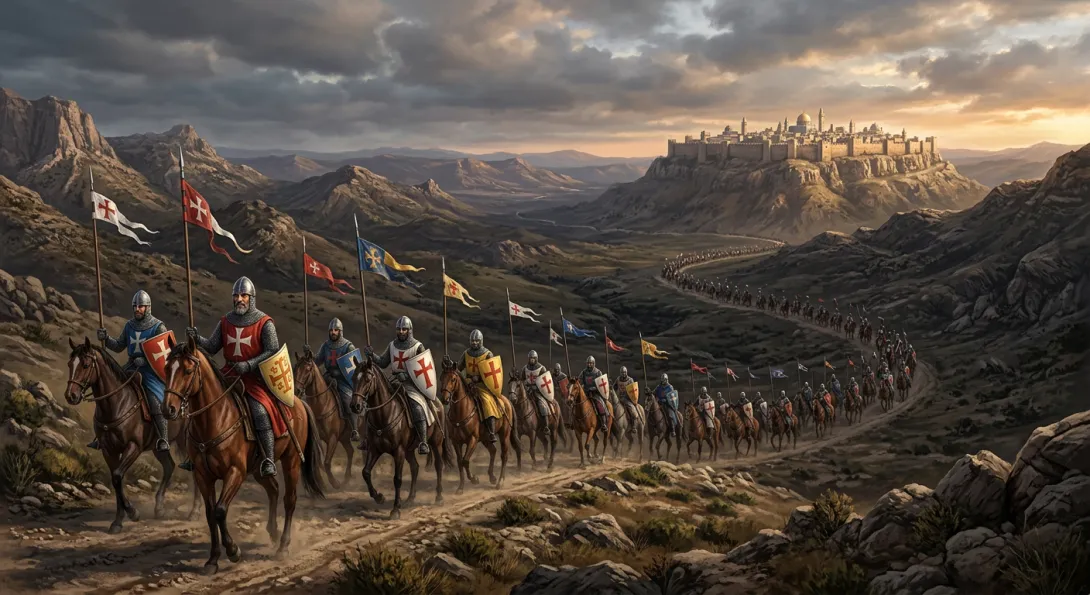
The Princes’ Crusade, part of the larger First Crusade, was led by powerful European commanders such as Godfrey of Bouillon, Raymond of Toulouse, and Bohemond of Taranto. These forces advanced through Anatolia, defeated Muslim armies, and seized key cities before reaching the gates of Jerusalem in June 1099. After a prolonged siege, the Crusaders breached the city’s defenses and, on 7 July 1099, they stormed the walls. The aftermath became one of the most notorious episodes of medieval warfare. Contemporary accounts describe widespread slaughter of the city’s Muslim and Jewish inhabitants. Adults and children, soldiers and civilians, were killed in the streets, homes, and places of worship. The Crusaders showed little mercy, and their victory was secured through terror and bloodshed.
The capture of Jerusalem was followed by the establishment of Crusader states: the Kingdom of Jerusalem, the County of Edessa, the Principality of Antioch, and the County of Tripoli. These were not merely religious settlements; they were colonial enterprises imposed on a region that had long been under Muslim rule. The local population, both Muslim and non-Muslim, was often marginalized, oppressed, or subjugated under foreign Christian authority. The Crusaders took control of sacred sites, converted mosques into churches, and reorganized the land to serve their own interests. For many in the region, the Crusader states were seen not as liberation but as occupation. The First Crusade would be followed by several more campaigns over the next two centuries, including the Second, Third, Fourth, and later Crusades. Some were led by kings and emperors, others by popes and nobles. Some aimed to recapture lost territories, others to expand Christian power further. The Third Crusade, for example, came in response to the rise of Saladin and the Muslim reconquest of Jerusalem. The Fourth Crusade took a shocking turn, as the Crusaders attacked and sacked Constantinople, a Christian city, in 1204. This showed that the Crusading spirit was not only directed outward against Muslims but could also be turned inward against fellow Christians when political interests demanded it.
The Crusades were driven by a combination of religious zeal, political calculation, and military ambition. They were not simply defensive wars, as some defenders claim. They were offensive campaigns aimed at conquest. The idea of a “holy war” gave moral cover to violence that would otherwise have been condemned. Popes offered indulgences and forgiveness of sins to those who took the cross, turning spiritual devotion into a means of recruitment and justification. This fusion of faith and force created a dangerous precedent that would echo through subsequent centuries of conflict. The aftermath of the Crusades left a deep scar on relations between the Christian West and the Muslim world. In the Middle East, the memory of the Crusades has often been invoked as a symbol of Western aggression and religious imperialism. In Europe, the Crusading narrative was sometimes glorified as a story of heroism and piety, even as it concealed the reality of massacre, plunder, and domination. The Crusades were not an isolated episode. They were part of a long pattern in which religious identity was used to justify war, expansion, and the subjugation of others.
In historical terms, the Crusades demonstrate how easily devotion can be twisted into destruction. Jerusalem fell in July 1099 not because of divine favor, but because of superior siegecraft, relentless assault, and brutal determination. The bodies left in the streets were a testament not to holy victory but to the cost of religious war. The Crusader states would not last forever; they were gradually rolled back by Muslim forces, and the last major Crusader stronghold, Acre, fell in 1291. Yet the legacy of the Crusades endured, shaping the imagination of both Christians and Muslims for centuries. The history of the Crusades should be remembered not for glory, but for warning. It is a record of how faith can be used to mobilize violence, how sacred rhetoric can mask conquest, and how the promise of eternal reward can be wielded to justify earthly slaughter. The Princes’ Crusade and the capture of Jerusalem in 1099 stand as a dark chapter in medieval history, a reminder that when religion is made the banner of war, ordinary people often pay the heaviest price.




Comments
Add new comment