Body
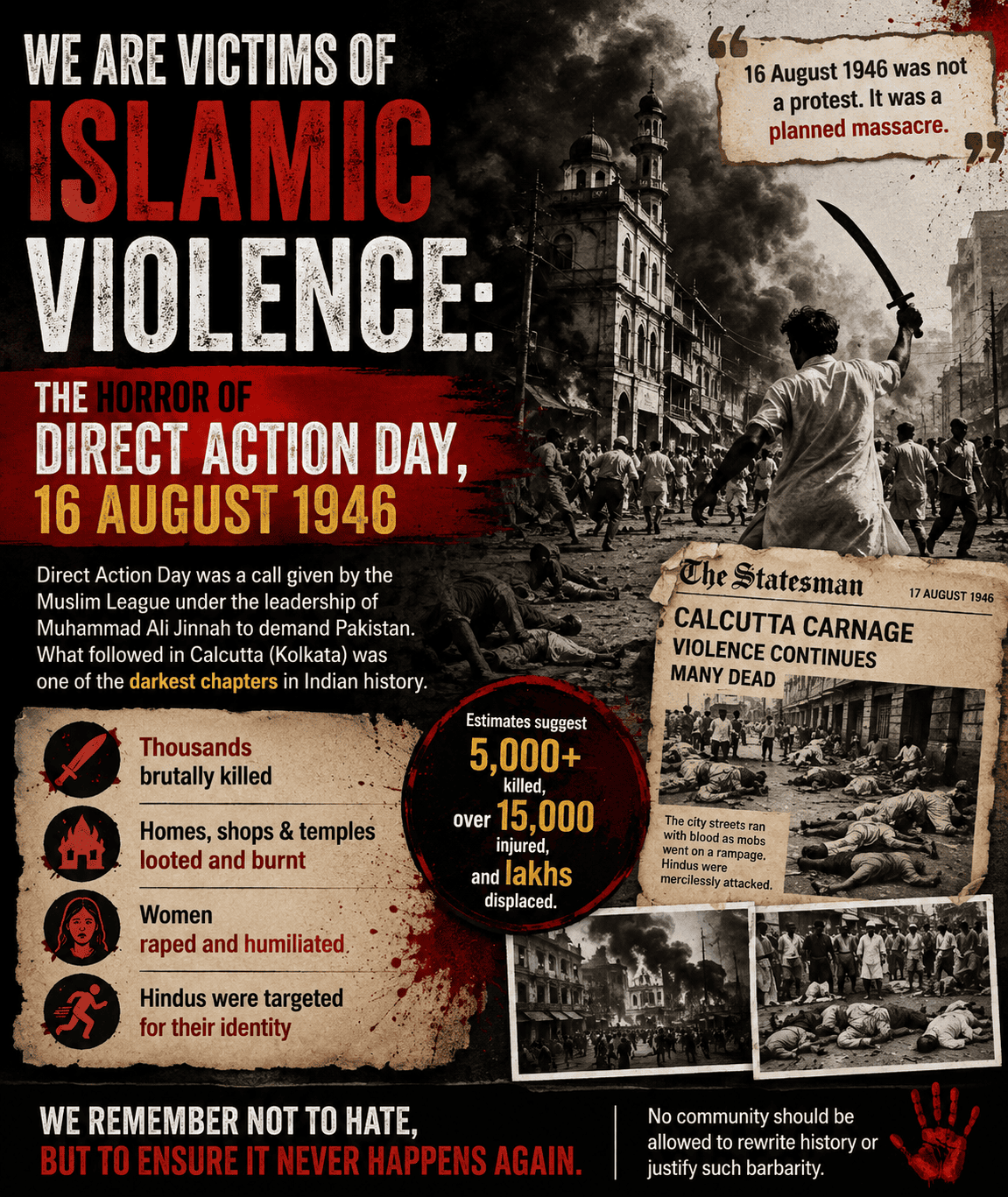
On 16 August 1946, the streets of Calcutta ran red. What the Muslim League called “Direct Action Day” was not a peaceful demonstration of political will. It was a calculated display of force meant to terrorize the Hindu population of Bengal and force the acceptance of a separate Islamic state. The result was one of the bloodiest episodes of communal slaughter in modern Indian history. Thousands of Hindus were butchered, their homes and businesses looted and burned, their women dishonored. The day stands as a stark reminder that the demand for Pakistan was advanced not merely through negotiation but through organized violence directed against non-Muslims. The Muslim League, under Muhammad Ali Jinnah, had grown increasingly impatient with the prospect of a united India in which Muslims would form a permanent minority. Its Lahore Resolution of 1940 had already articulated the goal of “independent states” for Muslims. By 1946, with the Cabinet Mission Plan faltering, the League decided to abandon constitutional methods. On 29 July 1946, the League Council formally withdrew from the Cabinet Mission scheme and called for “Direct Action.” The date chosen was 16 August. League leaders framed the day as a show of strength for an “autonomous and sovereign” Pakistan. In practice, the call was understood by many of its followers as a license to assert dominance through bloodshed.
In Calcutta, the League’s provincial ministry under H.S. Suhrawardy controlled the administration. Police and officials were either ordered to stand down or actively facilitated the violence. Mosques became centers of mobilization. Crowds poured out after Friday prayers, many armed with knives, spears, and iron rods. The initial targets were Hindu neighborhoods, shops, and temples. Men were dragged from their homes and killed in the streets. Women were subjected to unspeakable atrocities. Entire families were wiped out. Contemporary accounts, including those of British officials and Indian civil servants, describe systematic attacks rather than spontaneous rioting. Hindu properties were marked in advance. Lists circulated. The pattern was unmistakable: this was not mutual combat that suddenly erupted; it was an assault designed to terrorize one community into submission. The death toll remains disputed, but even conservative estimates place the number of dead in Calcutta alone between 4,000 and 10,000 within the first few days, with the overwhelming majority of the initial victims being Hindus. Tens of thousands more were injured or rendered homeless. The violence soon spread beyond the city. In Noakhali and Tippera in East Bengal, organized gangs of Muslim League supporters carried out further massacres, forced conversions, and abductions of Hindu women. The pattern repeated: selective targeting of Hindus, destruction of temples, and the imposition of Islamic supremacy through fear. Refugees poured into safer areas carrying stories of mutilation and humiliation that shocked even those hardened by earlier communal clashes.
The political message was clear. The League’s leadership calculated that the British and the Indian National Congress would be forced to concede Pakistan rather than preside over endless bloodshed. Jinnah’s own rhetoric had prepared the ground. He had spoken of the impossibility of Hindus and Muslims living together as equals in a single nation. Direct Action Day was the practical demonstration of that belief. It was not an aberration; it was the logical outcome of a politics that defined community identity in exclusive religious terms and treated the presence of large non-Muslim populations as an obstacle to be overcome by force if necessary. The consequences extended far beyond 1946. The Calcutta killings hardened attitudes on all sides and made the Partition of 1947 almost inevitable. When the Radcliffe Line was finally drawn, the violence of Direct Action Day had already taught millions that coexistence under a single polity was no longer possible. The subsequent migration of millions, the massacres in Punjab, and the enduring bitterness between India and Pakistan all trace part of their origin to the decision to settle political questions through organized communal terror.
Those who suffered in Calcutta and Noakhali were not abstract statistics. They were shopkeepers, clerks, teachers, artisans, and laborers whose only crime was belonging to the wrong faith in a city the League sought to claim for its future state. Their story is routinely softened or relativized in certain historical narratives that prefer to speak of “communal riots” as if both sides bore equal responsibility from the first hour. The documentary record does not support that symmetry. The initiative, the organization, the official protection, and the ideological justification all came from the Muslim League’s campaign for Pakistan. Remembering Direct Action Day is not an exercise in communal score-settling. It is an insistence on historical accuracy. Political movements that define themselves by religious exclusivity and that treat demographic strength as a warrant for coercion leave a trail of victims. The Hindus of Calcutta in August 1946 were among those victims. Their blood stained the path that led to Partition. Any honest accounting of the subcontinent’s modern history must begin with that fact rather than with euphemisms designed to obscure it.
The events of that August remain a warning. When a political demand is advanced through the systematic murder of civilians belonging to another community, the moral responsibility lies with those who issued the call and those who answered it with knives. The dead of Calcutta cannot speak. It falls to the living to record what was done to them, without apology and without dilution.




Comments
Add new comment