Introduction: When Biblical Mystery Becomes a Tool of Religious Persuasion
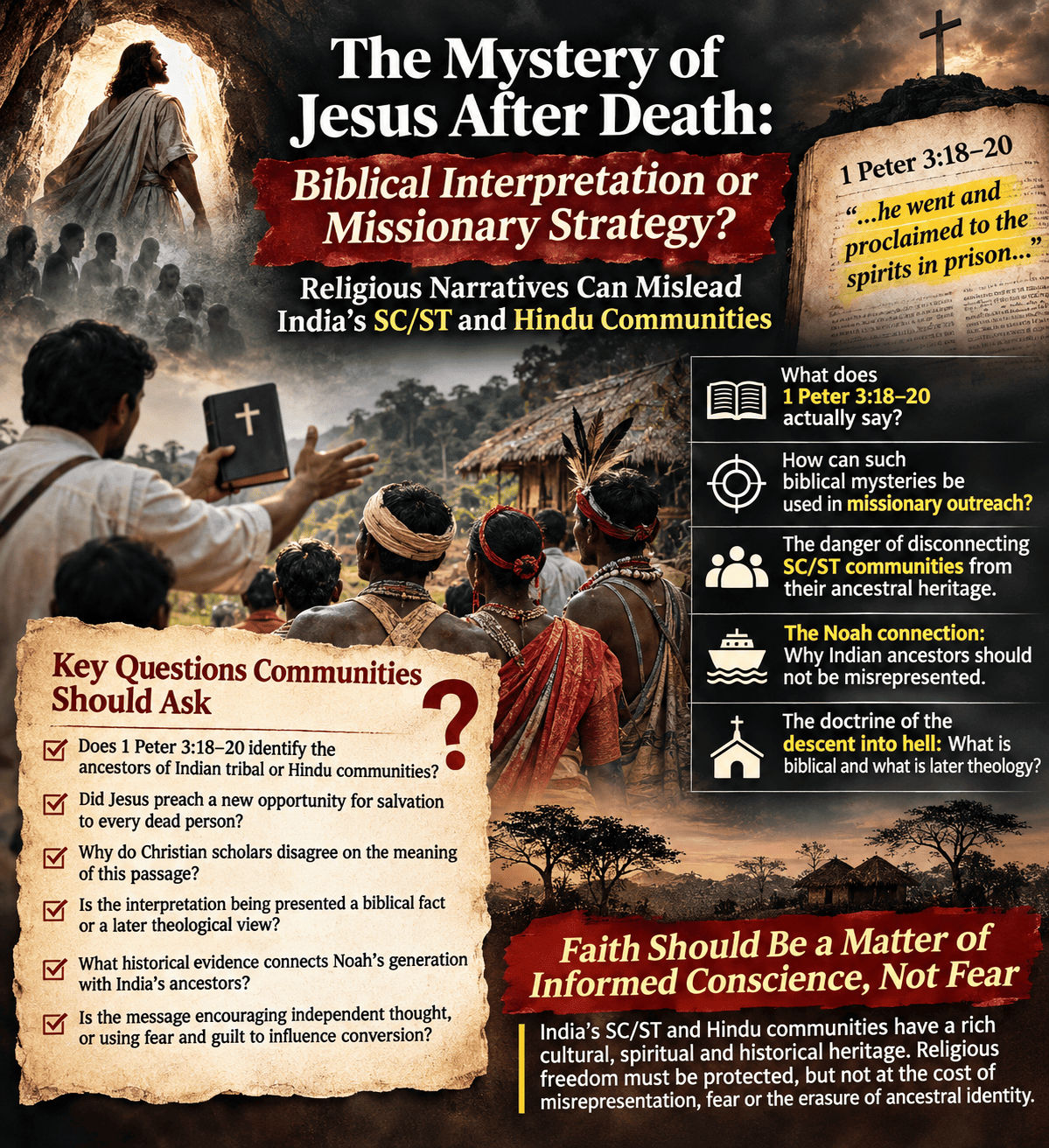
Religious conversion does not always begin with an invitation to change one's faith. Sometimes it begins with a story, an unfamiliar interpretation of scripture, a claim about salvation, or an explanation of death and the afterlife that creates curiosity, fear or emotional dependence. One such example is the mysterious biblical passage in 1 Peter 3:18–20, which describes Jesus Christ proclaiming something to the spirits imprisoned since the days of Noah. The passage has generated centuries of theological debate among Christian scholars. Even within Christianity, there is no universal agreement about what Peter intended to communicate. However, the question becomes particularly important when such complicated theological interpretations are introduced into India's Scheduled Caste (SC), Scheduled Tribe (ST) and Hindu communities through missionary preaching, religious literature, educational activities or evangelistic programmes. Are these passages being explained honestly, with their historical and theological uncertainties? Or are selected interpretations sometimes presented as established historical facts to influence people who may have limited access to biblical scholarship?
This deserves serious examination, particularly in a country where indigenous religious traditions, ancestral beliefs and cultural identities are deeply connected with community life.
1. What Does 1 Peter 3:18–20 Actually Say?
The passage describes Christ suffering and dying for humanity, being made alive in the spirit, and proclaiming a message to spirits in prison associated with the time of Noah.
The difficulty is that Peter does not clearly explain:
Where exactly Jesus went after his crucifixion.
Who the imprisoned spirits were.
What message Jesus proclaimed.
Whether the proclamation occurred before the incarnation, between death and resurrection, or in connection with his resurrection.
Whether the proclamation offered salvation or announced victory and judgment.
Christian scholars have proposed different interpretations. Some understand the passage as Christ preaching through Noah to the disobedient generation before the flood. Others interpret it as Jesus descending to the realm of the dead. A third interpretation identifies the imprisoned spirits with rebellious supernatural beings associated with the events described in Genesis 6. These interpretations are not interchangeable. They represent different theological explanations of an obscure passage. The central concern is what happens when one interpretation is presented to an uninformed audience as the only established truth. A theological possibility should not be advertised as an independently verified historical event.
2. How Can Such Biblical Mysteries Be Used in Missionary Outreach?
Missionary communication frequently uses narratives about sin, death, salvation, heaven, hell and eternal life. These subjects have enormous emotional significance. When presented responsibly, religious discussions can be part of legitimate theological exchange. However, the possibility of manipulation arises when complex doctrines are simplified into emotionally powerful claims without explaining their uncertainties.
Consider three possible approaches.
First: Creating fear about the afterlife.
If a preacher tells people that their ancestors, traditional religious figures or deceased family members are suffering in a spiritual prison because they did not accept Christianity, this can generate anxiety and guilt. But 1 Peter 3:18–20 does not explicitly identify the imprisoned spirits as India's ancestors, Hindu forefathers or tribal communities. Nor does it establish that all non-Christians are imprisoned spirits awaiting Jesus. Such claims would go beyond what the passage actually says.
Second: Presenting Christianity as the only source of ancestral liberation.
Some evangelistic narratives may contrast the Christian understanding of salvation with indigenous traditions, portraying ancestral beliefs as powerless, spiritually dangerous or incapable of providing liberation. This approach deserves scrutiny when it dismisses the dignity of communities whose religious practices are connected with generations of cultural memory. The Bible's reference to Noah cannot legitimately be used as historical proof that the ancestors of Indian tribal communities were spiritually condemned.
Third: Using supernatural mysteries to create religious dependency.
Stories about spirits, demons, spiritual imprisonment, deliverance and eternal punishment can be especially influential when people are experiencing social insecurity, illness, poverty or bereavement. If religious outreach uses these anxieties to pressure individuals into conversion, it raises serious ethical questions. It is important, however, to distinguish documented missionary activities from hypothetical examples. Not every Christian preacher uses such methods, and not every discussion of the afterlife is an attempt at manipulation.
3. India's SC/ST Communities: The Danger of Disconnecting People from Their Ancestral Heritage
India's Scheduled Tribe communities are not a single religious or cultural group. They include numerous communities with distinct languages, customs, festivals, oral histories, spiritual practices and relationships with nature. Among many Adivasi communities, ancestral memory, sacred groves, mountains, rivers, forests and community traditions have significant cultural importance.
For example, different tribal communities in Gujarat and other parts of India maintain distinct traditions involving:
* Worship and reverence associated with nature.
* Ancestral customs and community rituals.
* Traditional village deities and sacred places.
* Oral traditions explaining creation, death and the relationship between human beings and nature.
* Community festivals connected with agricultural cycles and seasonal changes.
These traditions cannot simply be dismissed through an interpretation of a New Testament passage. When religious teachings portray indigenous spiritual heritage as entirely false, evil or demonic, the consequences may extend beyond religious belief. They can affect cultural continuity, family relationships and community identity. Adivasi identity should not be reduced to a religious conversion debate. The constitutional rights of Scheduled Tribes, including freedom of conscience and religion, must be respected. Equally, their cultural heritage and freedom to retain ancestral traditions deserve protection. The same principle applies to Scheduled Caste communities, whose religious and social experiences are diverse.
4. The Noah Connection: Why Indian Ancestors Should Not Be Misrepresented
One of the most important elements of 1 Peter 3:18–20 is the reference to Noah. According to the biblical narrative, Noah's generation was disobedient, and the flood became an act of divine judgment. Some Christian interpretations understand the imprisoned spirits as the people who rejected Noah's warning. But there is a serious historical and theological distinction that must be maintained. The biblical account of Noah is a religious narrative. It cannot independently establish the religious identity, spiritual condition or historical fate of India's indigenous populations. India possesses ancient cultural traditions, archaeological records, oral histories and diverse religious philosophies. These deserve examination through historical, anthropological and archaeological methods rather than being automatically fitted into one religious narrative. No responsible interpretation of 1 Peter 3 can establish that Adivasi ancestors were among Noah's disobedient generation. Nor does the passage identify Hindu ancestors as people condemned to spiritual imprisonment. If such connections are made in missionary presentations, audiences should ask for the biblical and historical evidence supporting them.
5. The Doctrine of the Descent into Hell: What Is Biblical and What Is Later Theology?
The phrase "He descended into hell" appears in the Apostles' Creed in its traditional form. Different Christian traditions understand this statement differently. Catholic and Orthodox theology generally associates it with Christ's descent to the realm of the dead and his victory over death. Protestant traditions have offered varying interpretations, and some understand the phrase as referring to Christ's burial or the reality of his death. The distinction matters because 1 Peter 3:19 does not explicitly provide a detailed description of Jesus entering a geographical place of punishment and conducting an evangelistic campaign among dead people. Similarly, the expression "harrowing of hell" belongs to a developed Christian theological tradition. Its artistic and theological representations should not be confused with a complete narrative explicitly provided in the biblical text.
There is also an important distinction between:
* Proclaiming victory to imprisoned spirits.
* Preaching the possibility of salvation to dead people.
* Liberating righteous people awaiting the Messiah.
* Preaching through Noah to people who lived before the flood.
These are different interpretations, not four facts established by Peter. When missionary literature presents one of these explanations without acknowledging the others, readers may mistakenly believe that the Bible provides a precise account of Jesus' activities during the three days.
6. The Psychological Dimension: Fear, Hope and Religious Conversion
Religious conversion is a deeply personal matter. People may change their faith because of conviction, spiritual experience, philosophical reasoning, personal relationships or religious study. However, fear-based religious persuasion requires particular attention. Imagine a tribal family being told that its ancestors did not know the true God, that their traditional spiritual practices have no value, and that only acceptance of a particular religious doctrine can protect future generations from spiritual consequences. Such a message can create a conflict between religious conviction and inherited cultural identity. Now consider introducing the mysterious passage about imprisoned spirits. If the preacher connects it to ancestral suffering without biblical or historical evidence, the narrative can become a powerful instrument of emotional persuasion. This is where religious education must be distinguished from religious pressure. No individual should be made to feel that accepting a new religion is the only way to rescue deceased family members on the basis of an interpretation that the biblical passage itself does not establish. Religious freedom must include the freedom to question, examine, disagree and retain one's existing beliefs.
7. Questions That Hindu and Tribal Communities Should Ask
Rather than accepting sensational explanations, people should be encouraged to examine religious claims critically. Some important questions include:
1.Does 1 Peter 3:18–20 explicitly identify the imprisoned spirits as the ancestors of Indian tribal or Hindu communities?
2.Does Peter actually say that Jesus preached a new opportunity for salvation to every dead person?
3.Why do Christian scholars disagree about the identity of the imprisoned spirits?
4. Is the interpretation being presented a direct biblical statement or a later theological explanation?
5. What historical or archaeological evidence connects Noah's generation with the ancestors of Indian communities?
6. Why should indigenous ancestral traditions be declared spiritually invalid on the basis of an interpretation that remains disputed even within Christianity?
7. Is the religious message encouraging independent thought, or is it using fear, guilt and uncertainty to influence conversion decisions?
These questions are not an attack on Christianity. They are questions of religious literacy, intellectual honesty and cultural dignity.
8. Constitutional Freedom and the Protection of Cultural Identity
India's Constitution protects freedom of conscience and the right to profess, practise and propagate religion under Article 25, subject to constitutional limitations. At the same time, Articles 29 and 30 protect important cultural and educational rights, while the constitutional framework recognises the distinctive interests and protections of Scheduled Tribes. Religious freedom must operate within the constitutional framework. A Christian missionary has the right to explain Christian beliefs. A Hindu religious teacher has the right to explain Hindu philosophy. An Adivasi community has the right to preserve its traditions. Individuals have the right to examine these teachings and make their own religious decisions. The problem arises when religious persuasion becomes coercive, deceptive or exploitative. The appropriate response is not hostility towards any religious community. It is transparent religious education, protection of vulnerable populations and respect for individual freedom.
Do Not Allow Religious Mystery to Replace Historical Understanding
The mystery described in 1 Peter 3:18–20 is an important subject in Christian theology. It raises questions about Christ's death, resurrection, the realm of the dead and the victory of divine power over evil. But it does not provide evidence that India's Hindu or tribal ancestors were imprisoned spirits awaiting Christian salvation. It does not establish that indigenous religious traditions are spiritually condemned, nor does it offer a historical explanation of the origins of India's tribal communities. The real concern is not that Christians believe in the resurrection, the afterlife or the doctrine of Christ's descent into the realm of the dead. These are legitimate subjects of Christian belief and theological discussion. The concern is whether obscure biblical passages are sometimes taken out of their historical and textual context and used to create fear, undermine ancestral identities or influence vulnerable people through unsupported claims. India's Adivasi communities are not people without history, philosophy, spirituality or cultural memory. Their traditions deserve to be understood, documented and respected. Hindu communities likewise have a rich and diverse philosophical heritage that should not be casually dismissed. Faith should be a matter of informed conscience, not fear. Religious discussion should be based on evidence, not manufactured historical connections. And no community should be made to feel ashamed of its ancestors merely because another religion interprets the afterlife differently. India's religious diversity is not a weakness to be eliminated. It is a civilisational heritage that deserves protection through knowledge, dialogue, constitutional values and mutual respect.
Comments
Add new comment